
Loading Capacity Mismatch: Why Fleet Owners Lose Lakhs in India RC vs Insurance Guide
Super Policy Team •September 5, 2026 | 11 min read • 10 views
Super Policy Team •September 5, 2026 | 11 min read • 10 views
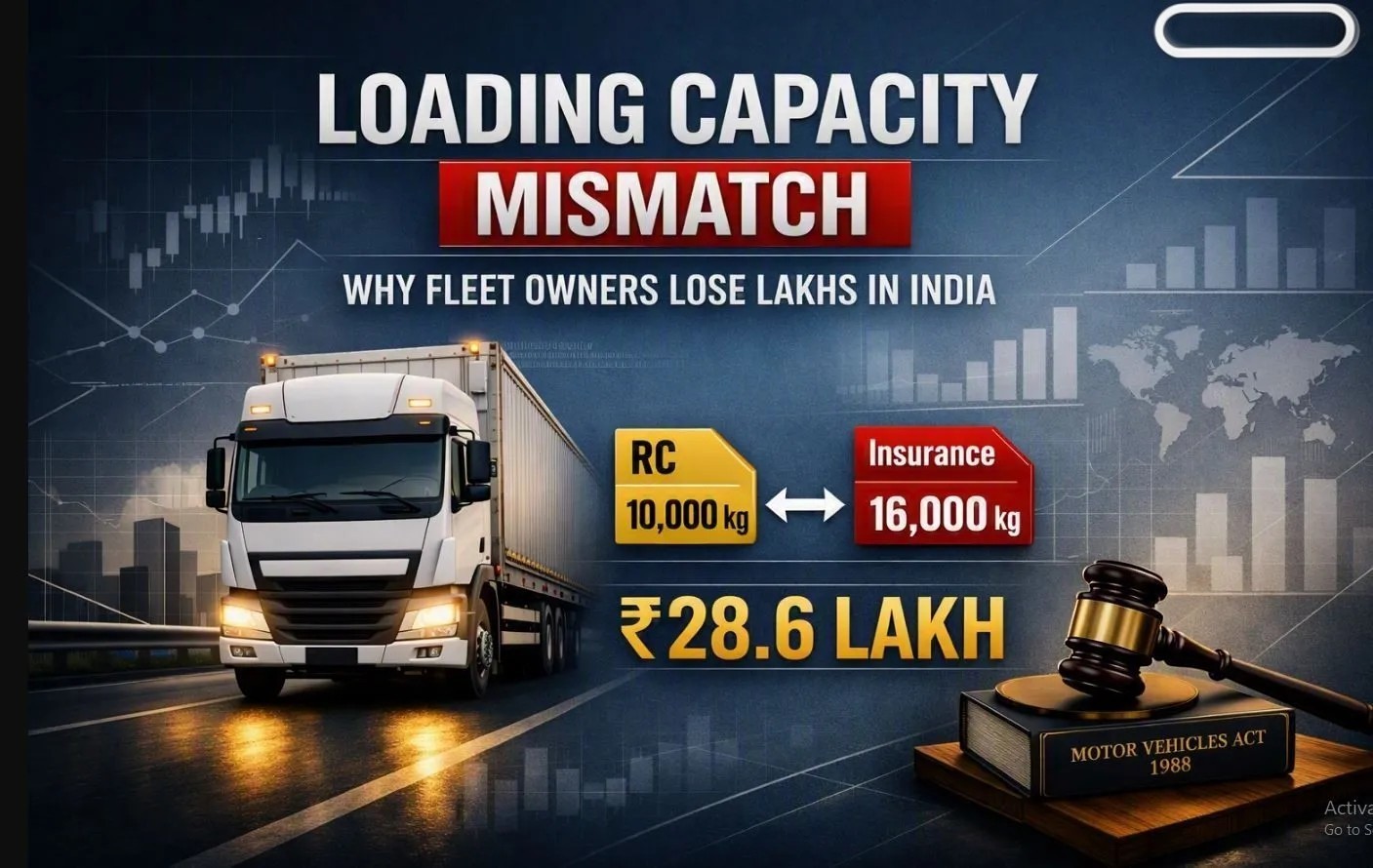
That gap is costing fleet owners lakhs.
A single line of paperwork — the load capacity written on your Registration Certificate versus the one buried in your insurance schedule — decides whether a highway accident becomes a covered loss or a repudiated file. Most owners find out the hard way.
|
₹28.6L Assessed loss on a single truck claim that an insurer tried to deny purely over a load mismatch |
₹20,000+ Statutory fine for overloading under Section 194, before insurance even enters the picture |
75% What courts increasingly award instead of zero, when a mismatch isn't proven to have caused the accident |
Ask any transporter with more than five trucks on the road, and they'll tell you the same story in different words: the accident wasn't the expensive part. The claim was. And more often than not, the reason wasn't a hidden exclusion or fine print nobody read — it was a number. The load-carrying capacity on the vehicle's Registration Certificate didn't match what the insurance policy said, or what was actually on the truck bed that day. That single mismatch is one of the most common — and most avoidable — reasons Indian fleet owners lose lakhs on claims they were fully entitled to.
Every commercial vehicle in India carries its load capacity in three separate places, and almost nobody checks whether they agree with each other.
The Registration Certificate (RC) lists the unladen weight and the Gross Vehicle Weight (GVW) fixed by the manufacturer and the RTO — this is the legal ceiling. The route permit can carry its own conditions on what and how much a vehicle is authorised to carry. And the insurance policy schedule is supposed to mirror the RC's declared capacity, but frequently doesn't — especially after a truck's body is rebuilt, a chassis is re-fabricated, or a second-hand vehicle changes hands without the paperwork catching up.
|
Document |
What it fixes |
Where the mismatch creeps in |
|
RC / Form 23 |
Manufacturer-rated GVW and unladen weight, set at registration |
Not updated after body-building, chassis extension, or a change of use |
|
Route Permit |
Authorised goods, route, and sometimes a capacity condition |
Renewed on autopilot without cross-checking the RC figure |
|
Insurance Schedule |
The carrying capacity the premium was calculated against |
Copied from an old RC, or the dealer's original spec sheet, never revised |
|
Actual Load (LR/GR) |
What's really on the truck, per trip |
Estimated by the loading point, rounded down to avoid extra freight cost |
On a normal day, none of this matters. The truck runs, deliveries happen, nobody opens the RC. It matters the day there's an accident — because that's when a surveyor pulls out a weighbridge slip, compares it against the RC and the policy, and finds a gap.
Here's the sequence that plays out in thousands of commercial vehicle claims a year. An accident happens. The insurer appoints a surveyor. The surveyor checks the load against the RC's permissible weight. If the truck was carrying more than that limit — even by a small margin — the file gets flagged for a possible breach of policy conditions, because most comprehensive policies make "use within the RC-permitted capacity" a standard condition.
What happens next varies by insurer, but a common industry pattern looks roughly like this: overloading within about 5% of the rated limit is usually waved through without comment. Cross into the 5%–25% range, and many insurers apply a proportional deduction to the payout rather than a flat refusal. Go significantly beyond that, and outright repudiation becomes far more likely — at least as a first response from the insurer's desk.
|
This isn't a fixed IRDAI-mandated slab — it's operating practice that varies by insurer, surveyor, and policy wording. The number that actually decides the outcome, as the next section shows, is a legal one: whether the overload caused the accident, not just whether it existed on paper. |
That last distinction is where fleet owners have been winning back money that insurers assumed they'd never have to pay.
Three cases from Indian consumer commissions and the Supreme Court, decided in the last few years, show exactly how this plays out in rupees.
|
J&K STATE CONSUMER DISPUTES REDRESSAL COMMISSION The sand truck that was 11.48% over limit VERDICT: INSURER LOSES A truck rated to carry 13,500 kg was found carrying 15,050 kg of sand — about 1,550 kg over its RC-permitted payload — when it met with an accident. The insurer's own surveyor had already assessed the loss at ₹28.63 lakh, net of salvage. Instead of paying, the insurer repudiated the claim, citing a National Highways Authority circular that allows only a 5% weight tolerance. The Commission's reasoning is the part that matters most: overloading alone doesn't sink a claim. The insurer had to show the excess weight actually caused the accident — and it hadn't. The repudiation was set aside. ₹28.63L surveyor-assessed net loss · 11.48% overload above RC limit |
|
PUNJAB STATE CONSUMER DISPUTES REDRESSAL COMMISSION A ₹35 lakh truck, a stray animal, and a 21.9% overload claim VERDICT: 75% AWARDED A Tata Prima truck insured for a declared value of ₹35 lakh — premium ₹61,984 for the year — collided with another vehicle after a stray animal ran onto the road. United India Insurance declared the file "No Claim," pointing to a 21.9% overload. The owner's tax invoice showed the actual load was within permissible limits, but the dispute still went to appeal. Applying the Supreme Court's own precedent, the Commission ordered the insurer to pay 75% of the assessed loss on a non-standard basis — rather than the zero the insurer had settled on. ₹35L insured declared value · 21.9% overload alleged by insurer |
|
SUPREME COURT OF INDIA · ASHOK KUMAR V. NEW INDIA ASSURANCE (2023) The ruling every fleet owner should know by name GOVERNING PRECEDENT The Supreme Court held that even where an insured has been careless, a policy breach must be fundamental — directly connected to the cause of the loss — before an insurer can deny a claim in full. Where it isn't, courts can order a 75% "non-standard" settlement instead. This built on earlier rulings, including B.V. Nagaraju v. Oriental Insurance (1996), National Insurance Co. v. Swaran Singh, and Manjeet Singh v. National Insurance (2017), which together placed the burden of proof squarely on the insurer. |
Loading capacity mismatch sits at the intersection of two separate legal regimes, and fleet owners often only learn about the first one after the second one has already cost them money.
Section 194 was rewritten to sharply raise the cost of overloading a goods vehicle, entirely separate from any insurance claim.
|
₹20,000 Base fine for overloading under Section 194(1), plus ₹2,000 for every extra tonne of excess weight. |
₹20,000 Fine under Section 194(1A) for a load extending beyond the body's width, front, rear, or height limits — the vehicle isn't allowed to move until corrected. |
|
₹3,000 Fine under Section 194 read with Section 114 if a driver refuses to stop for weighing, or offloads material to dodge a weighbridge check. |
Owner liable The amended Act explicitly extends liability to the vehicle owner, not just the driver, if overloading is permitted or ignored. |
This is where "fundamental breach" comes in. Indian courts have consistently held that a mismatch between RC-permitted capacity and actual load is, at most, a breach of a policy condition — not an automatic ground to void the entire contract. For the insurer to deny a claim outright, it has to prove two things: that the breach happened, and that it was serious enough, and connected enough to the loss, to be called fundamental. A truck that was overloaded but crashed because another vehicle ran a signal doesn't meet that bar. A truck whose overloaded axle snapped and caused the accident might.
There's a further protection worth knowing: statutory third-party liability — compensation owed to victims of an accident — is generally treated differently from an owner's own-damage claim. Insurers are typically required to pay third-party claims regardless of certain policy breaches, and can separately pursue recovery from the owner afterward. It's the comprehensive, own-damage portion of a claim that a loading mismatch puts at real risk.
None of this requires a lawyer on retainer. It requires treating three documents as one system instead of three unrelated pieces of paper.
|
1 |
Match RC, permit and policy at every renewal Before renewing insurance, place the RC's GVW, the route permit condition, and the policy schedule side by side. A five-minute check now costs nothing; the same gap discovered by a surveyor after an accident can cost lakhs. |
|
2 |
Re-register after any body modification If a truck's body is rebuilt, extended, or re-fabricated, the RC's capacity has to be formally amended with the RTO before the new body goes into commercial use — not after. |
|
3 |
Keep a weighbridge slip and LR/GR for every load A fresh "kanta" slip from the point of origin, matched to the Lorry Receipt or Goods Receipt, is the single strongest piece of evidence in a claim dispute — for or against you. |
|
4 |
Read the carrying-capacity endorsement wording, not just the sum insured Ask your insurer or broker to show you, in writing, exactly how "carrying capacity" is defined in your specific policy — it's rarely identical across insurers. |
|
5 |
Never round down a delivery challan to save freight An under-declared consignment note that doesn't match the actual load creates the exact paper trail insurers use to allege a breach. |
|
6 |
Install or mandate a weighbridge stop early in the route A stop within the first few kilometres catches an overload before it becomes a 500-kilometre liability. |
|
7 |
Keep the fitness certificate current A lapsed fitness certificate can be treated as a separate, more serious breach — one that makes the load-limit argument almost irrelevant, because the vehicle wasn't legally roadworthy to begin with. |
|
8 |
Don't accept a flat rejection without asking for the nexus If a claim is denied purely on a load mismatch, ask the insurer, in writing, to establish how the excess load caused the loss. Indian courts have repeatedly ruled that a mismatch on paper isn't enough on its own. |
Can an insurer reject my claim just because the RC and policy capacity don't match?
Not automatically. Indian courts, including the Supreme Court, require the insurer to prove the breach was fundamental and directly caused the loss — not simply that a mismatch existed on paper.
Is the overloading fine separate from the insurance claim outcome?
Yes. The ₹20,000-plus-per-tonne fine under Section 194 of the Motor Vehicles (Amendment) Act, 2019 is a traffic penalty, issued regardless of whether an accident happens or whether a claim is later approved or denied.
Does overloading affect compensation owed to third-party accident victims?
Generally, third-party compensation is treated as a statutory obligation the insurer has to honour, with recovery from the owner pursued separately where applicable. It's the owner's own-damage claim that carries the real risk from a loading mismatch.
What's the single most useful document to protect a claim?
A weighbridge slip from the point of loading, matched against the Lorry Receipt or Goods Receipt for that trip. It's the first thing a surveyor asks for, and the strongest evidence either side can produce.
Pull out the RC, the permit and the policy schedule for every vehicle in your fleet this week — before a surveyor does it for you after an accident.
Sources referenced
Get the latest articles delivered to your inbox