
Personal Bike for Delivery in India: Is It Legal?
Super Policy Team •October 19, 2026 | 12 min read • 10 views
Super Policy Team •October 19, 2026 | 12 min read • 10 views
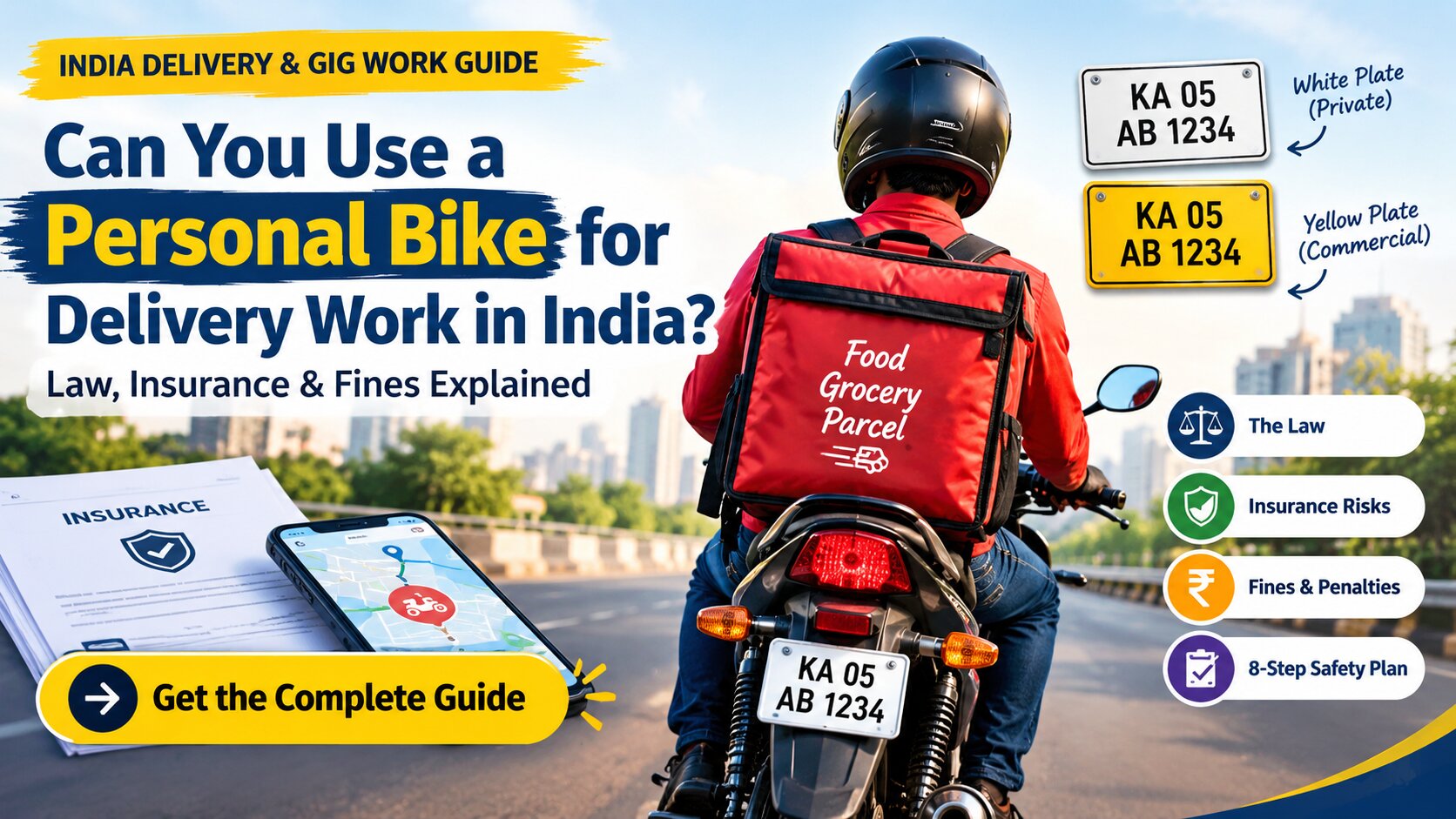
|
INDIA DELIVERY & GIG WORK GUIDE | UPDATED OCTOBER 2026
The law, the white-plate vs yellow-plate puzzle, insurance traps, fines, and a safe 8-step plan before you ride |
|
THE QUICK ANSWER In practice, yes, millions of riders do it. In law, it is a grey area that carries real risk. The Motor Vehicles Act, 1988 requires a permit for a motor vehicle used as a transport vehicle, and a bike registered as a private (white-plate) vehicle is not registered for that purpose. Yet Swiggy, Zomato, Zepto and other platforms routinely onboard riders on private bikes, and there is no clear, uniform national rule that bans or blesses this for delivery. The result: enforcement differs from state to state, and the biggest practical danger is often not a challan but a rejected insurance claim. Bottom line: you can start earning with your own bike, but go in with your eyes open, your papers complete and your insurance sorted. |
|
IN THIS GUIDE YOU WILL LEARN ✔ What the law actually says about private bikes used for work ✔ How white and yellow number plates differ, and why it matters ✔ What happened in Delhi, Karnataka, Uttarakhand and other states ✔ Why your personal bike insurance may fail you after an accident ✔ Your new gig-worker rights under the Code on Social Security ✔ A practical 8-step checklist, myths vs facts, and 6 FAQs |
01 Why This Question Is So Important Right Now
Open any food, grocery or parcel app in an Indian city and the person who rings your bell is very often riding their own two-wheeler. For a student in Pune, a driver between shifts in Hyderabad or a migrant worker in Gurugram, a bike they already own is the cheapest way to start earning.
But a bike bought for school runs and weekend trips was registered, taxed and insured for personal use. The moment it earns money on every trip, three authorities start to care: the transport department (RTO), your insurer, and the platform you work for. This guide explains what each of them expects, in plain language.
02 What the Law Says: Motor Vehicles Act, 1988
Three ideas hold the whole debate together.
A. Transport use needs a permit (Section 66)
Section 66 of the Motor Vehicles Act says a motor vehicle used as a transport vehicle generally needs a permit. Legal commentators note that using a vehicle commercially without registering it as a transport vehicle is technically non-compliant, which is why white-plate delivery sits in a grey zone rather than being clearly allowed.
B. White plate vs yellow plate
|
Feature |
White plate (black letters) |
Yellow plate (black letters) |
|
Meaning |
Private, non-transport registration |
Commercial, transport registration |
|
Typical use |
Commuting, personal errands |
Taxis, goods carriers, passenger or goods hire |
|
Permit |
Not registered as a transport vehicle |
Registered, with the appropriate permit |
|
Insurance |
Private two-wheeler policy |
Commercial or goods-carrying policy |
|
IMPORTANT WARNING Painting a plate yellow or fixing a yellow plate on a privately registered bike changes nothing in law. The registration record is what counts, not the colour on display. A yellow plate on a bike that is still privately registered can create more trouble, not less. |
C. Passenger rides and parcel delivery are not the same
Most court cases and crackdowns you read about concern bike taxis (carrying paying passengers). The Ministry of Road Transport and Highways itself has noted that the term "bike taxi" is not defined in the Act. Delivering a parcel is a different activity, and there is no specific rule that bans white-plate bikes from delivering food or packages. That absence of a clear rule is exactly what makes it a grey area, and why states and officers treat it differently.
03 What Is Happening on the Ground: State-wise Snapshot
India has no single enforcement pattern. These documented developments show how fast the picture can change.
|
State / Body |
What was reported |
What it means for you |
|
Delhi |
In 2023 the transport department said private-registration two-wheelers carrying passengers on hire violate the Act, citing Section 192 with a first-offence fine of Rs 5,000. Later, Swiggy told the government that its food-delivery riders were being challaned, with fines of up to Rs 15,000 reported, although the notification was aimed at bike taxis. |
Misinterpretation by field officers is possible. Carry every document and the platform ID. |
|
Uttarakhand |
The transport department reportedly prepared a crackdown on personal bikes used commercially for apps such as Rapido, Zomato and Swiggy. Over 100 private bikes used for passenger transport were seized in Dehradun, and notices went to app companies. |
Local drives can target delivery too. Check your district RTO position. |
|
Karnataka |
On 13 June 2025 the High Court ruled that bike-taxi operations must stop from 16 June 2025 unless the state frames a policy under Section 93. The state also passed the Karnataka Platform-Based Gig Workers (Social Security and Welfare) Act, 2025. |
Passenger bike taxis and delivery are treated differently. Gig-worker welfare rules exist at state level. |
|
Maharashtra / Supreme Court |
The Supreme Court declined to give Rapido relief against Maharashtra refusing a licence, noting the 2019 amendments on aggregators. |
Courts are strict on passenger aggregators needing licences. |
|
Centre (MoRTH) |
The Motor Vehicle Aggregator Guidelines 2025 allow regular white-plate motorcycles on app-based passenger platforms, but only where the state government approves. |
This concerns passenger services. Delivery has no uniform national rule yet. |
Note: laws and enforcement change often. Confirm the current position with your state transport department before you start.
04 The Hidden Danger: Your Insurance May Not Pay
Every motor vehicle in India must have at least third-party insurance. But insurers sell separate policies for private and commercial use. Several leading insurers and brokers state plainly that if a private two-wheeler is used for commercial purposes and meets with an accident, the insurer can reject the claim.
|
EXAMPLE: HOW A SINGLE ACCIDENT CAN GO WRONG (illustrative scenario) Imran, a delivery rider in Bengaluru, uses his white-plate scooter with a standard private comprehensive policy. During an evening order, a car hits him and damages the scooter. At the garage the surveyor sees the delivery bag, and the insurer finds an active order on the app at the time of the accident. What can happen: the insurer may argue that the bike was being used for hire or reward, which a private policy was not written for, and decline the own-damage claim. Imran then pays the repair bill and medical costs himself. Lesson: the premium you save today can cost many times more after an accident. Hiding delivery use at claim time is treated as misrepresentation and can make matters worse. |
Private vs commercial two-wheeler insurance at a glance
|
Point |
Private policy |
Commercial policy |
|
Designed for |
Personal rides and leisure |
Deliveries, courier work, rides for hire, goods transport |
|
Delivery use |
Can invalidate cover at claim time |
Covers the declared business use |
|
Premium |
Lower |
Higher, because the risk is higher |
|
Best for |
Non-working bikes |
Full-time and part-time delivery riders |
Smart move: before you sign up with any platform, call your insurer and ask in writing whether delivery use is covered, what endorsement or policy is needed, and what it costs. Price this before buying or renting a bike.
Need help comparing options? Check insurance plans on SuperPolicy.
|
|
|
Not sure if your bike policy covers delivery work? Explore insurance options for your bike with SuperPolicy, your one-stop shop for insurance. |
05 Penalties and Risks You Should Know
✔ Challan: for running a private-registered vehicle for hire without the required permit. Delhi's notice cited a first-offence fine of Rs 5,000 under Section 192.
✔ Higher fines on the road: delivery riders in Delhi were reported to be fined up to Rs 15,000 during one enforcement phase.
✔ Vehicle seizure: reported in Uttarakhand for private bikes carrying passengers.
✔ Insurance rejection: the largest financial risk after any accident.
✔ Account action by the platform: if your papers are invalid, expired or mismatched.
Remember: riding without a valid licence, registration certificate (RC) or insurance is a separate offence, whatever your job is.
06 Three Real-Life Style Examples, Explained
|
CASE 1 Priya, part-time rider with a white-plate scooter Priya delivers groceries for three hours each evening on her private scooter. Her platform onboarded her after checking her licence, RC and insurance. Verdict: Platform approval is not the same as legal permission or insurance cover. Priya should ask her insurer about delivery use and keep her documents ready for roadside checks. |
|
CASE 2 Arjun, full-time rider who wants to be fully compliant Arjun rides ten hours a day. He asks the RTO about commercial registration of his motorcycle and takes a commercial two-wheeler policy. Verdict: This is the lowest-risk route, though availability of two-wheeler transport permits varies by state, so check what your RTO offers. |
|
CASE 3 Meera, home baker delivering her own orders Meera delivers cakes to her own customers on her private bike, with no app involved. Verdict: It is still business use of a private vehicle. Because insurer and officer views can differ, she should confirm with her insurer in writing before relying on a private policy. |
07 Your Rights as a Gig Worker: Code on Social Security
The legal status of delivery partners changed in a major way. The Code on Social Security, 2020, which came into effect from 21 November 2025, formally recognises gig workers and platform workers, including food-delivery partners. Aggregators are required to contribute roughly 1 to 2 per cent of annual turnover, capped at 5 per cent of payments made to workers, into a social security fund.
Benefits can include life and disability cover, accident insurance, health and maternity support, but they depend on schemes being notified and on registration. The Code recognises gig workers without making them employees, so not every employment benefit applies. Karnataka has its own state law as well.
|
WHY THIS MATTERS FOR YOU India recorded about 1.7 lakh road deaths in 2023, and two-wheeler riders are among the most exposed. Register on the platform and government portals, keep your details updated, and do not treat welfare schemes as a replacement for proper vehicle insurance. |
08 Your Safe 8-Step Checklist Before You Ride
1. Check your papers: valid driving licence, RC, pollution certificate (PUC) and insurance, all current.
2. Read your insurance policy: look for the "use" clause (private or commercial).
3. Call your insurer: ask about delivery use, the exact endorsement needed and the cost. Get it in writing.
4. Ask your RTO: whether your state offers commercial registration or any rule for two-wheeler delivery.
5. Read the platform terms: note who bears the cost of fines, accidents and vehicle damage.
6. Carry documents and platform ID on every shift, in print or digital form.
7. Wear a certified helmet and protective gear: safety is not optional, whatever the delivery timer says.
8. Keep records: order history, payouts and receipts help with taxes and with any dispute.
09 Myths vs Facts
|
MYTH |
FACT |
|
"The app allowed me, so I am fully legal." |
Platform onboarding is a business decision. It does not change vehicle registration or insurance terms. |
|
"A yellow sticker or paint makes my bike commercial." |
Only the registration record with the transport authority counts. |
|
"Delhi banned bike taxis, so delivery is banned too." |
The notice targeted passenger bike taxis, though riders reported wrongful challans. Carry papers. |
|
"Third-party insurance is enough." |
It covers harm to others, not your own bike or injuries, and misuse can still cause disputes. |
|
"Gig workers have no rights." |
The Code on Social Security, 2020 now recognises them, although schemes are still rolling out. |
10 Smarter Alternatives to Consider
✔ Commercial registration and policy if you plan to deliver full time and your state offers it.
✔ Rental or lease bikes offered through platform or fleet partners, which are often already registered and insured for delivery. Confirm this in the agreement.
✔ Electric two-wheelers: electric vehicles have enjoyed certain permit exemptions in the aggregator context, but state rules differ, so check before you buy.
✔ Add-on covers: personal accident cover for the rider, over and above compulsory cover.
11 Frequently Asked Questions
Q. Is it legal to deliver food on my own private bike in India?
A. There is no clear national ban for delivery, but the Motor Vehicles Act requires permits for transport use. It is best described as a legal grey area with state-wise differences.
Q. Do I need a yellow number plate for Swiggy or Zomato?
A. Platforms commonly onboard riders with white-plate bikes. A yellow plate reflects commercial registration, which you obtain through the RTO, not by changing the plate colour.
Q. Will my bike insurance cover accidents during delivery?
A. A private policy may not. Insurers say claims can be rejected if the bike was used commercially. Ask your insurer for a commercial policy or written endorsement.
Q. What is the fine for using a private bike commercially?
A. It depends on the state and the section applied. Delhi's notice cited Rs 5,000 for a first offence under Section 192, and higher challans were reported for delivery riders.
Q. Are delivery partners now covered by social security?
A. The Code on Social Security, 2020 recognises them and requires aggregator contributions. Actual benefits depend on notified schemes and registration.
Q. Where can I verify the latest rules?
A. Your state transport department or RTO, your insurer, and the official Ministry of Road Transport and Highways website.
12 Final Verdict
Using a personal bike for delivery in India is common, tolerated in many places, but not clearly protected by law. The three risks to manage are enforcement, insurance and platform terms. Fix your papers, speak to your insurer, understand your state's stance, and register for the new gig-worker benefits. A little preparation protects your income, your bike and your family.
|
|
|
Ride Smart. Earn Safe. Stay Covered. Check your bike cover and compare insurance options on SuperPolicy before your next delivery shift. |
Get the latest articles delivered to your inbox

