
ABHA Card: How India’s Digital Health ID Is Quietly Rewriting Patient Power
Super Policy Team •April 13, 2026 | 5 min read • 157 views
Super Policy Team •April 13, 2026 | 5 min read • 157 views
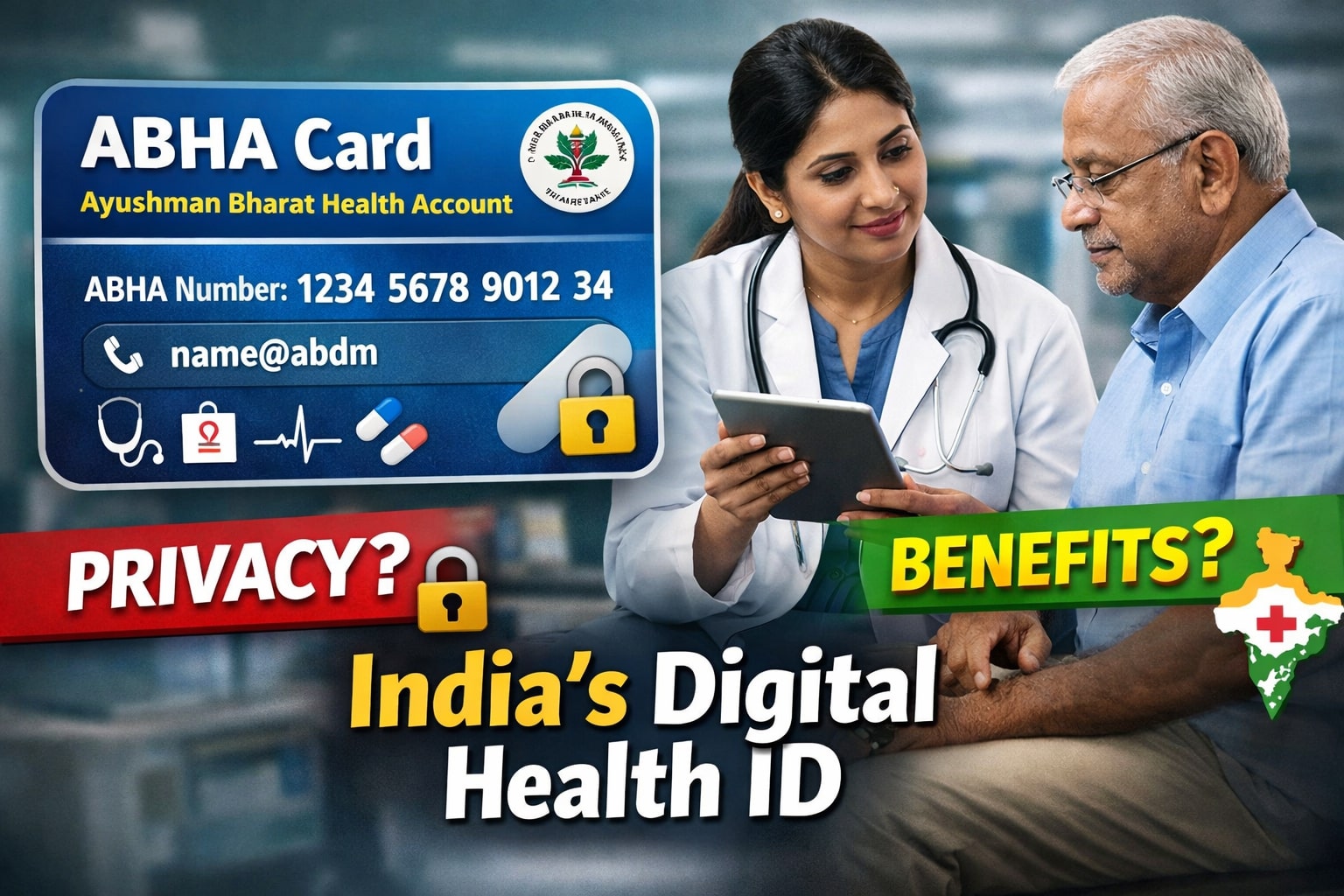
In India, the costliest inefficiency in healthcare is not expensive treatment—it is missing information. Patients shift cities, doctors change, hospitals operate in silos, and medical histories often exist as scattered prescriptions, forgotten files, or incompatible software entries. The result is repeated diagnostics, delayed decisions, and avoidable risks—especially in emergencies.
The ABHA Card (Ayushman Bharat Health Account) was introduced to address precisely this invisible gap. Positioned under the Ayushman Bharat Digital Mission (ABDM), ABHA is India’s attempt to give citizens continuity, ownership, and control over their health records—without centralising sensitive data.
This article goes beyond policy explanations to examine what ABHA actually changes in practice, where it falls short today, and why its long-term impact depends as much on citizens as on institutions.
At its core, the ABHA Card is a 14-digit digital health account number that allows an individual to link medical records generated across different healthcare providers into one consent-driven ecosystem.
However, clarity is essential.
A digital health identity, not a physical card
A tool to organise and access medical records
A voluntary, free service
A patient-controlled data-sharing mechanism
Not proof of identity like Aadhaar
Not mandatory for treatment or hospital admission
Not health insurance or coverage under Ayushman Bharat PM-JAY
Not a government database storing all your medical data
This distinction is critical because most misconceptions around ABHA stem from confusing it with other national ID frameworks.
Indian healthcare is decentralised by design—public and private providers coexist, but rarely communicate. ABHA attempts to solve three systemic issues:
Loss of Medical Continuity
Patients start from zero each time they change doctors or cities.
Doctor Blind Spots
Clinicians often treat without access to prior diagnoses, medications, or allergies.
Patient Disempowerment
Medical data historically belongs to hospitals, not individuals.
ABHA repositions the patient as the custodian of their own health data, rather than a passive subject within institutional systems.
Understanding ABHA requires following the consent lifecycle, which is its most defining feature.
Record Creation
A hospital, lab, or clinic generates a digital medical record during treatment.
ABHA Tagging
The record is linked to the patient’s ABHA ID if the provider is ABDM-enabled.
Consent Request
Another provider (for example, a new doctor) requests access for a defined purpose.
Patient Approval
The individual authorises or denies access using OTP-based authentication.
Time-Bound Sharing
Access expires automatically or can be revoked instantly.
At no point does ABHA store medical data centrally. Records remain with the original creator.
A patient from Chennai meets with an accident in Pune. With ABHA, doctors can (with consent) access allergy history, chronic conditions, or prior surgeries—saving critical time.
Diabetes, cardiac, or oncology patients often consult multiple specialists over years. ABHA helps maintain a longitudinal health history, reducing conflicting prescriptions.
For individuals who frequently change cities, ABHA offers continuity without carrying physical files.
Family members can help manage records digitally, reducing dependency on memory or paperwork.
Traditionally:
Hospitals owned records
Patients requested copies
Data portability was minimal
With ABHA:
Patients approve access
Providers request data
Sharing is purpose-bound and temporary
This is a structural shift—not just a technological one.
Concerns around digital health IDs are valid, particularly in a data-sensitive era. ABHA attempts to mitigate these risks through design rather than assurances.
Federated architecture (no central health database)
Explicit, granular consent
User-controlled revocation
Minimal data exposure
Encrypted data exchange
However, trust will ultimately depend on implementation discipline, provider compliance, and user awareness—not policy intent alone.
| Parameter | Traditional System | ABHA-Enabled System |
|---|---|---|
| Record Ownership | Hospital-centric | Patient-centric |
| Portability | Limited | Nationwide |
| Emergency Access | Slow | Faster (with consent) |
| Data Duplication | High | Reduced |
| Transparency | Low | High |
Despite its advantages, ABHA may not be ideal for everyone immediately.
You may consider delaying if:
You are uncomfortable with digital tools
You rely exclusively on a single local clinic
You are unwilling to actively manage consent requests
This is not a limitation of ABHA—but a reflection of its active-user model.
Myth: The government can see all my medical data
Reality: Data stays with hospitals and is shared only with consent
Myth: ABHA replaces hospital OPD cards
Reality: It complements, not replaces, local systems
Myth: ABHA is linked to income or tax records
Reality: It has no linkage with financial databases
ABHA is likely to become the backbone for:
Digital insurance claims
Telemedicine scale-up
Preventive healthcare analytics
AI-driven diagnostics
Cross-state healthcare portability
While it may never be mandatory, its utility could make it functionally indispensable over time.
The ABHA Card is neither a magic fix nor a surveillance instrument by default. It is a framework—one that redistributes control toward patients, provided they engage with it consciously.
Its success will depend less on government mandates and more on trust, literacy, and responsible adoption. If executed well, ABHA could do for healthcare what UPI did for payments—quietly, structurally, and irreversibly.
Get the latest articles delivered to your inbox