
GCV, PCV or Misc? The three letters that decide whether your insurer pays.
Super Policy Team •September 8, 2026 | 9 min read • 10 views
Super Policy Team •September 8, 2026 | 9 min read • 10 views
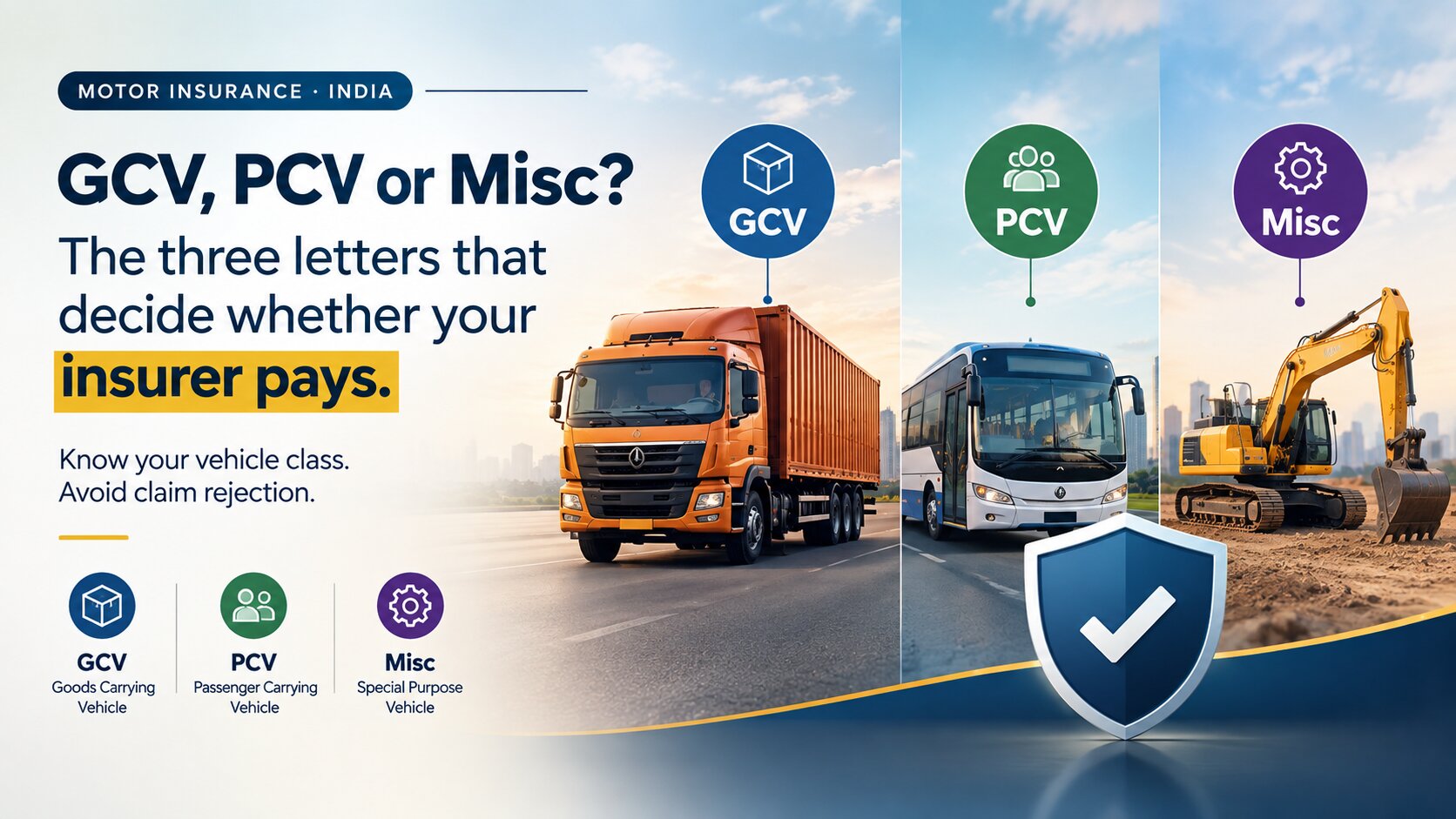
MOTOR INSURANCE · INDIA
Every vehicle sold in India is filed under a specific insurance class. Get it wrong — even by accident — and the very policy you paid for can be the reason your claim gets rejected.
9 min read
Most people find out what class their vehicle belongs to on the worst possible day — after an accident, when a surveyor is reading their policy line by line. By then, it's too late to fix. This isn't a fine-print technicality; it's the single most common, most avoidable reason genuine motor claims get denied in India.
The 10-second gut check
• Goods — Does your vehicle carry cargo, materials, or freight for hire or business use — a truck, tempo, tanker, or trailer? You likely need GCV cover.
• People — Does it carry paying or business passengers — a taxi, app-based cab, school van, auto-rickshaw, or bus? You likely need PCV cover.
• Neither — Is it a crane, forklift, ambulance, excavator, or other special-purpose vehicle used for business? It falls under Miscellaneous & Special Type cover.
• None of these — Purely personal use, no fare, no freight, no business errand? You're in the standard Private Car / Two-Wheeler category — not covered in detail here, but the same “declared use” rule still applies.
Motor insurance in India isn't one product with add-ons. It's a family of distinct products, each priced and worded around how a vehicle is actually used. Third-party (TP) cover is compulsory for every vehicle on Indian roads under the Motor Vehicles Act, 1988, and the premium, the permitted use, and the underwriting questions all change depending on which class your vehicle sits in.
|
Section 146 of the Motor Vehicles Act, 1988 makes it a legal requirement to hold a valid third-party liability policy before using any motor vehicle in a public place — regardless of whether that vehicle carries goods, passengers, or neither. |
Insurers don't just look at what your vehicle is on the day you buy the policy — they look at what it's declared and used for across the year. A private hatchback insured for personal use that starts running airport pickups on the side isn't a “private car” anymore in the eyes of your insurer, even if nothing about the vehicle itself has changed.
|
WHY THIS ACTUALLY MATTERS “Using a private vehicle for commercial purposes” is one of the most frequently cited reasons for motor claim rejection in India — cutting across ride-sharing, goods transport, and unregistered taxi use. The rejection applies to the own-damage portion of your claim even when the accident wasn't your fault. |
Here's what each one actually covers, who it's for, and how insurers price it.
|
GCV Goods Carrying Vehicle Any vehicle built or used to transport goods — trucks, mini-trucks, tempos, tankers, trailers, and three-wheeler goods carriers. • Third-party premium is rated mainly on gross vehicle weight (GVW), not engine size. • Own-damage premium factors in Insured Declared Value (IDV), age, and how the vehicle is used (own-fleet vs. hired out). • Standard GCV policies cover the vehicle only — not the cargo. Goods being transported need a separate Goods-in-Transit policy. |
|
PCV Passenger Carrying Vehicle Any vehicle built or used to carry paying or business passengers — taxis, app-based cabs, autos, school vans, and private or stage buses. • Third-party premium is rated mainly on seating capacity, and for buses/taxis, on the type of permit or route. • Requires the correct commercial permit from the RTO to be valid alongside the insurance. • A private car used as an unregistered taxi is not a PCV policyholder in the insurer's eyes — it's a private car being misused. |
|
Misc. Class Miscellaneous & Special Type Vehicles Everything built for a job, not for transport in the usual sense — cranes, forklifts, excavators, ambulances, and other construction or site equipment that still needs to move on public roads. • Doesn't fit neatly into “goods” or “passengers,” but still needs cover because of its commercial or institutional use. • The list of eligible vehicle types under this class is periodically updated by IRDAI to add new equipment types and retire obsolete ones. • Often the most overlooked category — owners assume “it's not a truck or a bus” means it doesn't need commercial cover at all. |
|
|
GCV |
PCV |
Misc. Class |
|
Typical vehicles |
Trucks, tempos, tankers, trailers |
Taxis, cabs, autos, buses, school vans |
Cranes, forklifts, ambulances, excavators |
|
TP premium based on |
Gross vehicle weight |
Seating capacity / permit type |
Vehicle type & usage |
|
Permit required |
Goods carriage permit |
Passenger / contract / stage carriage permit |
Depends on equipment & use |
|
Covers cargo/goods carried? |
No — separate Goods-in-Transit policy |
Not applicable |
Not applicable |
|
Common misclassification risk |
Overloading beyond declared GVW slab |
App-based rides on a private-car policy |
Treated as “not commercial” and left uninsured for business use |
Third-party rates are fixed periodically by IRDAI in consultation with the Ministry of Road Transport and Highways (MoRTH), and they differ sharply by class. As an illustration of scale, a draft MoRTH/IRDAI notification for private cars set base TP premiums at ₹2,094 (up to 1000cc), ₹3,416 (1001–1500cc), and ₹7,897 (above 1500cc) — while a goods-carrying commercial vehicle up to 7,500 kg was proposed at a base of roughly ₹16,049, rising well into five figures for heavier slabs.
Rates are reviewed most years and have been under active revision for FY 2026–27, with industry reports discussing a further 10–25% increase still awaiting final gazette notification at the time of writing. Always confirm the current notified slab for your vehicle on your renewal date rather than relying on last year's number.
|
The gap between a private-car premium and a GCV or PCV premium isn't arbitrary — it reflects genuinely different risk. That's exactly why insurers scrutinise declared use so closely at claim time: paying a private-car premium while running a commercial operation is underinsurance by definition, not a paperwork slip. |
|
1 |
Pull out your RC and your policy schedule Your Registration Certificate records how the vehicle is registered — private or commercial/transport. Your insurance policy schedule separately states the class it's insured under. Both should tell the same story. |
|
2 |
Match declared use to actual use If you use a personal car for any fare, delivery, or business errand — even occasionally — that use isn't covered by a standard private-car policy. |
|
3 |
Check the permit, not just the insurance A PCV or GCV insurance policy without the matching RTO permit (or vice versa) leaves you exposed on both fronts — regulatory and financial. |
|
4 |
When usage changes, call your insurer before the accident, not after Switching from personal to commercial use, adding a permit, or changing operators are all things insurers expect you to declare. It's a phone call now, versus a rejected claim later. |
Misclassification isn't automatically the end of the road. Indian policyholders have a structured, largely free escalation path:
• Ask for the rejection in writing, with the specific policy clause cited — not just a verbal reason.
• Escalate to the insurer's internal grievance cell first; most rejections must go through this stage before anything else.
• File on IRDAI's Bima Bharosa portal if the internal response is unsatisfactory or delayed.
• Approach the Insurance Ombudsman for a free, time-bound hearing — eligibility and monetary limits are set under the Insurance Ombudsman Rules and are worth confirming directly with IRDAI, since they're revised from time to time.
• Consumer court remains available as a formal legal route for larger or contested disputes.
Q. Can I insure my personal car for occasional cab work?
No — a standard private-car policy explicitly excludes commercial or hire-and-reward use. Even occasional app-based rides require a PCV policy and the matching commercial/taxi permit.
Q. Does a bigger engine or heavier vehicle always mean a bigger premium?
Not directly. Private car TP premiums scale with engine capacity (cc), while GCV premiums scale with gross vehicle weight, and PCV premiums scale with seating capacity or permit type — three different pricing logics for three different classes.
Q. Is goods-in-transit automatically covered under a GCV policy?
No. A GCV policy insures the vehicle itself. The goods being carried need a separate Goods-in-Transit (marine/inland transit) policy.
Q. What if my vehicle doesn't fit GCV or PCV at all?
Equipment like cranes, forklifts, ambulances, and construction machinery falls under the Miscellaneous & Special Type class — a distinct, often-overlooked category for business-use vehicles that aren't primarily transporting goods or people.
Q. Will a claim be rejected only for the accident-causing party, or for me too?
Your own-damage claim can be denied for a declared-use breach even when the other party caused the accident. Third-party liability to the injured person, however, must still be honoured by the insurer under the Motor Vehicles Act, 1988 — the insurer can later try to recover that amount from you separately.
This article is for general information only and does not constitute insurance, legal, or financial advice. Premium figures, thresholds, and regulatory limits mentioned above are illustrative and subject to periodic revision by IRDAI and MoRTH — always verify current rates and rules with your insurer or on irdai.gov.in before making a decision.
Get the latest articles delivered to your inbox