
Is ₹5 Lakh Health Insurance Enough in 2026? The Real Gap
Super Policy Team •October 21, 2026 | 21 min read • 12 views
Super Policy Team •October 21, 2026 | 21 min read • 12 views
Brokerage Free Insurance guidance by SuperPolicy™ | superpolicy.in
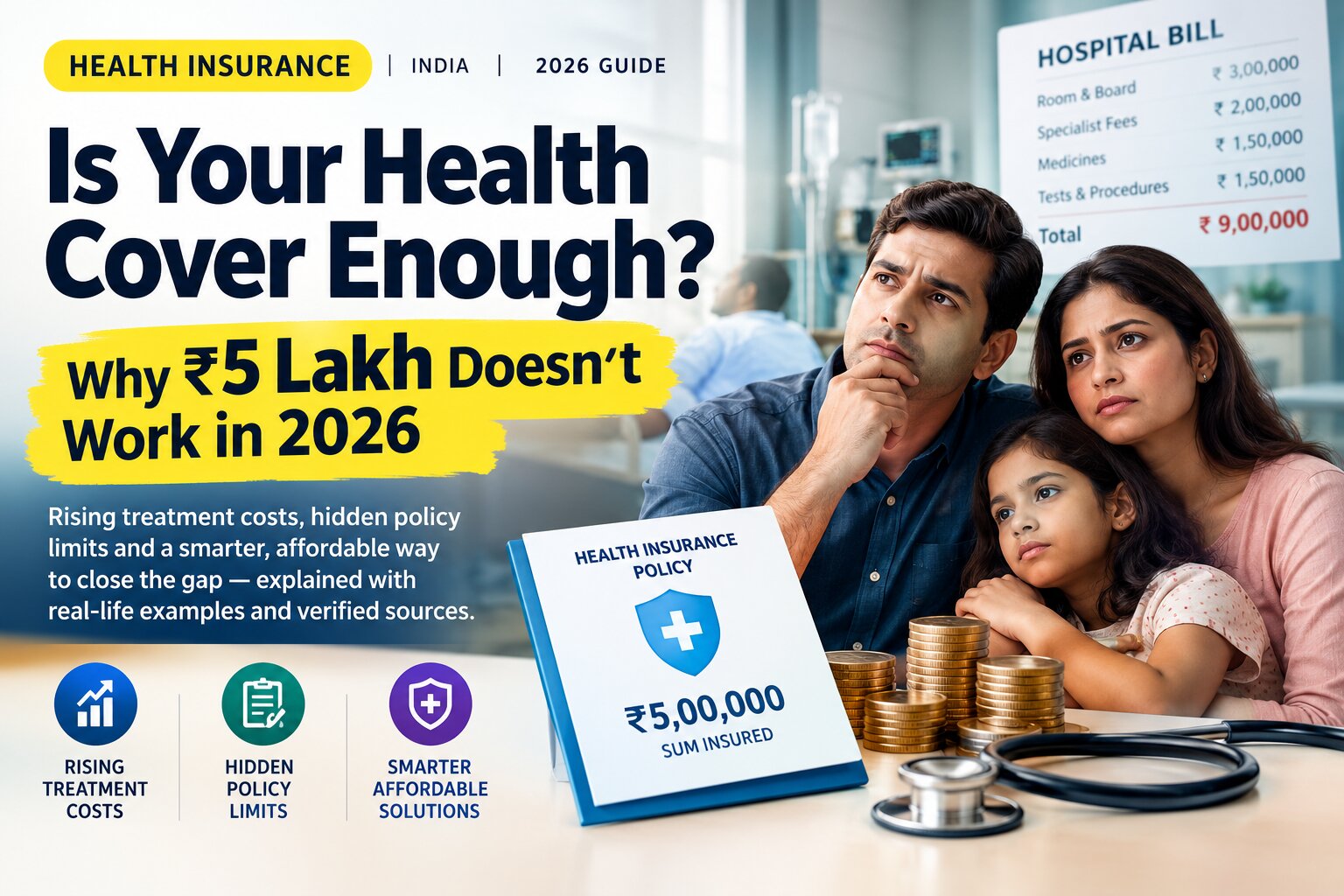
HEALTH INSURANCE | INDIA | 2026 GUIDE
Is Your Health Cover Enough?
Why ₹5 Lakh Doesn’t Work in 2026
Rising treatment costs, hidden policy limits and a smarter, affordable way to close the gap — explained with real-life examples and published industry data.
Updated 21 October 2026 • About 12-minute read
INSIDE THIS GUIDE
|
01 Medical inflation: the silent shrinking of your cover |
02 What serious treatment really costs in 2026 |
|
03 Six hidden traps that shrink ₹5 lakh |
04 Why “wait and see” backfires on premiums |
|
05 How much cover is enough? |
06 The smart fix: base policy + super top-up |
|
07 Know your rights: IRDAI reforms |
08 Three families, three outcomes |
|
09 Your 10-point self-audit |
10 Your 30-day action plan |
PUBLISHING PACK (for the content team — delete this block before circulating to readers)
|
SEO Title (56 chars) |
Is ₹5 Lakh Health Insurance Enough in 2026? The Real Gap |
|
Meta Description (143 chars) |
Is ₹5 lakh health insurance enough in 2026? With medical inflation near 12–14%, see real treatment costs, hidden claim traps and the smart fix. |
|
Focus Keyword |
is 5 lakh health insurance enough |
|
Secondary Keywords |
medical inflation India 2026, super top-up health insurance, health insurance sum insured, room rent capping, how much health cover is enough |
|
Suggested URL Slug |
/is-5-lakh-health-insurance-enough-2026 |
|
Top 12 Hashtag Keywords |
#HealthInsurance, #MedicalInflation, #HealthCover2026, #SuperTopUp, #HealthInsuranceIndia, #FamilyFloater, #CancerCoverage, #CriticalIllnessCover, #FinancialPlanning, #RoomRentCapping, #IRDAI, #InsuranceAdvice |
Ramesh, 42, is a software manager in Hyderabad. Five years ago he bought a ₹5 lakh family floater, paid the premium on time every year and felt thoroughly sorted. Then a bout of chest pain turned into an emergency admission, and the cardiologist said the word every family dreads: bypass.
The hospital’s final bill came to ₹9 lakh. His insurer paid ₹5 lakh — every rupee of the cover — and Ramesh paid the remaining ₹4 lakh from his savings, a week before his daughter’s school fees were due.
Ramesh is an illustrative example built from the cost ranges in this guide, not a real individual.
A ₹5 lakh policy does not mean ₹5 lakh of protection. It means up to ₹5 lakh, after every rule in the fine print has been applied.
|
THE SHORT ANSWER For the routine stuff — dengue, a fracture, a minor surgery in a mid-sized city — ₹5 lakh still does the job in many cases. For serious illness in a metro hospital (heart, cancer, transplant, long ICU stays), it very often does not. In 2026, ₹5 lakh works best as the first layer of your cover, not the whole of it. This guide shows you the numbers, the hidden traps, and a low-cost way to fix the gap — with figures drawn from published industry data. |
|
11.5% projected rise in employee medical-plan costs in India in 2026 (global average: 9.8%) |
12–15% annual medical inflation estimates, versus far lower general inflation |
+46% jump in average family-floater premium, from about ₹15,000 (2021) to over ₹22,000 (2025) |
|
>90% claims ratios at insurers — most premium income is already going out as claims |
~65% rise in cardiology treatment costs over the past five years |
₹15–25L minimum sum insured a major insurer’s claims analysis says is increasingly needed for cancer care |
Estimates differ by source because each measures a different basket (employer plans, retail insurance, hospital bills). The common thread is clear: healthcare costs are rising faster than most household incomes.
Medical inflation is the yearly rise in the cost of healthcare — hospital charges, drugs, diagnostics, devices and specialist fees. It is not the same as the retail inflation figure in the news. Think of it as the price of your hospital bill, not your grocery bill, and it has been climbing much faster. Recent estimates cluster between roughly 11% and 15% a year: Aon projects 11.5% for employer medical plans in India in 2026, one 2026 industry review puts it near 12–14%, and insurers and insurance blogs cite 14–15%. Niva Bupa’s CFO noted it had been above 10% and was projected near 13% for FY25.
Your sum insured is a fixed number. The cost of the treatment it must pay for is not. Here is our own arithmetic, using a conservative 12% a year, for a treatment that costs ₹5 lakh today:
|
Years from today |
Same treatment will cost (at 12% a year) |
Gap vs a ₹5 lakh policy |
Visual |
|
Today |
₹5.0 lakh |
None — just enough |
█████ |
|
In 3 years |
₹7.0 lakh |
₹2.0 lakh short |
███████ |
|
In 5 years |
₹8.8 lakh |
₹3.8 lakh short |
█████████ |
|
In 7 years |
₹11.1 lakh |
₹6.1 lakh short |
███████████ |
|
In 10 years |
₹15.5 lakh |
₹10.5 lakh short |
███████████████ |
This lines up with what brokers report from claims: a treatment that cost ₹5 lakh five years ago can easily cost ₹8–9 lakh today. A policy bought years ago and renewed without review is quietly buying less healthcare every year.
|
REAL-LIFE EXAMPLE | The unchanged policy Meena bought a ₹5 lakh policy in 2019 and has renewed it automatically ever since. Her premium crept up, but the cover stayed at ₹5 lakh. In 2026 the same procedure her doctor recommends is priced far higher than in 2019, so the policy that once covered a heart procedure with room to spare now covers only part of it. Nothing in the policy changed — the world around it did. |
Costs vary hugely by city, hospital tier, doctor, treatment protocol and complications, so treat every figure as an indicative range, not a quote. The table brings together recent published estimates and compares them with a ₹5 lakh sum insured.
|
Condition / procedure |
Indicative private-hospital cost |
Against ₹5 lakh cover |
|
Stroke hospitalisation |
₹2 – 6 lakh |
Fits, but little left |
|
Bypass (CABG) |
₹2 – 7 lakh (broker estimates) |
Fits only the low end |
|
Angioplasty / stent / bypass in private hospitals |
₹4 – 15 lakh |
Often exceeds |
|
Early-stage cancer (per case) |
₹5 – 7 lakh |
Uses all of it |
|
Breast cancer |
₹8 – 20 lakh |
Exceeds |
|
Lung cancer |
₹8 – 30 lakh |
Exceeds |
|
Advanced / high-complexity cancer |
₹20 – 30 lakh |
4–6× the cover |
|
Blood cancer |
₹15 – 40 lakh |
3–8× the cover |
|
Bone marrow transplant |
₹25 – 35 lakh |
5–7× the cover |
Two more data points show the direction of travel. Policybazaar’s analysis reports surgery costs rising 250–300% in a decade, with cancer surgery moving from about ₹13.5 lakh in 2013 to ₹50.8 lakh in 2024 and cataract surgery from about ₹35,000 (2016) to ₹1.26 lakh (2025). And in a Tata AIG-backed survey, nearly 60% of cardiologists said fewer than 40% of their patients could afford advanced cardiac treatment.
|
A NOTE ON THE FIGURES Several of these figures come from insurers and insurance brokers, who have a commercial interest in higher cover. The numbers are useful as market indicators, and the pattern is consistent across the estimates reviewed, but your own hospital’s package rate is the best benchmark — see the action plan in Section 10. |
|
REAL-LIFE EXAMPLE | Cancer is a journey, not a single bill Cancer care is rarely one admission. It typically spans surgery, multiple chemotherapy cycles, scans, possibly immunotherapy and months of follow-up, and Care Health’s claims analysis notes that treatment journeys often stretch over many months and that policies with low sums insured regularly hit their limit mid-treatment. The bill arrives in instalments — and so does the shock. |
|
Not sure where you stand? Get your free Health Cover Gap Score. Talk to the SuperPolicy team for a no-obligation review of your current cover against realistic treatment costs. |
Book Free Review 8095962020 | superpolicy.in |
Even if a treatment “fits” inside your sum insured, the amount actually paid can be lower. These are the six most common reasons.
Many policies limit the room rent they will pay per day (often a percentage of the sum insured, such as 1% — ₹5,000 a day on a ₹5 lakh policy). If you pick a costlier room, some policies reduce the entire claim proportionately, not just the room charge, because doctor fees, nursing and procedure charges are often linked to room category. Always read your own policy wording to see whether this applies.
|
REAL-LIFE EXAMPLE | The ₹10,000 room Policy cap: ₹5,000 a day. Room chosen: ₹10,000 a day for 4 days. Total bill: ₹3,00,000 (room ₹40,000 + other charges ₹2,60,000). Because the cap covers only 50% of the room tariff, the insurer pays 50% of the admissible bill: ₹1,50,000. The family pays the other ₹1,50,000 — on a bill that was nominally “inside” the ₹5 lakh limit. |
A co-payment means you pay a fixed share of every claim, whatever the bill. It is common on plans for older customers and on cheaper variants of a product.
|
REAL-LIFE EXAMPLE | The 20% co-pay Mr Iyer, 63, in Chennai has a ₹5 lakh policy with a 20% co-pay. A knee-replacement bill of ₹4,00,000 means the insurer pays ₹3,20,000 and he pays ₹80,000 — even though the claim is well within his sum insured. |
Some policies cap what they pay for particular procedures — cataract, joint replacement, kidney stones, or maternity — regardless of the overall sum insured. Prices rise; the sub-limit usually does not. Cataract surgery, for instance, is reported to have gone from about ₹35,000 in 2016 to around ₹1.26 lakh in 2025, so a fixed older sub-limit can cover only a fraction of a modern bill.
In a floater, one ₹5 lakh pool covers everyone. A large claim by one member leaves less for the others for the rest of that policy year. Some plans restore the sum insured, but the conditions vary — often it applies only to a different illness or person, so check the wording.
|
REAL-LIFE EXAMPLE | Two claims, one pool The Nair family (four members) has a ₹5 lakh floater. In March the father’s procedure costs ₹4,00,000, leaving ₹1,00,000 in the pool. In October their child is hospitalised for ₹1,80,000. Without a restoration benefit that applies, the family bears the ₹80,000 shortfall themselves. |
• Pre-existing diseases (PED): conditions you already had when buying, such as diabetes or hypertension, are covered only after a waiting period. IRDAI’s rules now cap this at three years, down from four.
• Specific-illness waiting periods: many policies hold back cover for certain conditions or surgeries for an initial period.
• Standard exclusions: out-patient treatment, cosmetic procedures and treatment outside India are commonly excluded on standard plans, regardless of sum insured.
Hospitalisation cover does not replace lost income during months of treatment and recovery, ongoing medication for chronic conditions, or travel and caregiver costs. Certain consumables and administrative items are also commonly non-payable. A policy can pay its full sum insured and you can still feel financially stretched.
You might think the answer is simply to wait. The numbers argue otherwise:
• A Kotak Neo market note (April 2026) says premiums may rise 10–15% over the next 12–18 months, with claims ratios above 90%.
• Individual policies became 23% costlier between FY23 and FY25, and the average family floater went from about ₹15,000 (2021) to over ₹22,000 (2025) — a 46% rise.
• Niva Bupa’s CFO said the insurer expected to raise premiums by 8–9% in FY26 to account for medical inflation, preferring annual increases to big jumps.
• For senior citizens, IRDAI reportedly capped annual premium increases at 10% without prior approval (from January 2025), a useful protection once you are covered.
|
THE SILVER LINING | Zero GST on individual health insurance From 22 September 2025, the GST on individual health insurance — including family floater and senior citizen plans — was cut from 18% to nil, for both new policies and renewals. Group or employer policies are not covered by the exemption. Worked example: a base premium of ₹30,000 attracted ₹5,400 of GST (18%), so you paid ₹35,400. Without GST the same base premium is ₹30,000 — a saving of ₹5,400 a year. Commentators caution that insurers lose input-tax credit and may not pass on the entire benefit, so compare quotes rather than assume. Smart move: redirect that saving into a super top-up (Section 06) and your net outlay may barely change while your protection multiplies. |
Buying or upgrading earlier also helps because waiting periods start counting from the date your cover begins, and premiums are generally lower at a younger age band.
There is no universal number, but published benchmarks give you a floor. Insurance advisors quoted in a Business Standard report on a Tata AIG survey say urban families now need at least ₹10–15 lakh, plus critical-illness riders. Care Health’s claims analysis points to ₹15–25 lakh for comprehensive cancer care. Brokers suggest ₹10–15 lakh for a single individual and more for families, usually reached through a base plan plus a super top-up. (Policybazaar goes further, calling ₹1 crore the new baseline, a view worth weighing against your own budget and risk profile.)
1. Where will you be treated? Metro private hospitals cost far more than mid-sized city facilities.
2. What runs in your family? Heart disease, cancer, kidney disease and diabetes history should push your number up.
3. Who is covered? Every person on a floater shares the same pool; parents aged 60+ need their own planning.
4. What is your age and income cushion? The less savings you hold as a buffer, the more insurance must carry.
|
Profile |
Total protection to explore |
One way to build it |
|
Young single, smaller city, no family history |
₹10 – 15 lakh |
₹5–10 lakh base + super top-up |
|
Couple or young family in a metro |
₹25 lakh and above |
₹10 lakh base + ₹25 lakh super top-up |
|
Family history of heart disease, cancer or diabetes |
₹30 – 50 lakh, plus critical-illness cover |
₹10–15 lakh base + larger super top-up + CI plan |
|
Parents aged 60+ |
₹10 – 20 lakh base with low or no co-pay |
Compare plans; add a super top-up if budget allows |
These are planning starting points synthesised from the figures above, not personal recommendations. The right figure depends on your health, city and finances — an adviser can run the numbers for you.
A super top-up is a low-cost policy that kicks in only after your claims cross a threshold (the “deductible”) in a policy year. Because the insurer is not paying the first slice, the premium for each extra lakh of cover is much cheaper than raising your base sum insured. Think of your base policy as the first-aid kit and the super top-up as the hospital wing that opens when the emergency gets serious. Brokers commonly suggest a ₹10 lakh base with a ₹20–50 lakh super top-up as an affordable way to reach a high cover.
|
REAL-LIFE EXAMPLE | Ramesh, revisited Suppose Ramesh had kept his ₹5 lakh base policy and added a ₹25 lakh super top-up with a ₹5 lakh deductible. For the ₹9,00,000 bypass bill: • Base policy pays: ₹5,00,000 • Super top-up pays (₹9L − ₹5L deductible): ₹4,00,000 • Ramesh pays: ₹0 |
|
Feature |
Top-up |
Super top-up |
|
How the deductible works |
Applies to each claim separately |
Applies to your claims added together in the year |
|
Example: ₹5L deductible, two claims of ₹3L and ₹4L |
Pays ₹0 — neither claim crosses ₹5L |
Pays ₹2L — combined ₹7L is ₹2L above ₹5L |
|
Usually better for |
Large single events |
Multiple or repeat claims — most families |
• Critical-illness cover: pays a lump sum on diagnosis of listed illnesses, helping with income loss and costs hospital cover does not touch.
• Policy features to prefer: no room-rent cap, no co-pay, restoration benefit, low sub-limits, and shorter waiting periods.
• Portability: you can move your policy to another insurer at renewal and carry over waiting-period credits already served — so never cancel an old policy before the new one is confirmed.
• Employer cover: useful, but it generally ends when you leave the job and group premiums still carry 18% GST. Keep a personal policy as your foundation.
|
See how a super top-up could work for your family. Get a quote at superpolicy.in/insurance, or let the SuperPolicy team walk you through your options in plain language. |
Get Guidance 8095962020 | superpolicy.in |
The regulator’s Master Circular on Health Insurance (29 May 2024) strengthened policyholders’ position. These changes work in your favour — but only if you know them.
|
Rule |
What it means |
Why it matters to you |
|
Cashless decision within 1 hour |
Insurers must decide on a cashless authorisation request within one hour of receiving it. |
Less waiting at the hospital desk during emergencies |
|
Discharge settlement within 3 hours |
Insurers have been instructed to settle cashless claims within three hours. |
Faster discharge, fewer last-minute payments |
|
PED waiting period: max 3 years |
Down from four years. |
Diabetes, BP and similar conditions are covered sooner |
|
Moratorium: 5 years |
After 60 continuous months, claims generally cannot be rejected for non-disclosure (fraud excepted). |
Pay premiums faithfully and your cover becomes much harder to dispute |
|
No upper age limit for new cover |
Insurers cannot set a maximum age for buying a new policy. |
Seniors can still buy cover |
|
MYTH-BUSTER | The “2-hour hospitalisation” rumour A viral claim says IRDAI has made two-hour admissions claimable. Analysts who read the master circular found it does not set any such minimum-stay rule. Don’t rely on social-media summaries: read your policy wording and the regulator’s circular at irdai.gov.in. |
The same bills, with a ₹5 lakh policy alone and with a super top-up added. Figures are illustrative and assume fully admissible bills, no sub-limits or co-pay, and a ₹5 lakh deductible.
|
Family & situation |
Bill |
With ₹5L only, family pays |
With ₹5L + super top-up, family pays |
|
Ramesh, 42, Hyderabad — bypass surgery |
₹9,00,000 |
₹4,00,000 |
₹0 (₹25L super top-up) |
|
Priya, 34, Pune — breast cancer treatment over ~10 months |
₹14,00,000 |
₹9,00,000 |
₹0 (₹30L super top-up) |
|
The Nair family, Kochi — father’s procedure (₹4L) then child’s admission (₹1.8L) in one year |
₹5,80,000 |
₹80,000 |
₹0 (₹25L super top-up) |
For Priya, the gap without a top-up meant ₹9 lakh from savings or loans — on top of lost income, which is where a critical-illness plan helps.
Tick each statement that is true for you today.
|
☐ |
1. My total sum insured (base + top-up) is at least ₹10–15 lakh — and higher if I live in a metro or have family history of serious illness. |
|
☐ |
2. I know my policy’s room-rent limit and I know whether it triggers proportionate deduction. |
|
☐ |
3. I know whether my policy has a co-payment, and what percentage. |
|
☐ |
4. I have checked for sub-limits on procedures such as cataract and joint replacement. |
|
☐ |
5. I know how many people share my floater, and how restoration works for us. |
|
☐ |
6. I know when every waiting period on my policy ends. |
|
☐ |
7. I hold a super top-up (or a base sum insured high enough for realistic worst cases). |
|
☐ |
8. I do not rely only on employer cover, and I know what happens to it if I change jobs. |
|
☐ |
9. I have thought about income protection or critical-illness cover for a long treatment. |
|
☐ |
10. I reviewed my sum insured in the last 12 months, and I have disclosed my medical history fully and accurately. |
|
Your score |
What it suggests |
|
0 – 3 ticks |
High exposure — a single serious illness could drain your savings. Review urgently. |
|
4 – 7 ticks |
Moderate exposure — you have a base, but important gaps remain. |
|
8 – 10 ticks |
Strong position — keep reviewing yearly and after life events. |
1. Week 1 — Gather your facts. Pull out your policy schedule and wording. Note sum insured, room-rent limit, co-pay, sub-limits, waiting periods and renewal date.
2. Week 1 — Run the self-audit in Section 09 and write down your gaps.
3. Week 2 — Benchmark real costs. Ask two hospitals in your city for package rates for the procedures that worry you most (cardiac, cancer, orthopaedic).
4. Week 3 — Price the fix. Get at least three super top-up quotes and compare porting options. Disclose your medical history completely — the moratorium protects you only if your declarations were honest.
5. Week 4 — Decide and diarise. Buy the new cover before cancelling anything, then set a yearly reminder — and review again after marriage, a new child, a parent turning 60 or a change of job.
Q. Is ₹5 lakh health insurance enough in 2026?
For routine hospitalisations in many cities, often yes. For serious illness in a metro — cardiac surgery, cancer, transplants — usually not on its own. Published estimates for these conditions often run well above ₹5 lakh.
Q. Is ₹10 lakh enough then?
It is a more realistic base, but brokers’ cost tables show that cancer and transplant treatment can still exceed ₹10 lakh, which is why a super top-up is widely recommended on top.
Q. What is the difference between medical inflation and general inflation?
General inflation tracks everyday consumer prices. Medical inflation tracks healthcare costs and has recently been estimated at roughly 11–15% a year, faster than general price growth.
Q. Will zero GST make my premium cheaper?
For individual policies, the 18% GST was removed from 22 September 2025, which can cut the tax component entirely; but insurers may also raise base premiums, so compare the final price.
Q. Can I buy a new policy if I already have diabetes or hypertension?
Generally yes, but the condition will be treated as pre-existing and covered only after the waiting period, now capped at three years. Disclose it honestly.
Q. Can I hold more than one health policy?
Yes. Policies work on the indemnity principle — you can claim up to your actual eligible expenses, not more — so a base plan plus a super top-up is a standard combination.
Q. Is my employer’s group cover enough?
It is a useful extra, but it is tied to your job and the sum insured is often modest. Keep a personal policy as your foundation.
Every year you wait, treatment costs go up and premiums follow. A short conversation today can turn a ₹5 lakh worry into a plan you understand — and can afford.
|
YOUR FREE HEALTH COVER GAP ANALYSIS WITH SUPERPOLICY INCLUDES • Gap Score: your current policy measured against realistic treatment costs for your city and family profile • Fine-print review: room-rent limits, co-pay, sub-limits and waiting periods flagged in plain language • Personalised guidance: how a super top-up could sit on top of your base plan, and what to ask insurers before you buy • Claim-readiness checklist: documents and steps to keep ready so cashless approvals go smoothly |
Request your free analysis — share these details via WhatsApp on 8095962020, email info@superpolicy.in, or book a slot at superpolicy.in/schedule-call
|
Full name |
Mobile / WhatsApp |
|
|
City |
|
Your age |
Family members to cover |
|
Current sum insured (₹) |
Insurer & renewal month |
|
Existing conditions (optional) |
Best time to call |
|
Prefer to talk? Call SuperPolicy today. Call or WhatsApp 8095962020, Monday to Saturday, 9:00 AM – 6:00 PM, or book a free consultation at superpolicy.in/schedule-call. |
Call Now 8095962020 | superpolicy.in |
|
SuperPolicy™ by Brokerage Free Call / WhatsApp 8095962020 • info@superpolicy.in • Mon–Sat, 9:00 AM – 6:00 PM Get a quote: superpolicy.in/insurance | Free consultation: superpolicy.in/schedule-call Salem: No 3/349, Second Street, CTO Colony, Balaji Nagar, Fairlands, Salem – 636004 | Bangalore: No 146, Sukhavana, Sridhar Gardenia, Chikka Gubbi, Bangalore – 560077 Also from Brokerage Free (brokerage-free.in): Zerodha demat support, free stock-market training and tax filing. |
|
IMPORTANT DISCLAIMER This article is for general information and education only. It is not financial, legal, medical or insurance advice, and the planning ranges shown are not personal recommendations. Treatment costs, premiums and regulations change; policy terms vary by insurer and product, so read your policy wording and consult a licensed adviser before deciding. Case studies (Ramesh, Meena, Priya, Mr Iyer, the Nair family) are illustrative examples, not real individuals. Insurance is the subject matter of solicitation. Insurance products are offered through SuperPolicy (Barik Insurance Brokers Pvt. Ltd., IRDAI Direct Insurance Broker (Life & General), License No. 955, valid till 02/04/2027, Code IRDA/DB1078/2024, CIN U66220TZ2023PTC029071). Standard terms and conditions apply; please read the sales brochure and policy wording carefully before buying. Information you submit may be shared with insurers. |
Get the latest articles delivered to your inbox