
COMMERCIAL VEHICLE INSURANCE IN INDIA The Complete Guide for Truck, Taxi & Fleet Owners
Super Policy Team •September 24, 2026 | 16 min read • 10 views
Super Policy Team •September 24, 2026 | 16 min read • 10 views
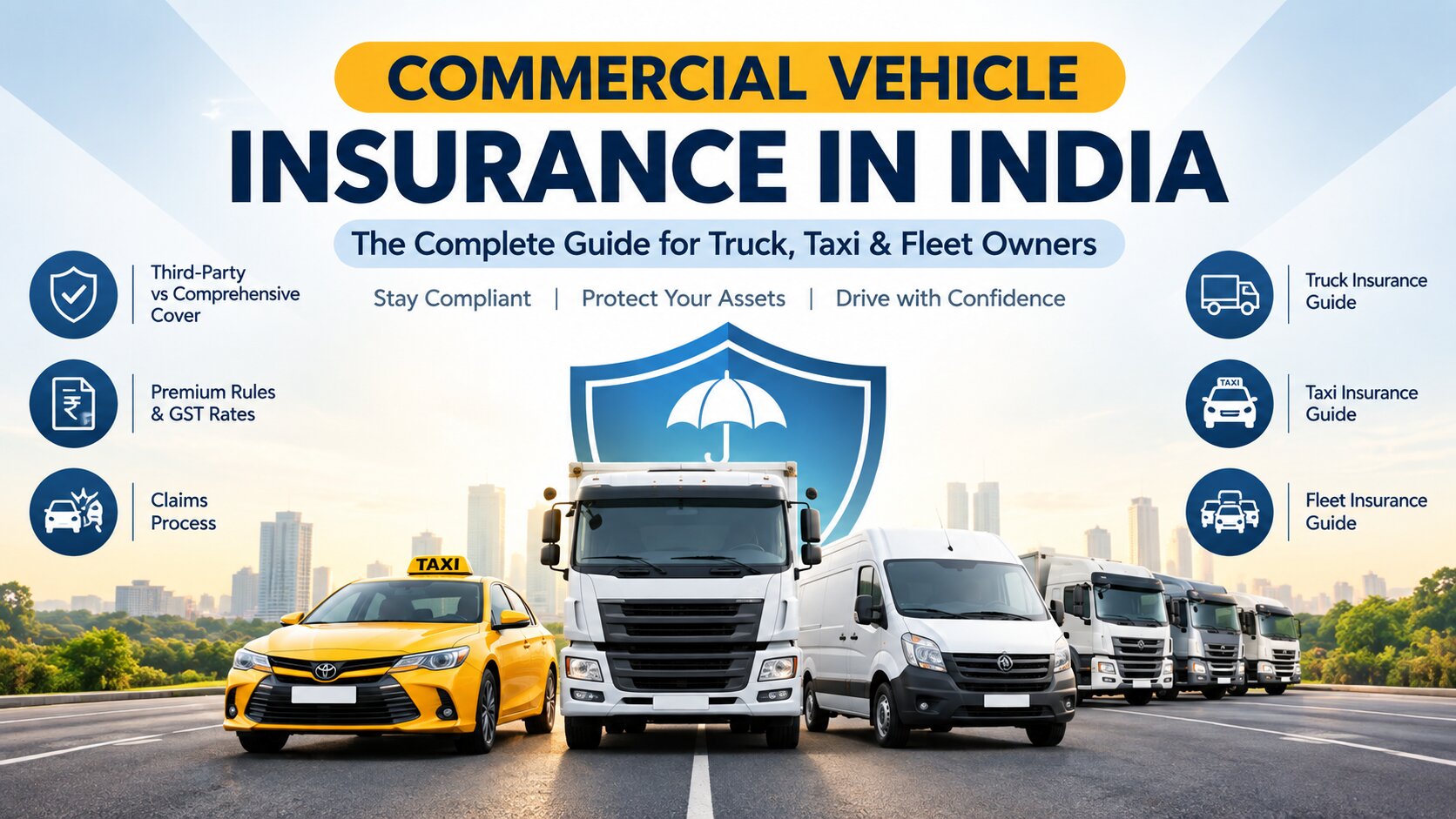
India's roads carry more than passengers and cargo — they carry livelihoods. Whether it is a long-haul truck moving goods across states, a taxi ferrying daily commuters, or a fleet of delivery vans powering e-commerce, commercial vehicles are business assets first and vehicles second. Yet a large number of owners still treat their insurance policy as a compliance formality rather than a financial safety net.
This guide breaks down what commercial vehicle insurance actually covers, what Indian law requires, how premiums are calculated, and how fleet owners can insure smartly — all verified against the Motor Vehicles Act, 1988, IRDAI circulars, and current GST notifications.
Any vehicle registered for trade, business, or hire — not personal use — is classified as a commercial vehicle. This spans a wide spectrum:
❖ Goods-carrying vehicles: trucks, mini-trucks, LCVs, HCVs, trailers, tankers and containers
❖ Passenger-carrying vehicles: taxis and cabs (including aggregator-linked cars), auto-rickshaws, school vans, staff buses and tourist coaches
❖ Miscellaneous & special-purpose vehicles: ambulances, tractors, cranes, excavators and other construction or agricultural machinery used commercially
Because these vehicles spend far more hours on the road, carry third-party risk (goods, passengers, hired drivers), and are central to someone's income, insurers price and structure their cover differently from private car policies.
Section 146 of the Motor Vehicles Act, 1988 makes third-party liability insurance mandatory for every motor vehicle used in a public place in India, commercial vehicles included. Driving without valid third-party cover is a punishable offence.
|
Penalties for Driving Without Valid Insurance • ₹2,000 fine for a first offence • ₹4,000 fine for a subsequent offence • Possible imprisonment of up to three months, in addition to or instead of the fine • Under the Motor Vehicles (Amendment) Act, 2019 framework |
Premium rates for this mandatory third-party cover are not decided freely by insurers. They are notified annually by IRDAI in consultation with the Ministry of Road Transport & Highways (MoRTH), based on claims-ratio data from the Insurance Information Bureau of India. This is why third-party pricing looks similar across insurers for the same vehicle category, while comprehensive/own-damage pricing varies.
Note: Third-party rates for most categories were largely frozen for several years after FY 2019-20. As of 2026, IRDAI and MoRTH are in the process of notifying a fresh revision — commercial and goods vehicles are expected to see one of the steeper increases once the new schedule takes effect. Always check the IRDAI or your insurer's site for the rate applicable on your policy start date.
Every commercial vehicle owner in India effectively chooses between two structures of protection:
|
Aspect |
Third-Party (Liability-Only) |
Comprehensive (Package Policy) |
|
Legal status |
Mandatory under Section 146, MV Act |
Optional, but strongly recommended |
|
Covers |
Injury/death and property damage to third parties |
Third-party liability + own vehicle damage |
|
Own vehicle damage |
Not covered |
Covered (accident, fire, theft, natural calamity) |
|
Premium basis |
Fixed by IRDAI/MoRTH |
Set by insurer, based on IDV, GVW, usage, claims history |
|
Best suited for |
Owners wanting bare legal compliance |
Owners protecting a working business asset |
For a truck or taxi that is the primary source of income, comprehensive cover is usually the financially sound choice — an accident, fire, or theft that isn't covered can halt earnings entirely while repair or replacement costs are borne out of pocket.
Pays for injury, death, or property damage caused to a third party — pedestrians, other vehicles, or public/private property — as a result of an accident involving the insured vehicle. Liability for bodily injury/death is unlimited by law; property damage liability is typically capped (commonly around ₹7.5 lakh under standard policy wording, subject to the specific policy).
Available only under comprehensive/package policies. Covers loss or damage to the insured vehicle itself from accidents, fire, self-ignition, lightning, explosion, burglary, theft, riots, strikes, and natural calamities such as floods, cyclones, and earthquakes.
Following an IRDAI directive, every motor policy — commercial vehicles included — must carry a minimum Personal Accident cover of ₹15 lakh for the owner-driver, for a standard annual premium of ₹750. It pays out on accidental death or permanent total disability while driving, mounting, or alighting from the insured vehicle. This is separate from any cover for third parties or hired drivers.
Commercial vehicles typically employ drivers, cleaners, or conductors. Liability towards these employees for injury or death arising in the course of employment falls under the Employees' Compensation Act, 1923, and is usually added through an endorsement (such as IMT-28) rather than assumed automatically — fleet owners should confirm this is explicitly included.
For goods carriers, standard motor insurance does not automatically cover the value of cargo being transported. A separate Goods-in-Transit or Marine (Inland) cargo policy is needed if the owner or transporter wants protection for the goods themselves against loss or damage in transit.
❖ Roadside assistance — critical for long-haul trucks operating far from base
❖ Engine protection cover — guards against water-logging and lubricant leakage damage
❖ Zero depreciation / bumper-to-bumper (where offered for commercial categories)
❖ Consumables cover and tyre-related add-ons for heavy vehicles
❖ Loss of income / trip cancellation cover for cabs and tourist vehicles (insurer-dependent)
Insured Declared Value (IDV) is the current market value of the vehicle — essentially the maximum amount the insurer will pay in case of total loss or theft. It is calculated from the manufacturer's listed selling price, adjusted for depreciation based on the vehicle's age. Under-declaring IDV to save on premium directly reduces the claim payout; over-declaring inflates the premium without real benefit.
No Claim Bonus (NCB) is a discount on the own-damage premium for each claim-free year, and it is tied to the vehicle/policy rather than the owner. For fleets, tracking claims discipline across drivers matters — a single avoidable claim can reset the accumulated bonus on that vehicle.
A commercial vehicle policy is an annual contract. If it is not renewed on time, it enters a break-in period — and driving during this window is legally the same as driving uninsured, since the mandatory third-party cover under the Motor Vehicles Act is no longer in force.
❖ Most insurers allow renewal within 90 days of expiry to retain accumulated No Claim Bonus; beyond that window, the NCB typically resets to zero
❖ A break-in renewal is usually treated as a fresh proposal rather than a simple renewal, and insurers commonly require a vehicle inspection (physical or self-inspection via app/video) before restoring own-damage cover
❖ There is zero cover during the break — any accident, theft, or third-party liability arising in this window is not payable, and the owner bears the full cost
❖ For a commercial fleet, even one lapsed vehicle can disrupt operations, since an uninsured vehicle cannot legally ply and may also fail permit/fitness renewal checks
The safest practice for truck, taxi, and fleet owners is to set renewal reminders well ahead of the expiry date — commercial vehicles that run daily cannot afford an uninsured gap.
Commercial vehicle premiums are driven by a different set of factors than private car insurance:
❖ Gross Vehicle Weight (GVW) / seating or carrying capacity — heavier or higher-capacity vehicles attract higher third-party slabs
❖ Usage category — goods carriage, passenger carriage (public/private), or miscellaneous/special type
❖ Geographic zone of registration and operation
❖ IDV, vehicle age, and claims/NCB history
❖ Number of vehicles insured together (fleet discounts, where offered)
Following the GST Council's rate rationalisation effective 22 September 2025, GST on motor insurance was restructured:
|
Policy Type |
GST Rate |
Applies To |
|
Third-party cover — goods carriage vehicles |
5% |
Trucks, LCVs, HCVs used for goods transport |
|
Comprehensive / own-damage cover |
18% |
All commercial vehicle categories |
|
Add-on covers |
18% |
Roadside assistance, engine protect, etc. |
Businesses registered under GST that use the vehicle exclusively for business purposes can typically claim Input Tax Credit (ITC) on the GST paid on commercial vehicle insurance, provided the insurance invoice carries the business's GSTIN — this is a meaningful, often-overlooked saving for transporters and fleet operators.
Third-party premiums for goods carriers are structured by Gross Vehicle Weight (GVW)/carrying capacity, not a flat rate. The table below reflects the Ministry of Road Transport & Highways' FY 2023-24 draft base rates (excluding GST) as an illustrative reference — a fresh, higher schedule is expected to be notified for 2026-27, so treat these as directional rather than current.
|
Goods-Carrying Vehicle Category |
Illustrative Base TP Premium (₹/year) |
|
Motorised three-wheelers (goods carriage) |
4,492 |
|
Goods carriers (other than 3-wheelers) up to 7,500 kg GVW |
16,049 |
|
Goods carriers, higher GVW slabs up to 40,000 kg and above |
27,186 – 44,242 |
Figures are base premiums as per MoRTH's FY 2023-24 draft notification, exclusive of GST. Actual premiums vary by insurer add-ons, vehicle age, and the rate schedule in force on your policy's start date.
Most trucks and fleet vehicles in India are purchased on loan, which brings hypothecation into the picture — the lender (bank/NBFC) holds a financial charge over the vehicle until the loan is repaid.
❖ The hypothecation is recorded on both the vehicle's Registration Certificate (RC) and its insurance policy, and must be renewed each year alongside the policy
❖ In a total loss or theft claim, the insurer's payout is first routed to settle the outstanding loan with the financier, with any surplus paid to the owner
❖ Switching insurers mid-loan is possible, but the new insurer will verify and re-record the hypothecation on the policy
❖ Courts have clarified that liability for driving an uninsured vehicle rests with the person in possession and control of it — not automatically with the financing bank
❖ Once the loan is fully repaid, owners should complete hypothecation removal at the RTO (Form 35) and update it with the insurer, or resale and full claim settlement can get complicated later
A commercial vehicle needs more than an insurance certificate to legally ply — insurance is one leg of a three-legged compliance stool that also includes the permit and fitness certificate.
❖ Commercial vehicles require a valid permit (national or state, depending on the route) under the Motor Vehicles Act — carrying goods or passengers without one is a separate offence from being uninsured
❖ Goods and passenger vehicles must clear periodic fitness certification confirming roadworthiness; an expired fitness certificate can complicate or even jeopardise an insurance claim
❖ Insurers and surveyors typically check the RC, permit, fitness certificate, and driving licence category together at the time of a claim — a mismatch in any one document can delay settlement
❖ Practical tip for fleet owners: track insurance, permit, fitness, and PUC renewal dates on one calendar per vehicle rather than relying on memory across a growing fleet
Cabs onboarded onto ride-hailing platforms are commercial vehicles in the eyes of the law and must carry commercial insurance, not private car insurance — a private policy can lead to claim repudiation if the vehicle is found to be earning fares.
❖ Under the Motor Vehicles Aggregator Guidelines, vehicles listed with an aggregator must have valid registration, a permit to ply, and commercial third-party insurance
❖ Aggregators are separately required to provide driver-linked health and term life insurance, which is distinct from the vehicle's own motor policy
❖ Owner-drivers who use a personal car for aggregator rides without converting to a commercial policy and permit risk both regulatory penalties and claim denial
The explosive growth of food and quick-commerce delivery has created a category that regulation is still catching up with: riders using personal (privately registered, white-plate) two-wheelers for paid delivery work.
❖ Strictly, using a personally registered two-wheeler for commercial purposes (fare or delivery income) is not the intended use under a private motor policy, and insurers can question or reject a claim on grounds of commercial use if this comes to light
❖ A vehicle used purely commercially is expected to carry a commercial registration (black-on-yellow plate) and corresponding commercial insurance
❖ Riders relying solely on their personal two-wheeler insurance for delivery work should treat this as a real coverage gap, not a technicality — it directly affects whether an accident claim gets paid
❖ Some insurers have begun exploring dedicated commercial-use two-wheeler covers for delivery riders; it is worth asking your insurer directly whether your current policy recognises delivery/gig work
Owners running more than a handful of commercial vehicles can typically consolidate them under a single fleet policy rather than managing separate policies for each vehicle. The practical benefits include:
❖ One renewal date and one consolidated premium payment across the fleet
❖ Simplified documentation and a single point of contact for claims
❖ Potential volume-based pricing benefits, negotiated with the insurer based on fleet size and claims history
❖ Easier tracking of NCB, IDV, and add-ons across vehicles from one dashboard
Fleet operators should still review each vehicle's IDV and usage category individually — a one-size premium approach across dissimilar vehicles (say, tankers and tempos) can under- or over-insure specific units.
❖ Ensure driver and vehicle safety first, then inform the police where required (mandatory for third-party injury, death, or significant property damage) and obtain an FIR/panchnama copy
❖ Notify your insurer or their 24x7 claims helpline as soon as possible — most policies specify a reporting window
❖ Avoid moving or repairing the vehicle before the surveyor's inspection, except where safety requires it
❖ Keep the RC, driving licence, permit, fitness certificate and insurance copy ready — commercial vehicles need valid permits and fitness certificates for a claim to proceed smoothly
❖ For cashless repairs, use the insurer's network garage; for reimbursement claims, retain original bills and payment receipts
❖ For goods-carriage claims involving cargo damage, keep consignment notes (LR/GR) and delivery challans, as these are typically required to process any linked goods-in-transit claim
Fleet owners are not without recourse if a claim is delayed, underpaid, or rejected unfairly. IRDAI mandates a structured escalation path for every policyholder:
❖ Step 1 — Insurer's Grievance Redressal Officer (GRO): Every insurer must have a GRO whose contact details appear on policy documents; they are required to respond within 15 days
❖ Step 2 — Bima Bharosa portal: IRDAI's centralised online grievance platform (successor to the earlier IGMS) at bimabharosa.irdai.gov.in lets you register and track a complaint if the insurer's response is unsatisfactory or delayed
❖ IRDAI's toll-free helpline (155255 / 1800-4254-732) and email (complaints@irdai.gov.in) are also available for registering grievances
❖ Step 3 — Insurance Ombudsman: If still unresolved, policyholders can approach the Insurance Ombudsman for their region — an independent, cost-free forum set up under the government's Ombudsman scheme — or pursue the matter through a civil court or consumer forum
Keeping every document — the policy copy, claim correspondence, survey report, and GRO acknowledgment — organised from day one makes this escalation path far faster to use if it's ever needed.
|
Watch Out For These • Letting the policy lapse between renewals — even a short gap voids continuity benefits like NCB • Declaring a lower carrying capacity or vehicle usage than actual, which can lead to claim repudiation • Assuming cargo value is automatically insured — it usually is not, without a separate goods-in-transit policy • Skipping legal liability cover for paid drivers/cleaners, exposing the owner to compensation claims under employee-compensation law • Renewing permits, fitness certificates, and pollution certificates out of sync with the insurance policy • Choosing the cheapest premium without checking claim settlement track record and network garage spread |
❖ GST on third-party goods-carriage insurance reduced from 12% to 5% effective 22 September 2025, following the 56th GST Council meeting, while comprehensive cover continues at 18%
❖ IRDAI and MoRTH are finalising a revision of third-party premium rates — after being largely frozen since FY 2019-20 — with commercial and goods vehicles expected to see some of the sharper increases once notified
❖ Long-frozen third-party slabs mean many fleet owners have been under-budgeting for insurance; reviewing renewal costs against the latest notified rates each year is now essential
Commercial vehicle insurance is not a paperwork formality — it is the financial shock absorber for a business asset that works every single day. Understanding the difference between third-party and comprehensive cover, keeping personal accident and employee liability protections in place, tracking GST and ITC benefits, and reviewing fleet policies regularly can be the difference between a manageable setback and a business-ending loss. When in doubt, read the policy wording, ask the insurer direct questions, and choose informed protection over blind compliance.
Disclaimer: This article is for general awareness only and is not financial, legal, or insurance advice. Premium figures, GST rates, and regulatory provisions are accurate as of the sources cited and are subject to periodic revision by IRDAI, MoRTH, and the GST Council. Always verify current rates and policy wording directly with IRDAI (irdai.gov.in) or your insurer before making a decision.
Get the latest articles delivered to your inbox