
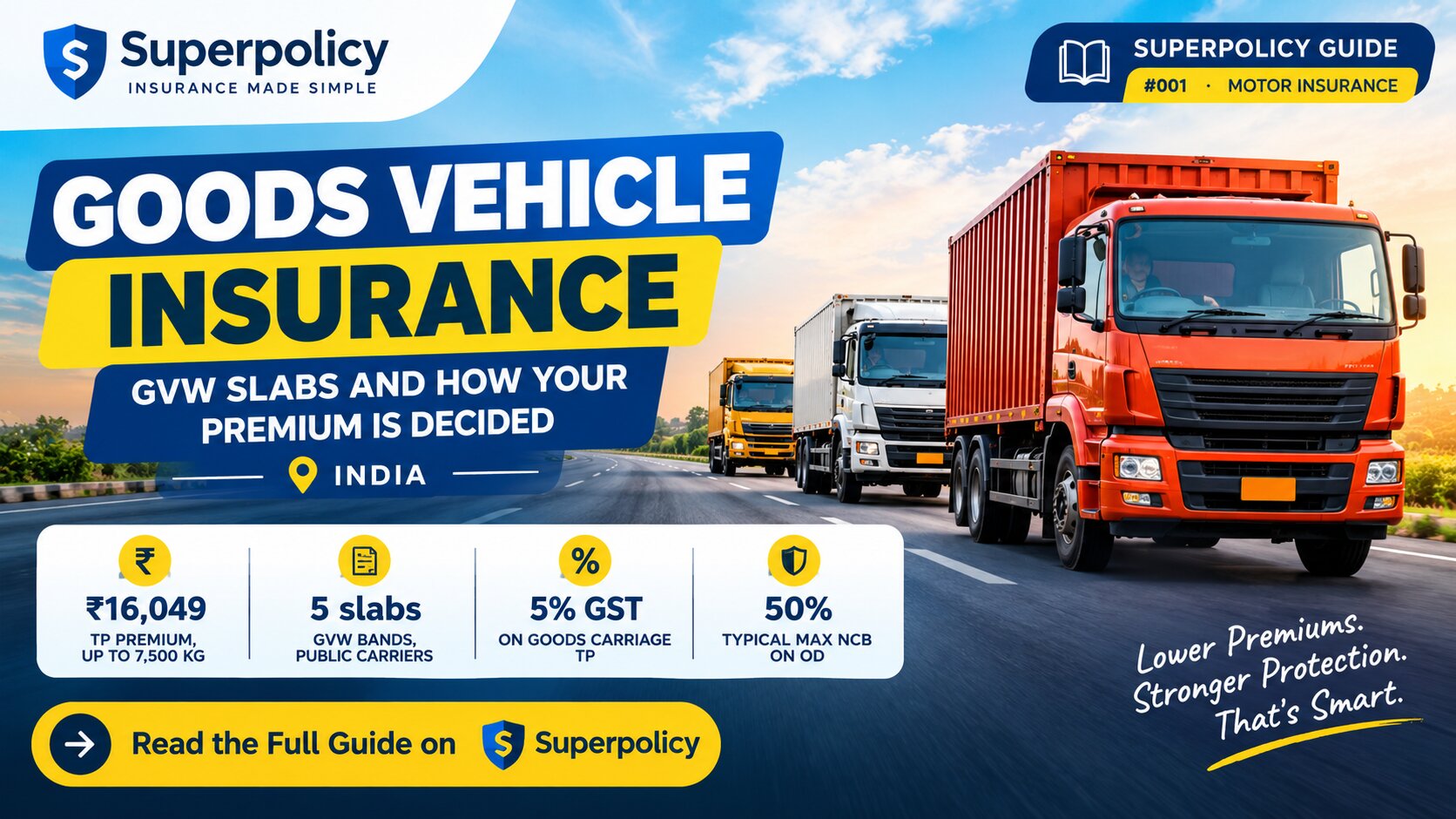
GOODS VEHICLE INSURANCE : GVW SLABS AND HOW YOUR PREMIUM IS DECIDED · INDIA
Super Policy Team •October 27, 2026 | 14 min read • 16 views
Super Policy Team •October 27, 2026 | 14 min read • 16 views
|
₹16,049 TP PREMIUM, UP TO 7,500 KG |
5 slabs GVW BANDS, PUBLIC CARRIERS |
5% GST ON GOODS CARRIAGE TP |
50% TYPICAL MAX NCB ON OD |
How GVW Shapes Your Bill
Two trucks roll out of the same showroom on the same day, painted the same colour and registered in the same city. A year later, one owner pays far more at renewal. Which of them is being overcharged? Usually, neither. The difference comes from a few variables most transporters never examine, and the most powerful is the Gross Vehicle Weight (GVW) printed on the Registration Certificate.
For anyone running lorries, mini-trucks, tippers, tankers or container carriers, goods carrying vehicle (GCV) insurance is both a legal obligation and a business shield. One serious accident can bring a claim running into lakhs, and a truck off the road earns nothing. This guide explains the GVW slabs, the government-notified third-party rates, the factors insurers weigh while pricing own damage cover, and practical ways to keep costs sensible without weakening protection.
AT A GLANCE
– Third-party (TP) cover is compulsory under the Motor Vehicles Act, 1988. Its premium is fixed by the Central Government, so every insurer charges the same base rate.
– For public goods carriers, TP premium climbs with the GVW slab, from ₹16,049 (up to 7,500 kg) to ₹44,242 (above 40,000 kg) a year, before GST.
– Own damage (OD) premium is set by each insurer using IDV, vehicle age, location, usage, claim history and more.
– GST: 5% on third-party insurance of goods carriages (since 22 September 2025); 18% on the own damage portion.
– A revision of TP rates has been discussed for FY 2026-27. Always confirm the rate in force on the day you buy.
Goods carrying vehicle insurance is a motor policy for vehicles that transport cargo, from three-wheeler cargo carriers and pick-ups to multi-axle trailers. It protects the owner against financial loss from accidents, theft, fire, natural calamities and, most importantly, legal liability towards people injured or property damaged by the vehicle.
PUBLIC CARRIERS AND PRIVATE CARRIERS
Indian rules classify goods vehicles by how they are used, and this single classification changes the premium noticeably.
|
CATEGORY |
WHAT IT MEANS |
|
Public carrier |
Carries goods for hire or reward, for example a transporter's truck moving customers' consignments. It runs on a goods carriage permit and attracts the higher TP rates. |
|
Private carrier |
Carries only the owner's own goods in the course of the owner's business, such as a manufacturer's delivery truck. TP rates are lower than for public carriers. |
THREE TYPES OF POLICY
|
POLICY TYPE |
WHAT YOU GET |
|
Liability-only |
Covers legal liability for death or injury to third parties and damage to their property, plus the mandatory owner-driver personal accident cover. Your own truck is not covered. |
|
Package |
Third-party liability plus own damage cover for accident, fire, theft, flood, earthquake, riot and similar perils. Common for financed and fleet vehicles. |
|
Standalone own damage |
Covers only damage to your vehicle. Available if you already hold a valid long-term TP policy. |
WHY IT IS NOT OPTIONAL
Section 146 of the Motor Vehicles Act, 1988 prohibits using a vehicle in a public place without at least a valid third-party policy. Driving uninsured can attract a fine of ₹2,000 and/or imprisonment of up to three months for a first offence, and ₹4,000 and/or imprisonment for a repeat offence. The larger risk is financial: if an uninsured truck causes a fatal accident, the compensation awarded by the Motor Accident Claims Tribunal can fall entirely on the owner.
Gross Vehicle Weight (GVW) is the maximum total weight at which the manufacturer permits the vehicle to be operated on the road. It combines the weight of the empty vehicle (chassis, cab, body and fuel), the driver and crew, and the maximum payload. You will find it on your Registration Certificate and the manufacturer's plate.
GVW IS NOT THE LOAD YOU CARRY
– Unladen weight (ULW): weight of the empty vehicle.
– Payload: roughly GVW minus ULW, the cargo the vehicle may legally carry.
– GVW: ULW plus payload. This, not the tonnage of a particular trip, places your truck in a premium slab.
Under the Motor Vehicles Act, goods vehicles are broadly grouped as light (GVW up to 7,500 kg), medium and heavy (GVW above 12,000 kg). Insurers use finer slabs, because a bigger, heavier truck carries more momentum, travels longer distances and causes more severe third-party losses when things go wrong.
Practical tip: if you modify the body, add an axle or have the GVW revised by the transport authority, get it endorsed on your RC and inform your insurer. A mismatch between the policy and the RC can become a ground for dispute at claim time.
The third-party premium is not decided by the insurer. It is notified by the Ministry of Road Transport and Highways (MoRTH) in consultation with the insurance regulator, IRDAI, and applies uniformly to all general insurers. The rates currently in force for goods vehicles were last revised with effect from 1 June 2022.
PUBLIC CARRIERS, OTHER THAN THREE-WHEELERS
|
GVW SLAB |
INDICATIVE VEHICLE TYPES |
ANNUAL TP PREMIUM (₹) |
|
Up to 7,500 kg |
Mini trucks, pick-ups, small LCVs, light tippers |
16,049 |
|
7,501 to 12,000 kg |
Medium-duty trucks, intermediate commercial vehicles |
27,186 |
|
12,001 to 20,000 kg |
Heavy rigid trucks, tippers, container carriers |
35,313 |
|
20,001 to 40,000 kg |
Multi-axle rigid trucks, mid-size tractor-trailers |
43,950 |
|
Above 40,000 kg |
Heavy articulated vehicles, high-capacity trailers |
44,242 |
Rates are per year, before GST. Vehicle types are indicative; the slab is always determined by the GVW stated on the RC.
OTHER GOODS VEHICLE CATEGORIES
|
CATEGORY |
ANNUAL TP PREMIUM (₹) |
|
Private carrier (other than three-wheeler), GVW up to 7,500 kg |
8,510 |
|
Goods carrying three-wheeler, public carrier (excluding e-carts) |
4,492 |
|
Goods carrying three-wheeler, private carrier (excluding e-carts) |
3,922 |
Private carriers in higher GVW slabs, trailers and e-carts have their own notified rates. A 15% discount on the TP premium is available for electric goods carrying vehicles, which makes the shift to electric fleets more attractive over a vehicle's life.
RATE REVISION: WHAT TRANSPORTERS SHOULD KNOW
Insurers have been seeking an upward revision of third-party rates, and industry reports have discussed an increase for FY 2026-27, with commercial vehicles likely to see a steeper change. At the time of writing, no revised schedule had been gazetted. Until a notification with an effective date is issued, the existing rates apply. A revision applies to policies issued from the effective date and does not alter policies already in force.
A goods vehicle policy is built in layers. Think of it as a simple equation:
TOTAL PREMIUM = [ TP + OD + ADD-ONS − DISCOUNTS ] + GST
LAYER 1: THE THIRD-PARTY COMPONENT
The fixed layer, determined entirely by vehicle category and GVW slab. It funds legal liability cover: unlimited liability for death or bodily injury to third parties, and third-party property damage up to the legal limit. A mandatory personal accident cover for the owner-driver is part of the package for eligible owners. Optional covers, such as legal liability to paid drivers and cleaners, are priced separately.
LAYER 2: THE OWN DAMAGE COMPONENT
A market-priced layer. Each insurer applies its own rating to the vehicle's Insured Declared Value (IDV), then adjusts it for risk. The table shows what typically moves the number.
|
FACTOR |
HOW IT INFLUENCES THE PREMIUM |
|
GVW slab and vehicle class |
Heavier trucks usually carry higher OD rates because repair costs and accident severity rise with size. |
|
IDV |
OD premium is a percentage of IDV, so a higher IDV means a higher premium, but also a fairer payout after theft or total loss. |
|
Age of the vehicle |
Older trucks may attract loadings, while IDV falls with each year, reducing the base on which premium is charged. |
|
Zone and operating area |
Metros and high-traffic corridors with higher theft and accident frequency are rated higher. Permit area (local, state or national) also matters. |
|
Make, model and body type |
Tippers, tankers, container carriers and refrigerated bodies differ in repair cost and risk profile. |
|
Nature of goods carried |
Hazardous, high-value or easily pilfered cargo can lead to higher pricing or special conditions. |
|
Claims history and NCB |
A claim-free record earns a discount on OD premium; frequent claims push pricing up at renewal. |
|
Voluntary deductible |
Agreeing to bear a larger share of every claim earns a premium discount. |
|
Add-ons chosen |
Each extra cover, such as zero depreciation or roadside assistance, adds to the cost. |
|
Fleet size and risk management |
Large fleets with trained drivers, GPS tracking and a good loss ratio can negotiate better terms. |
UNDERSTANDING IDV AND DEPRECIATION
IDV is, in simple terms, the vehicle's market value when you buy or renew: the manufacturer's listed selling price less depreciation. For vehicles up to five years old, the standard schedule is:
|
AGE OF VEHICLE |
DEPRECIATION ON LISTED PRICE |
|
Up to 6 months |
5% |
|
6 months to 1 year |
10% |
|
1 to 2 years |
15% |
|
2 to 3 years |
25% |
|
3 to 4 years |
35% |
|
4 to 5 years |
45% |
For older vehicles, IDV is generally agreed between owner and insurer, based on condition and market value. Setting IDV too low to save premium is a false economy, since it directly caps what you receive after a total loss or theft.
NO CLAIM BONUS (NCB)
If you complete a policy year without a claim, you earn a discount on the own damage premium at the next renewal. It typically starts at 20% and can build up to 50% after several consecutive claim-free years. NCB applies only to the OD portion, never to the third-party premium, and is generally lost if the policy lapses for a prolonged period. An NCB protection add-on can safeguard your accumulated discount against a single claim.
Consider a hypothetical public goods carrier: a three-year-old truck with a GVW of 16,000 kg, an IDV of ₹14 lakh and a 25% NCB. The OD figure is an assumed value used only to show the mechanics; actual OD premiums vary by insurer.
|
COMPONENT |
AMOUNT (₹) |
|
TP premium (12,001 to 20,000 kg slab) |
35,313.00 |
|
Own damage premium before discount (assumed) |
38,000.00 |
|
Less: NCB at 25% of OD |
− 9,500.00 |
|
Net own damage premium |
28,500.00 |
|
Premium before GST |
63,813.00 |
|
GST at 5% on TP premium |
1,765.65 |
|
GST at 18% on net OD premium |
5,130.00 |
|
Total payable (approx.) |
70,708.65 |
Figures exclude optional add-ons and any owner-driver personal accident premium. More than half of the pre-GST amount is the fixed TP premium, which is why moving up a GVW slab changes cost so sharply, and why shopping around mainly helps on the own damage side.
A standard package policy leaves some gaps. Depending on your vehicle's age and routes, these add-ons are commonly offered:
|
ADD-ON |
WHAT IT DOES |
|
Zero depreciation |
Claims are settled without deducting depreciation on replaced parts, usually available for younger vehicles. |
|
Engine and gearbox protection |
Covers repair costs from water ingression or oil leakage, which standard policies often exclude. |
|
Tyre protection |
Useful for vehicles covering long distances on varied road conditions. |
|
Roadside assistance |
Towing and on-spot help that limits expensive downtime. |
|
NCB protection |
Retains your discount even after a claim. |
|
Legal liability, driver and cleaner |
Covers the owner's liability under employee compensation law. |
A motor policy covers the vehicle, not the cargo. Goods in transit need a separate marine cargo or goods-in-transit policy.
CURIOUS WHAT YOUR TRUCK WOULD COST TO INSURE?
Keep your RC, previous policy and permit handy and explore goods vehicle insurance options through Superpolicy. We can walk you through GVW slab, IDV and add-on choices before you decide.
You cannot negotiate the third-party rate, but you have real influence over the rest of the bill.
– Declare the correct GVW and usage. Accuracy protects both your premium and your claim.
– Compare before you renew. OD pricing differs between insurers, so compare quotes with identical IDV and add-ons.
– Protect your NCB. Consider paying minor repairs yourself rather than claiming, especially when the repair cost is close to the deductible.
– Opt for a sensible voluntary deductible if your cash flow can handle small repairs.
– Renew before expiry. A lapse can mean a vehicle inspection, loss of NCB and an uninsured period during which you carry all the risk.
– Invest in risk management. Driver training, GPS tracking and regular maintenance reduce claims and strengthen your hand in fleet negotiations.
– Consider a fleet policy if you operate several vehicles; it simplifies administration and can improve pricing.
A policy only helps if the claim is honoured. These are the issues that most often cause trouble for goods vehicle owners:
|
ISSUE |
WHY IT MATTERS |
|
Overloading |
Carrying cargo beyond the permitted GVW or axle limit breaches the permit and policy conditions and can affect own damage claims. |
|
Invalid permit, fitness or RC |
A goods vehicle must hold valid documents at the time of the accident. |
|
Driver without a valid licence |
The driver needs a licence of the correct class, with transport or heavy goods vehicle authorisation where applicable. |
|
Wrong use or declaration |
Using a private carrier to carry goods for hire, or misstating GVW or routes, can lead to repudiation. |
|
Delayed intimation |
Late reporting of an accident or theft makes verification difficult and gives the insurer grounds to question the claim. |
|
Lapsed policy |
Any loss during a break in cover is not payable. |
One reassurance: even where a policy condition is breached, the insurer is generally required to pay a genuine third-party victim, and may then recover the amount from the owner. That is a strong reason to keep every document in order.
KEEP THESE READY
– Registration Certificate (RC) showing GVW, make, model and registration date
– Valid goods carriage permit and fitness certificate
– Previous policy details and NCB information, for renewals
– Driver's licence and a valid Pollution Under Control certificate
– Owner's KYC documents such as PAN and address proof
FIVE STEPS TO INSURE OR RENEW
1 Share vehicle details: registration number, GVW, body type, usage and permit area.
2 Choose your cover and decide your IDV.
3 Select add-ons and deductible to match your routes and budget.
4 Compare quotes on premium, claim service, network garages and settlement record.
5 Pay and receive the policy by email; keep a digital copy accessible to your driver.
Is the premium based on GVW or the load I actually carry?
It is based on the GVW stated on the RC, not the tonnage of any particular trip.
Do all insurers charge the same third-party premium?
Yes. The TP premium is notified by the government and is identical across insurers. Quotes differ because of the own damage portion, add-ons and discounts.
Can I buy only third-party insurance for my truck?
Yes, it is the legal minimum. But it leaves your own vehicle unprotected, so a package policy is wiser for most owners, especially for financed vehicles.
What GST applies to goods vehicle insurance?
Third-party insurance of goods carriages attracts 5% GST from 22 September 2025. The own damage portion and add-ons are taxed at 18%.
Does insurance cover the goods inside my truck?
No. Cargo needs a separate marine cargo or goods-in-transit policy.
Will a TP rate revision affect my existing policy?
No. A policy continues on the premium at which it was issued. New rates apply to policies issued or renewed from the effective date of the notification.
Goods vehicle insurance premiums are not mysterious once you see the structure. The GVW slab sets a fixed, government-notified third-party floor, while the own damage layer reflects your vehicle's value, age, location, usage and claim record. Declare details correctly, choose your IDV and add-ons deliberately, protect your NCB and renew on time, and you will pay a fair price for cover that actually performs when you need it.
READY WHEN YOU ARE
Get the right cover for your truck, without the guesswork
Share your vehicle details and let our experts help you choose the right GVW-based cover, IDV and add-ons for your fleet.
REQUEST YOUR QUOTE AT SUPERPOLICY
Get the latest articles delivered to your inbox