India's Insurance Shake-Up: Inside IRDAI's Plan to Rewire How Policies Are Sold
Super Policy Team •September 26, 2026 | 8 min read • 6 views
Super Policy Team •September 26, 2026 | 8 min read • 6 views
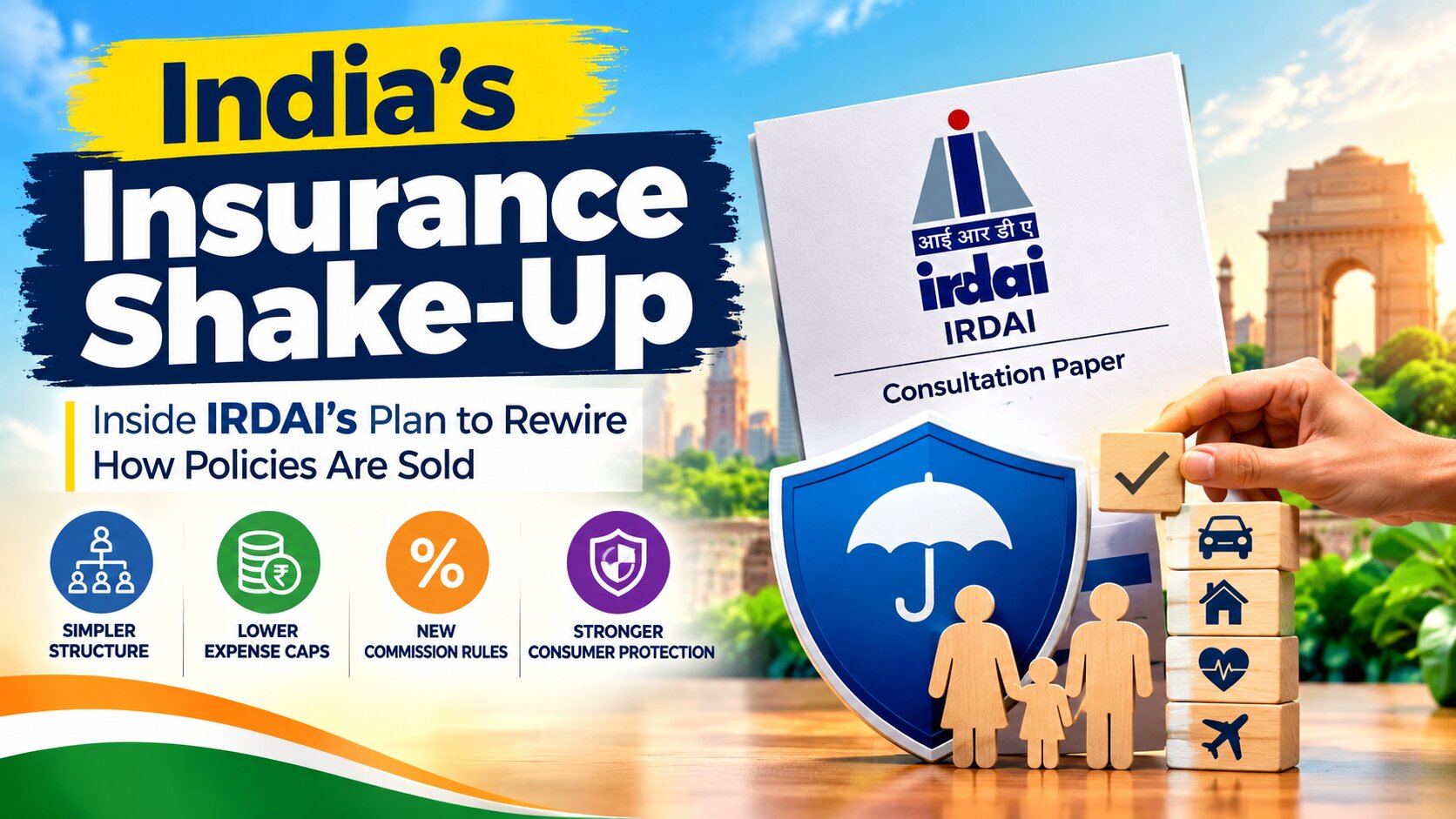
On September 23, 2026, the Insurance Regulatory and Development Authority of India (IRDAI) dropped one of the most consequential papers the sector has seen in years: a consultation document titled “Recalibrating Economics of Insurance Distribution.” In plain English — the regulator wants to rebuild, from the ground up, how insurance reaches Indian households, and how everyone in that chain gets paid for selling it.
This isn't a minor tweak. It touches the structure of distribution itself, the commissions agents and brokers earn, how much insurers can spend to acquire business, and the safeguards meant to stop policyholders from being sold products they don't need. IRDAI has invited comments from insurers, intermediaries and the public, with the window closing on October 25, 2026. Nothing is final yet — but the direction of travel is unmistakable.
1. A simpler three-tier distribution architecture
Today's distribution landscape is a maze of agents, brokers, corporate agents, web aggregators, point-of-sale persons and bank channels, each governed by its own rulebook. IRDAI wants to collapse this into three clean categories:
● Insurance Distribution Entities (IDEs) — organisations that distribute insurance
● Insurance Distribution Persons (IDPs) — individuals who sell insurance
● Market Infrastructure Institutions (MIIs) — the digital and institutional backbone of distribution
The guiding principle, in the regulator's own words, is “same structure, same functions, same norms” — meaning two entities doing the same job should face the same rules, regardless of what they're called. IRDAI also wants simpler registration and significantly lower entry and capital requirements, making it easier for new players to enter distribution.
2. Tighter Expense of Management (EoM) limits
This is the number that will keep CFOs up at night. EoM caps the total share of premium an insurer can spend on running its business, including commissions. IRDAI's proposed glide path:
● Life insurers: EoM to fall to roughly 15% of Gross Direct Premium Income (GDPI) within two years, and 12.5% within five years. Insurers already running leaner than this benchmark would be pushed down to around 10% within five years.
● General insurers: A phased reduction over the same five-year glide path, moving the calculation base from Gross Written Premium (GWP) to GDPI, which excludes reinsurance inflows, with FY2027-28 treated as Year One.
IRDAI has also proposed mandatory, independent cost audits of insurers to keep this honest.
3. A commission overhaul, not just a commission cut
Rather than one flat commission rule for everyone, IRDAI wants payouts calibrated by insurance segment, line of business, distribution channel, product complexity, and — notably — the actual effort involved in selling and servicing a policy. There's also a sweetener: higher rewards for distributors who sell in underserved rural areas and smaller towns, an attempt to widen insurance penetration rather than just concentrate it in metros.
Crucially, the definition of “commission” itself is being widened to capture indirect and disguised remuneration — marketing support, IT reimbursements, and similar payments that have historically sat outside formal commission caps.
4. A direct hit on bancassurance incentive structures
Banks and NBFCs, which distribute a huge share of India's insurance through their branch networks, face some of the sharpest changes. IRDAI wants to prohibit volume-linked or reward-linked incentives for the bank and NBFC staff who sell insurance across the counter — the sales targets and bonus structures long blamed for aggressive, sometimes unsuitable, selling. Loan-linked insurance bundling is also squarely in the crosshairs.
5. Real accountability against mis-selling — and a ban on “dark patterns”
Perhaps the most consumer-facing change: every policy would carry the identity of the individual who sold it. IRDAI wants mis-selling incidents placed in the public domain, commission claw-backs when mis-selling is established, and a documented record of the “needs and suitability” assessment behind every sale. The paper also explicitly targets “dark patterns” — manipulative sales-interface and disclosure tactics used to nudge customers into products or add-ons they didn't really ask for. Insurers and large distributors would also have to publish their commission policies in plain, accessible language — no more burying payout structures in fine print.
6. More room to operate, not just less room to earn
It isn't all tightening. Alongside the cost caps, IRDAI proposes lower regulatory fees and greater flexibility for distribution entities to combine insurance selling with other financial and non-financial activities — potentially opening new income streams for distributors in smaller markets, where insurance alone often doesn't cover the cost of a dedicated outlet.
7. A digital backbone: Bima Sugam and the Public Insurance Registry
The Market Infrastructure Institutions (MII) category isn't just a label — it's meant to formalise “pull-based” digital distribution, where customers initiate purchases themselves rather than relying entirely on commissioned sellers. IRDAI is building this around two platforms: Bima Sugam, the proposed unified insurance marketplace, and the Public Insurance Registry (PIR), meant to support policy comparison, portability and transparent administration across insurers. Together, these are the infrastructure IRDAI is counting on to make lower-cost, direct distribution actually viable at scale.
The numbers explain the urgency. Gross commission payouts across India's insurance industry crossed ₹1 lakh crore in FY25, and the commission expense ratio for non-life insurers climbed from 6.21% to 6.86% in a single year. For years, insurers selling largely similar products have competed for distributor shelf space by raising payouts rather than lowering prices — a dynamic paid for, indirectly, by policyholders. A January 2026 amendment to the Insurance Act gave IRDAI, for the first time, the explicit legal power to prescribe commission ceilings — and this consultation paper is the regulator putting that power to use.
|
IN THE REGULATOR'S OWN WORDS “The proposed reduction in EoM is intended to lower the overall cost of insurance, thereby expanding the risk pool available in general insurance and enhancing returns to policyholders in life savings products,” IRDAI stated in the consultation paper. |
Here's how the proposed reforms are likely to play out for each stakeholder — in the immediate term, and over the next few years:
|
Stakeholder |
Short Run |
Long Run |
|
Brokers & Intermediaries |
Margin compression, especially for commission-heavy bancassurance, NBFC and aggregator channels; smaller agents may consolidate or exit. |
Shift from volume-driven selling to effort- and renewal-quality-driven advisory models; lower entry barriers may invite new tech-first distributors. |
|
Insurance Companies |
Rework board-approved commission policies, rebuild EoM budgets, invest in compliance and seller-ID/disclosure infrastructure. |
Leaner cost structures improve underwriting economics; early movers on digital distribution gain a durable cost advantage. |
|
Policyholders |
Little immediate change — rules are still in consultation; awareness of commission and seller identity begins to rise. |
Need-based selling, public mis-selling data, claw-backs and potentially more competitive pricing as distribution costs fall; better access in underserved areas. |
For Insurance Brokers and Intermediaries — Market nervousness turned into a rout within a day of the paper's release: PB Fintech (Policybazaar) shares crashed as much as 36%, wiping out over ₹31,000 crore in market capitalisation in its worst single-day fall on record, while Turtlemint Fintech Solutions dropped 20%. Brokerage Bernstein flagged that the proposed commission cuts were “far more severe than expected,” with PB Fintech seen as the most exposed. Analysts describe the shift as a structural reset — moving the industry toward an effort-aligned payout framework that rewards productivity and renewal quality over pure acquisition volume.
For Insurance Companies — Expect a scramble to redesign commission structures, tighten EoM budgets and build the compliance rails — seller-ID tagging, public disclosure portals, cost-audit readiness — well before any final regulation bites. Companies overly dependent on high-commission channels for growth may see short-term pressure on new business, but a leaner cost base should pay off over time.
For Policyholders and Consumers — This is where the long-term upside is clearest. Named, accountable sellers; public mis-selling data; documented suitability checks; and plain-language disclosures together push the industry from push-selling toward need-based selling — with the potential for more competitive pricing and wider access as distribution costs come down.
This is a consultation paper, not law. IRDAI will collect feedback until October 25, 2026, before deciding how — and in what final form — these rules take shape. Expect intense lobbying from banks, NBFCs, brokers and insurers in the coming weeks, since the numbers on the table directly rewrite who earns what in a distribution economy worth well over ₹1 lakh crore a year. But the regulator's intent is unambiguous: cheaper distribution, greater transparency, and an insurance market that finally competes on price and trust rather than payout size.
|
BOTTOM LINE Whichever way the final rules land, one thing is certain — the economics of selling insurance in India are about to be rewritten. |
Get the latest articles delivered to your inbox