
ONE POLICY TO RULE THEM ALL. Fleet Insurance vs. Insuring Vehicles One by One
Super Policy Team •October 3, 2026 | 9 min read • 7 views
Super Policy Team •October 3, 2026 | 9 min read • 7 views
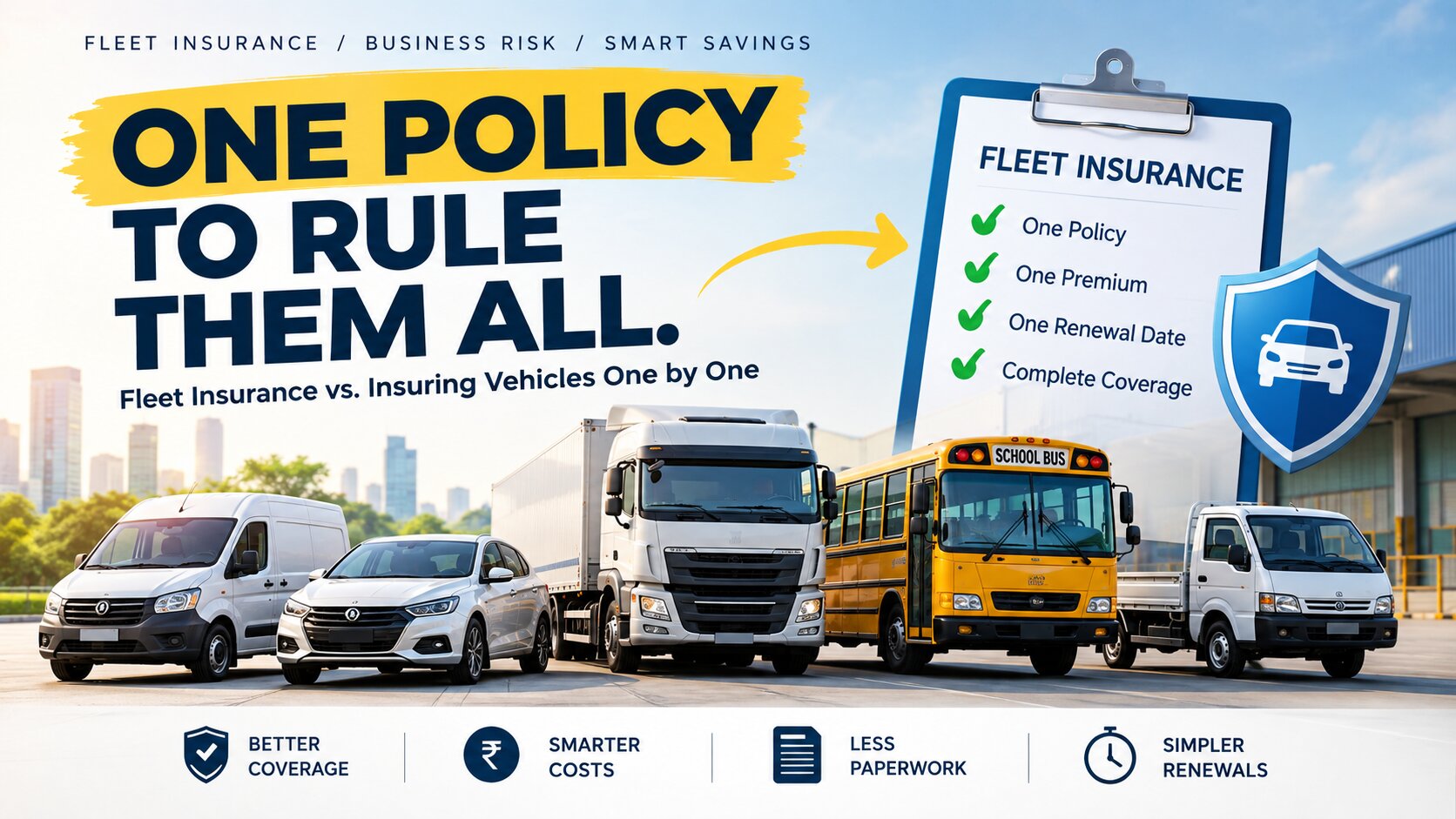
Why juggling twenty renewal dates is a hobby no business owner asked for.
READ About 9 minutes
Picture this. It is the last week of the month, and you are staring at a spreadsheet with fifteen vehicles, fifteen policy numbers, and fifteen renewal dates that refuse to line up. One van lapsed on Tuesday. A truck is due on Friday. Nobody is quite sure whether the pickup is covered for goods in transit.
If that sounds familiar, you are not running a business. You are running an insurance help desk. Fleet insurance exists to end that circus.
“Insurance should protect your business, not become a second job.”
▸ ▸ ▸
01
Fleet insurance is a single motor insurance policy that covers multiple vehicles owned or operated by one business. Instead of buying a separate policy for every car, van, truck, bus, or two-wheeler, you bring them all under one umbrella with one insurer, one premium, and usually one renewal date.
Insurers typically define a fleet as a minimum number of vehicles, often somewhere between two and five. The exact threshold varies by insurer and country, so always check before you assume you qualify.
In most countries, at least third-party liability insurance is compulsory for every vehicle on a public road. In India, for example, this is required under the Motor Vehicles Act. A fleet policy does not remove that obligation. It simply packages it, along with any extra cover you choose, in a far more manageable way.
▸ ▸ ▸
02
On paper, both options protect a vehicle against accidents, theft, and third-party liability. The difference shows up in how the cover is managed, priced, and used. Here is the breakdown.
With individual insurance, each vehicle has its own policy, its own documents, and its own expiry date. With fleet insurance, there is one master policy with a schedule listing every vehicle. Fewer documents, fewer errors, and far fewer panicked phone calls in renewal week.
Individual premiums are calculated vehicle by vehicle. Fleet premiums are calculated for the business as a whole. Insurers often offer volume-based discounts because they are writing a larger, more predictable block of business, and a strong fleet-wide claims record can reduce your premium further over time.
Treat any discount figure you see advertised as a guide, not a promise. Actual savings depend on vehicle types, usage, driver profiles, location, and claims history.
An individual policy looks at one car and one owner. A fleet policy looks at the whole operation: how many vehicles, how they are used, who drives them, how routes are planned, and what safety practices are in place. That rewards businesses that train drivers and manage risk well.
Businesses grow, shrink, and swap vehicles all the time. Fleet policies are built for this. You can usually add or remove vehicles mid-term through an endorsement, with the premium adjusted proportionally. Doing the same with separate policies means fresh paperwork every single time.
Many insurers assign a dedicated relationship manager or claims contact to fleet customers. Instead of explaining your situation to a new person after every incident, you deal with a team that already knows your business, your vehicles, and your history.
Individual policies are usually tied to a named owner. Fleet policies can often be written to cover any authorised driver, which suits businesses where vehicles pass between employees. Terms differ, so confirm exactly who is covered and under what conditions.
▸ ▸ ▸
03
Meet two delivery companies. Each runs eight vans, and each has the same drivers, routes, and ambition.
Company A insures every van separately. Eight policies, eight renewal dates, and a part-time employee whose entire job is chasing paperwork. When a new van joins mid-year, a fresh policy is bought from scratch. When a van lapses unnoticed, a minor accident turns into a very expensive lesson.
Company B holds one fleet policy. One renewal, one schedule of vehicles, and one claims contact who already knows the business. A new van is added through a quick endorsement, and the premium is adjusted for the remaining term.
Same vans, same roads. One company spends its energy on growth, while the other spends it on admin. That gap is the real value of fleet insurance, and it is rarely visible on a quote.
“The cheapest policy is the one that works on the day you need it.”
▸ ▸ ▸
04
Fleet policies can be tailored, but most are built from the same core blocks. Your exact cover depends on your insurer and the options you choose.
Covers injury, death, or property damage caused to others by your vehicles. This is mandatory in most countries.
Protects your own vehicles against accidents, fire, theft, natural calamities, and other listed risks, in addition to third-party liability.
▸ ▸ ▸
05
▸ ▸ ▸
06
Audit your fleet. List every vehicle with its type, age, usage, value, and location. Accurate data prevents disputes at claim time.
Know your drivers. Gather licence details, experience, and incident history. Strong driver profiles are one of your best negotiation tools.
Compare more than the price. Look at claim settlement record, repair-garage network, speed of service, and quality of the support team.
Invest in risk management. Driver training, telematics, regular maintenance, and sensible route planning lower claims and strengthen your hand at renewal.
Review every year. Your business changes, and your policy should keep pace. Revisit cover, limits, and add-ons before each renewal.
▸ ▸ ▸
07
It depends on the insurer. Many start at two to five vehicles, so ask for their exact definition of a fleet.
Not always. It often saves money and time at scale, but a small, low-risk group of vehicles can sometimes be cheaper on separate policies. Compare both before deciding.
Usually yes. Most insurers let you add or remove vehicles through an endorsement, with the premium adjusted for the remaining period.
Often it can, but it depends on the policy wording. Some policies cover any authorised driver, while others name specific people. Always confirm this in writing.
Vehicle types and values, how and where they are used, driver experience, claims history, and the risk-management measures you have in place.
Most insurers allow cars, vans, and trucks under one policy, though some price or structure them differently. Ask your insurer how mixed fleets are handled.
▸ ▸ ▸
THE BOTTOM LINE
Insuring vehicles individually is like paying for every guest at a party with a separate bill. It works, but it is slow, messy, and rarely the best deal. Fleet insurance brings everything onto one tab, with better visibility, smarter pricing, and a lot less stress.
If your business runs multiple vehicles, a fleet policy deserves a serious look. Get quotes from at least three insurers, compare the terms line by line, and choose the one that protects your business best, not just the one with the smallest number on the page.
“Run your fleet like a pro. Insure it like one too.”
Ready to simplify? Gather your vehicle list this week and request three fleet quotes.
This article is for general information only and is not insurance, legal, or financial advice. Policy terms, discounts, and eligibility vary by insurer and country, so consult a licensed insurance professional before buying.
Get the latest articles delivered to your inbox