
₹12 LAKH SALARY ₹0 Tax Saved vs ₹58,500 Saved The Insurance Strategy Most Indians Get Wrong
Super Policy Team •August 1, 2026 | 9 min read • 7 views
Super Policy Team •August 1, 2026 | 9 min read • 7 views
|
AT A GLANCE 6 MIN READ • Under the New Tax Regime, a ₹12 lakh salary already pays ₹0 tax. Buying insurance for a tax break that no longer exists is the mistake. Switching from a bundled endowment plan to pure term-plus-health cover frees up roughly ₹58,500 a year — with far higher protection. |
In Budget 2025, the Finance Minister announced that individuals earning up to ₹12 lakh a year would pay zero income tax under the New Tax Regime. For salaried employees, the standard deduction pushes that tax-free ceiling even further, to roughly ₹12.75 lakh. It was, by most accounts, the most significant middle-class tax relief in decades, and millions of taxpayers welcomed it with open arms.
But somewhere between the celebration and the fine print, a quieter, more expensive story has been unfolding inside Indian households: people continuing to buy insurance policies purely to 'save tax' — under a regime where that tax was never going to exist in the first place.
The tax was already zero. The premium was never optional. And nobody stopped to ask what the insurance was actually buying.
Here is the part that gets lost in the celebration. Section 87A of the Income Tax Act now offers a rebate of up to ₹60,000 for resident individuals under the New Tax Regime, effectively wiping out tax liability for taxable income up to ₹12 lakh. Add the ₹75,000 standard deduction available to salaried taxpayers, and a gross salary of roughly ₹12.75 lakh can result in a tax bill of exactly nothing.
That is genuinely good news. The problem is what this rebate structurally removes. The New Tax Regime does not permit deductions under Section 80C (life insurance premiums, ELSS, PPF) or Section 80D (health insurance premiums). Roughly seventy such deductions and exemptions from the old system simply do not apply here. Under the old regime, those same instruments used to lower your taxable income and, in turn, your tax. Under the new one, they don't touch your tax bill at all.
For a ₹12 lakh earner, this creates a strange, invisible trap: the tax is already zero, so there is nothing left to save — yet the habit of buying insurance 'for tax benefit' persists, unquestioned, year after year.
For nearly three decades, insurance in India was sold and bought through a single, well-worn pitch: buy this policy, save tax under Section 80C. Endowment plans, money-back policies and ULIPs built entire distribution networks around that one sentence. It worked because it was true — under the old regime, and at income levels where 80C actually reduced tax owed.
The New Tax Regime became the default option in 2023, and after Budget 2025 it is now the clearly better choice for the vast majority of salaried individuals earning up to ₹12–13 lakh, since their tax liability there is already nil. Yet insurance renewal notices keep arriving, past sales pitches keep echoing, and premiums keep getting paid — often without anyone re-checking whether the original reason for buying still holds true.
This is the mistake at the heart of this article: continuing to treat a protection product as a tax tool, long after the tax benefit has quietly disappeared.
❦ ❦ ❦
Consider a composite, illustrative example built from typical market premiums — call him Rohan, 32, a salaried professional in Bengaluru with a gross annual salary of ₹12 lakh.
Under the New Tax Regime for FY 2025-26, Rohan's taxable income after the ₹75,000 standard deduction works out to about ₹11.25 lakh — comfortably inside the ₹12 lakh threshold. Thanks to the Section 87A rebate, his tax liability is exactly ₹0. So far, this matches the good news everyone read about.
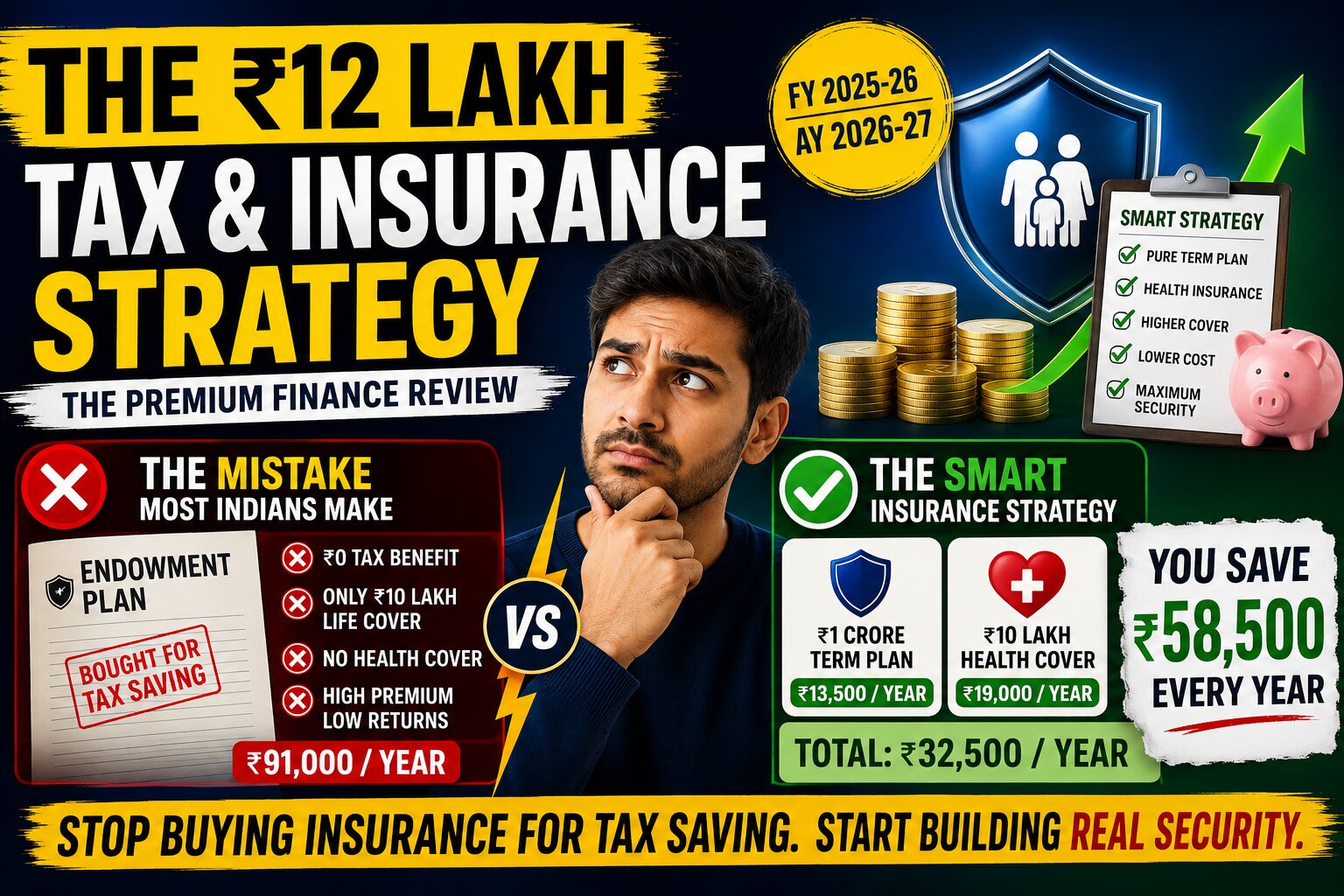
Five years ago, however, Rohan was sold a traditional endowment-cum-insurance policy: a ₹10 lakh life cover bundled with a modest, low-single-digit investment return, at an annual premium of roughly ₹91,000. The pitch at the time was simple — 'this saves you tax under 80C.' Rohan never revisited that decision after switching to the New Regime, so the premium kept auto-debiting.
● Zero tax benefit — 80C simply does not apply under the New Regime.
● Only ₹10 lakh of life cover — thin protection for a family relying on his income.
● No dedicated health insurance — medical costs remain a separate, unhedged risk.
● A blended, low-growth return, because part of every premium pays for insurance costs and distributor commissions rather than pure investment.
Now compare that to a simple, protection-first strategy at the same age and income:
● A pure term insurance plan with ₹1 crore of life cover — roughly ₹13,500 per year for a healthy 32-year-old non-smoker.
● A family floater health insurance policy with ₹10 lakh cover for self and spouse — roughly ₹19,000 per year.
● Combined annual outlay: approximately ₹32,500 — for ten times the life cover and dedicated health protection the endowment plan never offered.
|
What You're Comparing |
Old Habit: Endowment / ULIP |
Smart Strategy: Term + Health |
|
Annual Premium |
₹91,000 |
₹32,500 |
|
Life Cover |
₹10,00,000 |
₹1,00,00,000 |
|
Dedicated Health Cover |
None |
₹10,00,000 Floater |
|
Tax Saved (New Regime) |
₹0 |
₹0 |
|
Annual Cash Freed Up |
— |
₹58,500 |
Under the New Tax Regime, neither strategy 'saves tax' — that column reads ₹0 either way, because the rebate already zeroed Rohan's liability before insurance ever entered the picture. The difference that matters is the second one: switching to pure term and health cover frees up about ₹58,500 every year, while simultaneously multiplying his life cover tenfold and adding health protection he never had.
₹58,500 saved is not a tax refund. It is the price of confusing insurance with investment for five years running.
That freed-up amount, redirected into a diversified equity mutual fund, PPF, or the National Pension Scheme, compounds quite differently from an insurance-linked return. Invested consistently at a long-term average return, ₹58,500 a year has the potential to grow into a substantial retirement corpus over two to three decades — value the endowment plan was structurally never designed to deliver, because a meaningful share of every premium there pays for insurance charges and distribution costs rather than growth.
❦ ❦ ❦
Three forces quietly conspire to keep this mistake alive.
Many taxpayers picked the old regime years ago and have simply never recalculated. Salaried employees can switch between regimes every financial year, but that requires an active comparison most people postpone indefinitely.
Endowment, money-back and many ULIP products bundle a thin insurance layer with a mediocre investment layer, and price both at once. The tax argument was often the deciding factor at the point of sale — remove that argument, and the product's actual value proposition looks considerably weaker.
Premiums auto-debit. Policies auto-renew. Nobody sends a reminder saying, 'by the way, this stopped saving you tax two Budgets ago.' The only way to catch it is to check deliberately.
The fix is not to avoid insurance — it is to buy the right kind, for the right reason, and stop expecting a tax break that the New Regime structurally does not offer.
● Separate protection from investment. Buy pure term insurance for life cover and a standalone health policy for medical risk — never a bundled product priced to do both badly.
● Size life cover to income replacement, not premium comfort. A common benchmark is 10–15 times annual income, not whatever a ₹10 lakh 'starter' policy happens to offer.
● Recompute your regime every year before filing. Compare old versus new using your actual 80C, 80D, HRA and home loan interest figures — not last year's assumption.
● If your total genuine deductions are large — significant home loan interest, HRA, or maximised 80C and 80D together — the old regime can still work out cheaper even above ₹12 lakh. Run both numbers; don't assume.
● Redirect the difference. Whatever premium the bundled policy used to cost beyond pure term-plus-health, invest it separately — PPF, ELSS, NPS or a diversified index fund — where it can compound without insurance charges eating into it.
This is not a blanket case against the old regime — only against buying insurance for a tax benefit you no longer receive. At meaningfully higher incomes, or where deductions are unusually large, the arithmetic can flip.
A taxpayer with a large home loan, HRA claims, and fully utilised 80C and 80D deductions may still find the old regime cheaper overall, even at income levels above ₹12 lakh, because the combined deduction value can outweigh the new regime's lower slab rates. The only reliable way to know is to compute both regimes side by side, using real numbers, every single year — not to default to either one out of habit.
❦ ❦ ❦
|
KEY TAKEAWAYS ✓ A ₹12 lakh salary under the New Regime already pays ₹0 tax — no insurance premium changes that. ✓ 80C and 80D deductions simply don't apply in the New Regime — so 'tax-saving' insurance saves nothing there. ✓ Term + health insurance can free up ~₹58,500/year versus a bundled endowment plan, with far higher cover. ✓ Recalculate old vs new regime every year — large HRA, home loan interest or maxed deductions can still flip the answer. |
A ₹12 lakh salary under the New Tax Regime already pays ₹0 tax. No insurance premium changes that number, up or down. What it can change is how well protected you are, and how much of your income actually compounds for your future instead of quietly funding someone else's commission.
The real strategy most Indians get wrong is not choosing the wrong tax regime — it's continuing to buy insurance for a benefit that expired the day their regime changed. Fix that one decision, and the ₹58,500 a year was there all along, waiting to be saved.
Insurance should protect your family. Investment should grow your money. The moment one product tries to do both, on the promise of a tax saving that no longer exists, you are paying twice for something that works once.
Get the latest articles delivered to your inbox