
Your Insurance May Fail You When You Need It Most The Hidden Numbers That Decide Whether Your Claim Gets Paid
Super Policy Team •July 18, 2026 | 7 min read • 9 views
Super Policy Team •July 18, 2026 | 7 min read • 9 views
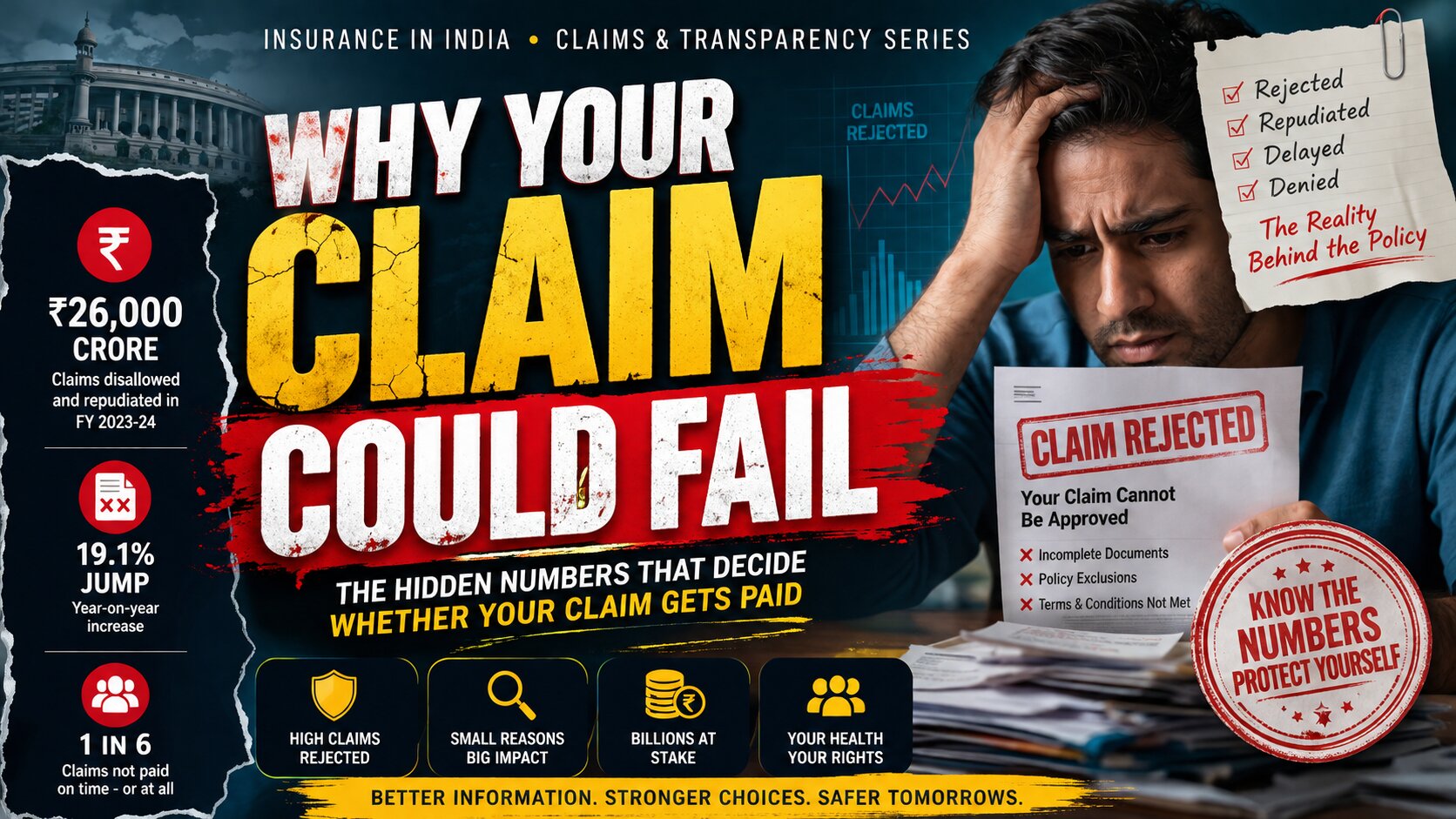
In the year ending March 2024, Indian insurers turned away health insurance claims worth ₹26,000 crore — enough to fund several state health budgets. That is not a rumour. It is a number the Insurance Regulatory and Development Authority of India (IRDAI) itself published. And most policyholders find out how their insurer really behaves only on the one day they can least afford a surprise: the day they file a claim.
Every year, IRDAI's Annual Report quietly discloses a number that never makes it onto a glossy brochure: how much money insurers refused to pay. For the financial year 2023-24, health insurers disallowed claims worth ₹15,100 crore — about 12.9% of all claims filed — and repudiated (formally denied after review) a further ₹10,937 crore. Add the two together and insurers held back roughly ₹26,000 crore, a 19.1% jump from the ₹21,861 crore denied the year before.
|
₹26,000 crore Total health insurance claims disallowed and repudiated in India, FY 2023-24 — up 19.1% year-on-year (Source: IRDAI Annual Report 2023-24) |
Put in everyday terms: as of March 2024, insurers rejected 11% of health claims outright and left another 6% pending — meaning roughly one in every six claims filed was not paid on time, if at all.
IRDAI draws a sharp line between two words that sound similar but mean very different things for a policyholder's wallet.
— Disallowed / Rejected: A claim is refused before the insurer even evaluates its merits — usually because of missing documents, a mismatch in details, or a procedural lapse.
— Repudiated: The insurer reviews the claim fully and then denies it, typically citing a policy exclusion, non-disclosure, or a breach of terms — often under Section 45 of the Insurance Act, 1938.
The distinction matters because a large share of "rejected" claims fail on paperwork alone — a missing signature, an address mismatch, an outdated nominee detail — not because the illness or event wasn't genuinely covered. In other words, a meaningful slice of the ₹26,000 crore was arguably avoidable with better documentation on the customer's side.
Insurers love to advertise their Claim Settlement Ratio (CSR) — the percentage of claims settled out of those received. A headline CSR of 98% sounds reassuring. But CSR counts claims by number, not by value. If an insurer settles thousands of small claims quickly but stalls or denies the few large, high-value ones, the CSR can still look excellent while the policyholders who needed the money most were left out.
|
Metric |
What It Measures |
Why It Can Mislead |
|
Claim Settlement Ratio (CSR) |
% of claims settled by number, in a year |
Ignores claim value — big-ticket denials can hide behind a high percentage |
|
Incurred Claim Ratio (ICR) |
Claims paid ÷ premium collected, by value |
A very low ICR can mean restrictive claim practices; a very high one can signal insurer stress |
For FY 2024-25, the non-life insurance industry's overall ICR stood at 82.88%, with public sector general insurers running a combined ICR of 99.84% — meaning they paid out almost every rupee of premium they collected in claims, a sign of financial strain even as it looks generous to claimants. Industry experts generally consider an ICR between 70% and 90% a healthy, sustainable zone.
Independent analysis of insurer-level data also shows how skewed a small number of large denials can be. In one widely-cited FY 2024-25 example from a leading private life insurer, the average value of a denied claim was roughly 14 times higher than the average value of a paid claim — a gap that a simple percentage-based CSR does not reveal at all.
Death claims fare noticeably better than health claims. For FY 2024-25, individual life insurers settled 97.82% of death claims by number — meaning roughly 2 in every 100 claims were still repudiated or rejected. Star Health Insurance recorded the industry's highest claim settlement ratio for FY 2024-25 at 99.06%, while a good CSR is generally considered to be anything above 80%.
Health insurance, the fastest-growing segment of India's insurance market, processed 3.26 crore claims in FY 2024-25 with an overall repudiation rate of around 8% — a reminder that even in a booming category, roughly 1 in 12 claims is turned down after review.
India's overall insurance penetration — total premiums as a share of GDP — fell for a second straight year to 3.7% in 2023-24, down from 4% in 2022-23 and 4.2% during the pandemic years. That is roughly half the global average, even as India ranks as the world's tenth-largest insurance market by premium volume.
The number of new individual life policies sold also fell 7.4% in FY 2024-25, even as premium collections and insurer profits both rose. That combination — more money from existing customers, fewer new customers being added — signals an industry deepening its hold on those already covered rather than expanding protection to the uninsured majority.
It isn't only claims that are under pressure. Policyholder grievances registered with insurers surged roughly 20% in FY 2024-25 to about 2.57 lakh complaints, with claims-related issues accounting for close to 69% of all complaints filed against general and health insurers — the single largest category of policyholder frustration in the country.
Facing this pattern of rejections and rising grievances, IRDAI introduced a set of policyholder-friendly reforms through FY 2024-25 aimed at tightening insurer accountability:
1. Mandatory Customer Information Sheets — a simplified, standardised summary of what is and isn't covered, to be issued with every policy.
2. A 60-month moratorium on health insurance claims — after five continuous years of coverage, insurers can no longer contest a claim on grounds of non-disclosure or misrepresentation (except proven fraud).
3. A 1-hour turnaround requirement for cashless pre-authorisation decisions at network hospitals, cutting the anxious wait patients and families used to face.
— Disclose everything, every time. Vague answers about pre-existing conditions, smoking, or family history are the single biggest reason genuine claims get repudiated later.
— Keep your documentation airtight. Illness dates, hospital names, and treatment details must match exactly across your policy, prescriptions, and discharge papers.
— Read the exclusions, not just the cover page. Waiting periods, room-rent limits, co-payment clauses, and named exclusions decide more claims than any dramatic denial ever does.
— Look beyond the claim settlement ratio. Compare CSR by number, CSR by value, and ICR together — never rely on one headline percentage from a brochure.
— Understand the new moratorium rule. Since March 2025, five continuous years of coverage protects you from non-disclosure disputes on health claims — don't let a policy lapse and restart the clock.
— Escalate a stuck claim — don't just wait. Insurers must respond within a fixed timeline; if they don't, escalate to the Insurance Ombudsman or IRDAI's Bima Bharosa grievance portal.
— Know your claim's timeline. A cashless claim is meant to be settled before discharge; a reimbursement claim typically takes about 15 days once complete documents are submitted — know which clock you're on.
None of this means Indian insurance doesn't work — the vast majority of claims, especially smaller ones, are paid without drama. But the IRDAI's own data makes one thing clear: the fine print, the disclosure form, and the documentation you submit on day one matter as much as the premium you pay every year. A policy is only as good as the claim it eventually honours — and in India today, roughly one in nine claims still isn't.
Get the latest articles delivered to your inbox