
The ₹10,000 Insurance Mistake Most Indians Make Every Year Riders Exposed
Super Policy Team •August 1, 2026 | 8 min read • 8 views
Super Policy Team •August 1, 2026 | 8 min read • 8 views
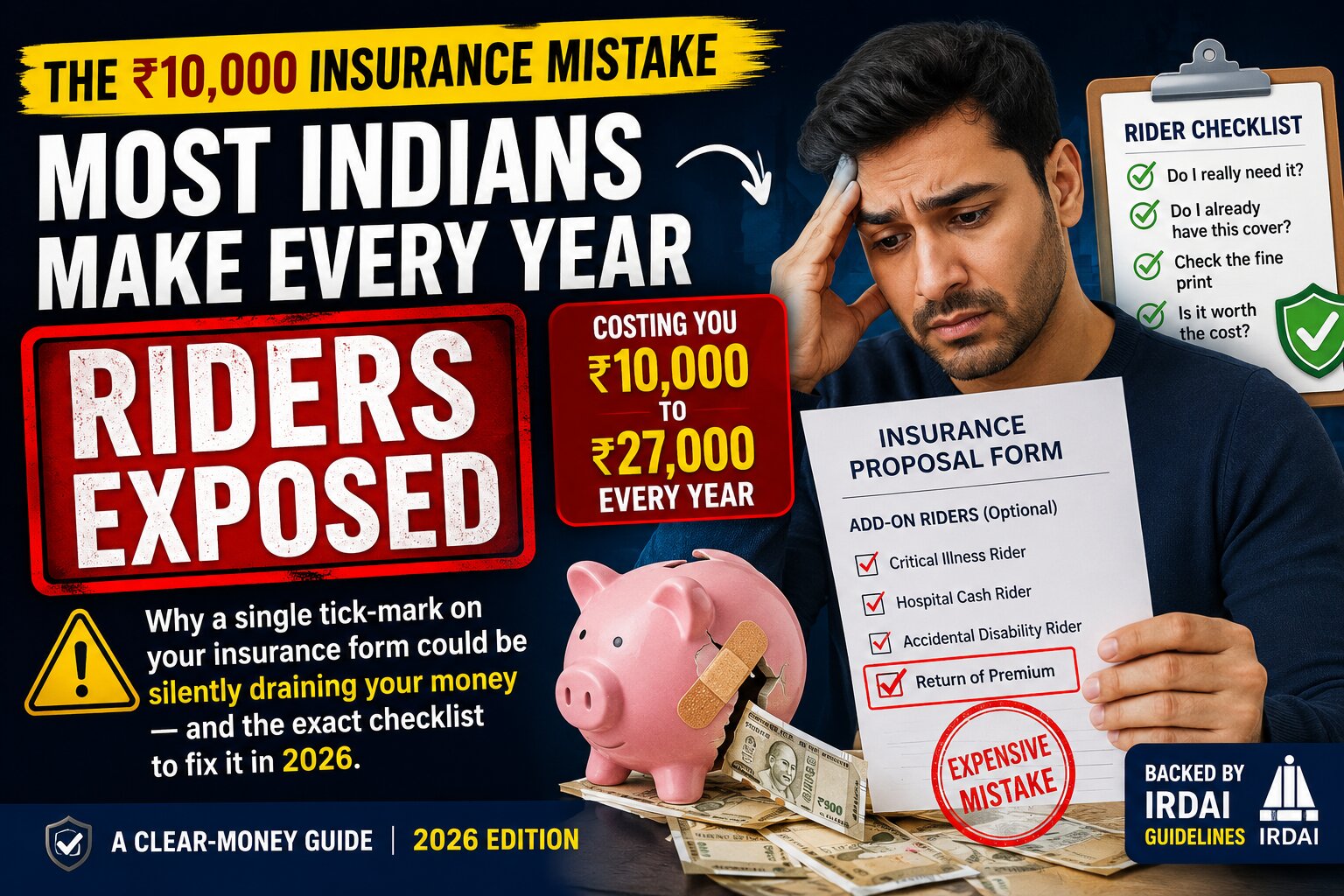
Why a single tick-mark on your insurance form could be silently draining your money — and the exact checklist to fix it in 2026.

A CLEAR-MONEY GUIDE • 2026 EDITION
The Silent Rider Trap
Every year, millions of Indians sit across an insurance advisor, sign a term insurance form, and tick a few extra boxes labelled "riders." They walk away feeling completely protected. What most of them never realise is that one of those tick marks quietly costs them somewhere between ₹10,000 and ₹27,000 a year — money that vanishes without adding a rupee of real protection.
Riders are optional add-ons attached to a base insurance policy. Used correctly, they are genuinely valuable — a good rider can put cash in your hand the moment a health crisis hits, long before a death claim would ever apply. Used carelessly, they turn into an invisible, recurring leak in your household budget. The difference between the two usually comes down to a handful of small decisions that almost nobody double-checks.
|
A rider is not automatically a benefit. It is a benefit only when it matches a risk you actually carry — everything else is a subscription you forgot you were paying for. |

Mistake No. 1 — The "Get Your Money Back" Illusion
The most expensive rider decision in Indian insurance today is not a rider at all in the technical sense — it is the Return of Premium (ROP/TROP) option, sold with the comforting pitch: "pay a little more, and if you survive the term, you get every rupee back."
Here is the real arithmetic. For a healthy 25-year-old buying ₹2 crore of cover until age 65, a standard pure term plan costs roughly ₹19,719 a year. The Return-of-Premium version of the very same plan costs roughly ₹47,075 a year — an extra ₹27,356 every single year, for decades, just for the promise of a refund at the end.
That extra amount, invested instead in an ordinary long-term instrument such as a mutual fund SIP or the Public Provident Fund, would very likely compound into a far larger sum than the plain refund the ROP plan eventually pays out — because ROP simply hands back your own money with no real growth built in. The insurer is not giving you a gift; they are giving you your own premium back, minus decades of what it could have earned elsewhere. A single wrong tick here crosses the ₹10,000 mark almost three times over, every year, for the life of the policy.
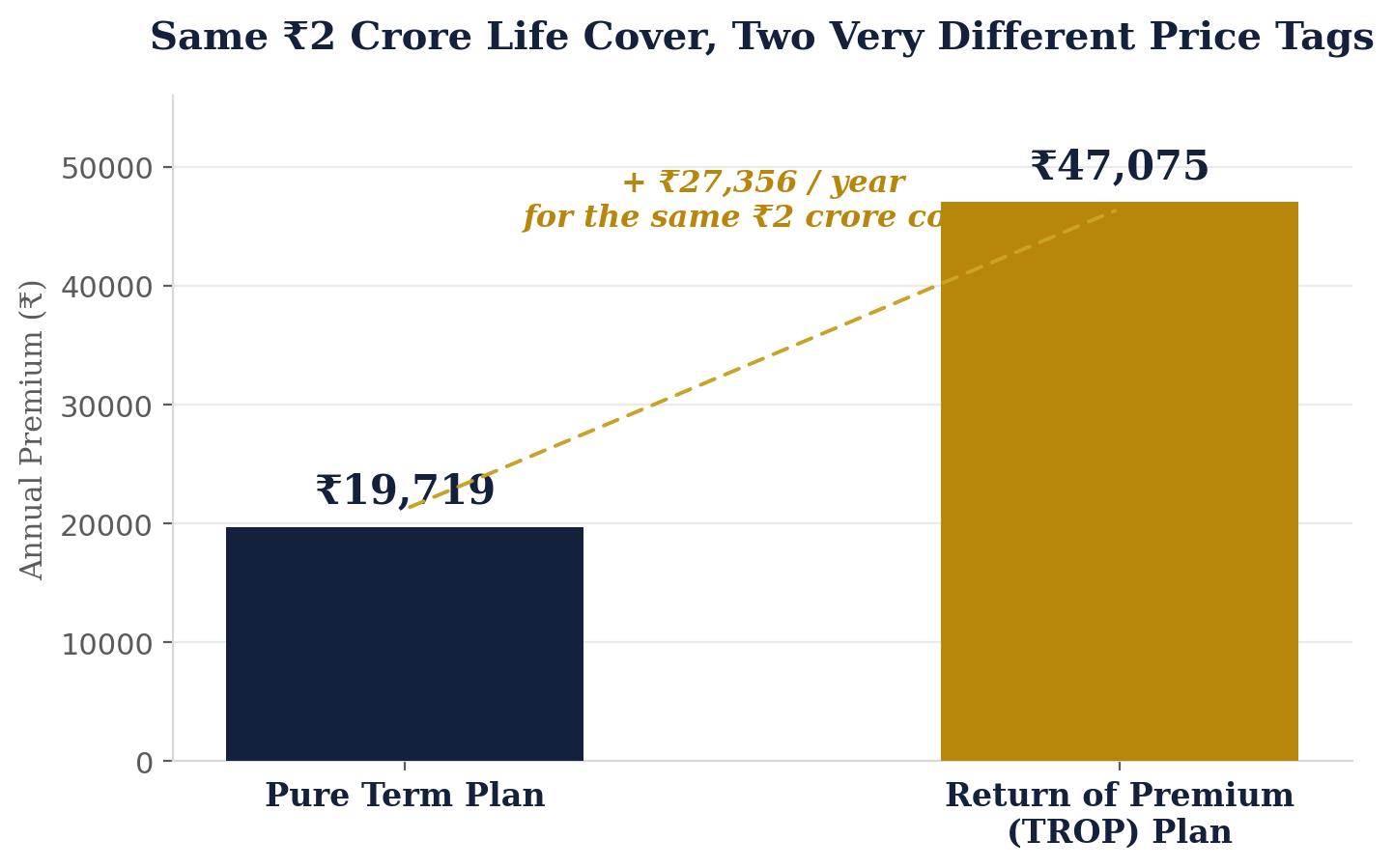
Illustrative premiums for a 25-year-old, ₹2 crore cover until age 65, based on a leading insurer's published rates.

Mistake No. 2 — Paying Twice for the Same Protection
The second common leak is duplication. Many salaried Indians already have a comprehensive health insurance policy — through their employer, a personal family floater, or both — that covers hospitalisation, critical illness treatment, and daily cash benefits.
When the same person then adds a Critical Illness rider or a hospital-cash rider onto their term insurance policy without checking what their existing health cover already includes, they end up paying an additional ₹3,000 to ₹8,000 a year for protection that substantially overlaps with a policy they are already paying for. This is not extra safety; it is a second bill for the same seat.
❖ Example: A 32-year-old with a ₹10 lakh employer health policy adds a ₹5 lakh Critical Illness rider on his term plan for ₹4,500/year — despite his employer policy already reimbursing major illness treatment in full.

Mistake No. 3 — Accelerated vs Non-Accelerated: The Fine Print Nobody Reads
Critical illness riders come in two very different structures, and the difference is almost never explained clearly at the point of sale.
❖ Accelerated riders: the payout is deducted from your base life cover. Example — a ₹1 crore base policy with a ₹20 lakh accelerated Critical Illness rider. If you claim for the illness, you receive ₹20 lakh now, but your family's eventual death benefit drops to just ₹80 lakh.
❖ Non-accelerated (additional) riders: the payout is on top of your base cover. Same numbers — you claim ₹20 lakh for the illness, and your family still receives the full ₹1 crore later. This version costs more, but it is the one doing what people assume all riders do.
Buyers who assume they have "extra protection" often discover — usually during a claim, the worst possible moment — that they actually reduced their family's eventual death benefit. Reading this one clause before signing costs nothing; missing it can cost lakhs.

Mistake No. 4 — Riders That Quietly Expire Before Your Policy Does
A base term policy can run until age 70 or 80, but many riders — especially critical illness and accidental disability riders — are only valid until age 60 or 65. Policyholders routinely assume every rider they bought runs alongside the base plan for its entire life.
The result: a person pays for a rider for twenty or thirty years, only to find it lapsed years before the risk it was meant to cover — a major illness in one's late 60s or 70s — actually became most likely. Always check the rider tenure separately from the base policy tenure; the two numbers are rarely the same.

The IRDAI Rule Almost Nobody Reads
The Insurance Regulatory and Development Authority of India caps the combined premium of all riders attached to a policy — the total rider cost cannot exceed 100% of the base policy premium. This rule exists precisely to stop over-insurance and runaway add-on costs.
Yet because most buyers never see this ceiling mentioned anywhere in the sales conversation, they routinely stack three, four, or five riders recommended by an advisor without ever asking whether each one earns its place — pushing their add-on costs needlessly close to that regulatory limit, and their annual outgo needlessly high.
What the Mistake Actually Costs You
A conservative, real-world tally of the most common unnecessary rider costs looks like this:
|
Common Mistake |
Typical Extra Annual Cost |
Real Protection Added |
|
Return of Premium (ROP/TROP) upgrade |
₹18,000 – ₹27,000 |
None — it's your own money returned |
|
Duplicate Critical Illness / hospital-cash rider |
₹3,000 – ₹8,000 |
Little to none if health cover overlaps |
|
Wrong accelerated rider selection |
₹0 extra, but reduces death cover |
Negative — shrinks family's payout |
|
Rider lapsing before base policy term |
Full rider premium paid, cover gone |
Zero in later, highest-risk years |
Add these together and the average over-insured Indian household crosses ₹10,000 in avoidable rider costs within the very first year — and that figure compounds every year the policy runs, often for two or three decades.

How to Fix It — A Five-Minute Checklist
✓ Compare pure term vs ROP — Calculate the exact rupee difference over your policy term before choosing the "refund" version. Investing the difference almost always wins.
✓ Audit for overlap — List every rider against your existing health insurance. Drop any rider that duplicates a benefit you already have.
✓ Ask: accelerated or non-accelerated? — Get this answer in writing before signing. It decides whether your family's death benefit shrinks after a claim.
✓ Match rider tenure to base tenure — Confirm in the policy schedule — not from memory — that each rider runs as long as you expect it to.
✓ Check the 100% rider cap — If your combined rider premium is creeping close to your base premium, ask your advisor to justify every single rider, one at a time.

The Bottom Line
Riders are not the villain in this story — blind, unchecked bundling is. The same ₹10,000 to ₹27,000 that quietly disappears into an unnecessary Return-of-Premium upgrade or a duplicate critical illness rider could instead be redirected into a plain, well-chosen term policy plus a simple long-term investment — and still leave you with stronger, clearer, and cheaper protection.
The next time an advisor slides a form across the table with a list of riders already ticked, take the five minutes this checklist asks for. It is very likely the highest-return five minutes of financial planning you will do all year.
Disclaimer: This article is for general educational and informational purposes only and does not constitute financial, insurance, or investment advice. Product features, premiums, and regulations vary by insurer and are subject to change. Please read policy documents carefully and consult a licensed insurance advisor before making any purchase decision.
Get the latest articles delivered to your inbox