
EV Insurance Isn’t Just Car Insurance: The Battery Risk Every Indian Buyer Must Understand
Super Policy Team •June 19, 2026 | 5 min read • 140 views
Super Policy Team •June 19, 2026 | 5 min read • 140 views
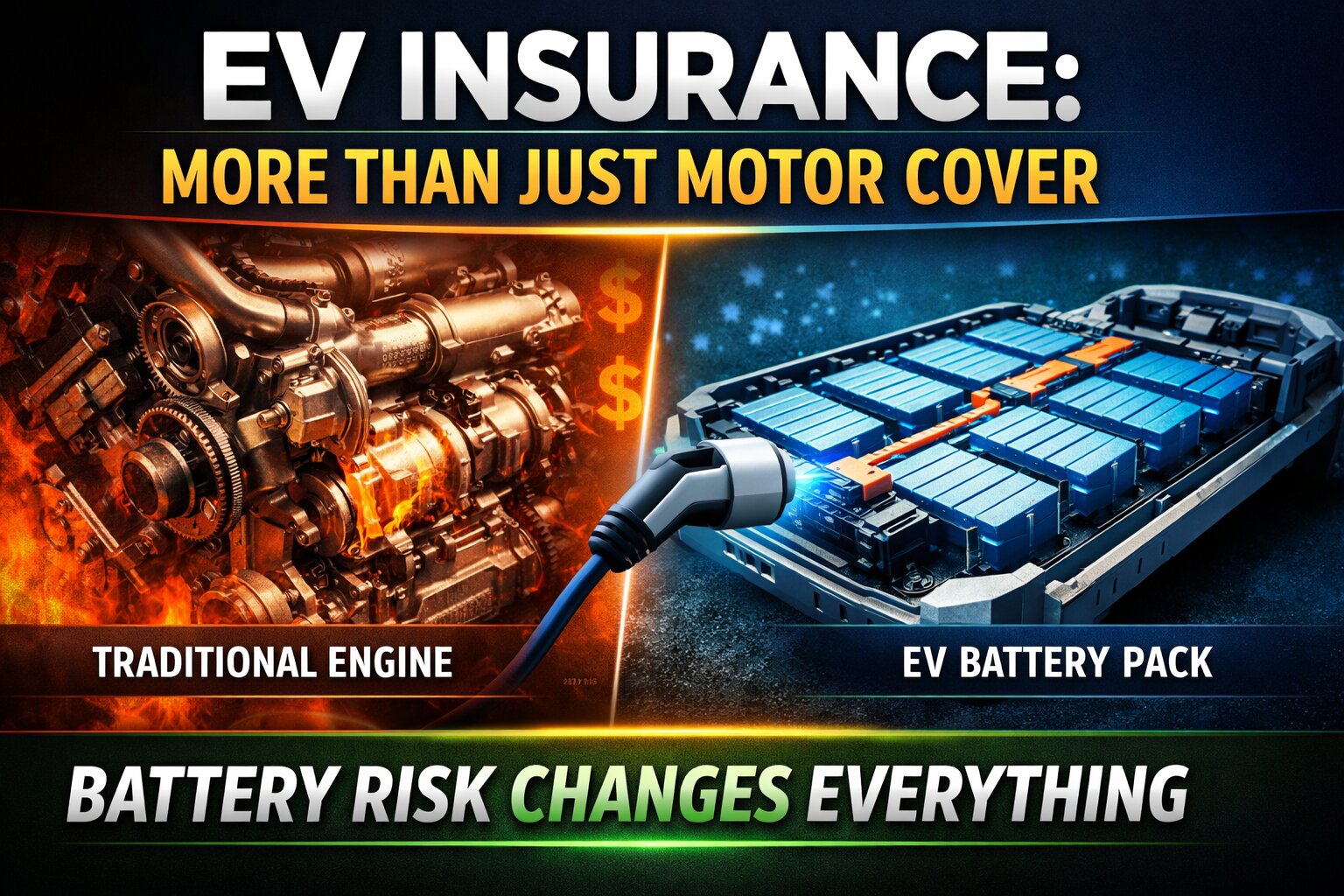
Electric mobility is accelerating across India. But while most buyers obsess over range, charging time, and subsidies, insurance remains under-analysed — despite being a high-impact cost and risk variable.
This Master Discover Edition reframes EV insurance as a risk architecture decision, not a checkbox purchase.
Under regulations of the Insurance Regulatory and Development Authority of India (IRDAI), third-party insurance is mandatory for all vehicles.
However, EVs introduce a fundamentally different underwriting structure because:
Battery = 30–50% of vehicle cost
High electronics dependency
Specialized repair ecosystem
Charging infrastructure exposure
In insurance terms:
ICE risk = mechanical wear
EV risk = high-severity component exposure
The frequency of minor issues may be lower in EVs. But claim severity can be significantly higher.
The lithium-ion battery pack is the single most important insurance variable.
High replacement cost (₹4–8 lakh depending on segment)
Sensitive to water ingress
Vulnerable to short circuits
Thermal risk (rare but high impact)
A standard comprehensive motor policy may cover accidental battery damage — but often without depreciation protection.
Battery Protect Add-on
Zero Depreciation
Return to Invoice (RTI)
Without these, claim payouts may be materially lower than expected.
Despite fewer moving mechanical parts, EV insurance premiums are typically 10–25% higher than comparable petrol variants.
Higher insured declared value (IDV)
Imported battery components
Limited EV-certified garages
Expensive spare parts
This is a severity-driven pricing model.
For ICE vehicles, add-ons are often optional upgrades. For EVs, they are strategic risk buffers.
Battery Protection Cover
Zero Depreciation
Return to Invoice
Roadside Assistance
Consumables Cover
Charger/Wall Box Coverage
The home charger is frequently uninsured unless explicitly declared.
In flood-prone cities like Mumbai, Chennai, Bengaluru low-lying zones — water ingress risk is real.
Battery damage due to flooding can escalate claim value rapidly.
Before purchasing:
Confirm flood damage coverage
Check sub-limits for electrical damage
Verify exclusions in policy wording
The Government of India provides incentives under EV promotion schemes.
However:
Insurance IDV calculation may not always reflect subsidy-adjusted cost.
Depreciation schedules apply annually.
RTI cover is critical in early ownership years.
Always confirm IDV base at purchase.
| Variable | ICE Vehicle | Electric Vehicle |
|---|---|---|
| Routine Service Cost | Higher | Lower |
| Insurance Premium | Moderate | Higher |
| Major Risk | Engine overhaul | Battery replacement |
| Repair Network | Wide | Limited but expanding |
| Add-on Importance | Moderate | High |
EV saves on fuel and routine maintenance — but insurance must hedge battery risk to preserve TCO advantage.
Similar process as ICE vehicle.
Inspection required. OEM-certified evaluation. Potential high-cost claim.
Covered only if declared and endorsed.
Before buying insurance, confirm:
Authorized EV garage network in your city
Claim turnaround time
Cashless repair availability
⚠️ Consumers often overlook:
Charger not automatically covered
Software-related malfunction ambiguity
Depreciation on battery components
Long repair wait time due to part imports
Towing limits for EV-specific breakdown
Always read the policy schedule, not just the brochure.
Battery Protect + Zero Dep = Essential
Add charger theft & surge protection cover
Battery water ingress coverage critical
Higher deductible may reduce premium cost
| Component | ICE (₹15L) | EV (₹15L) |
|---|---|---|
| Fuel (5 yrs) | High | Significantly lower |
| Insurance (5 yrs) | Moderate | Higher |
| Major Risk | Engine wear | Battery replacement |
| Net Outcome | Predictable | Savings if battery intact |
Note: Figures are illustrative. Actual costs vary by model, insurer, city, and usage profile.
Domestic battery manufacturing may reduce replacement cost.
Repair ecosystem expansion may compress premium gap.
Telematics-based usage pricing may emerge.
Actuarial models will improve as claims data scales.
Early adopters currently pay a risk premium for uncertainty.
✔ Confirm battery add-on
✔ Verify charger inclusion
✔ Check flood & electrical exclusions
✔ Compare IDV basis
✔ Review network garages
✔ Evaluate RTI in first 3 years
✔ Understand claim settlement process
EV insurance is not just motor insurance for a cleaner engine. It is a battery-risk protection framework.
Consumers who optimize for lowest premium may underinsure their highest-value component.
Consumers who insure intelligently protect the economics of EV ownership itself.
In the EV era:
The engine no longer defines risk. The battery does.
Premium differences, battery costs, and claim scenarios discussed are indicative. Actual coverage terms, pricing, and exclusions vary by insurer, city, vehicle model, risk profile, and policy wording. Consumers should review final policy documents before purchase.
Get the latest articles delivered to your inbox