
From Accidents to Theft: The Smart Indian’s Guide to Choosing the Right Car Insurance
Super Policy Team •June 11, 2026 | 5 min read • 104 views
Super Policy Team •June 11, 2026 | 5 min read • 104 views
A single flooded street in Mumbai can turn a ₹15 lakh car into a ₹3 lakh repair bill overnight.
Motor insurance in India is not merely regulatory compliance—it is balance-sheet protection for a depreciating but high-liability asset.
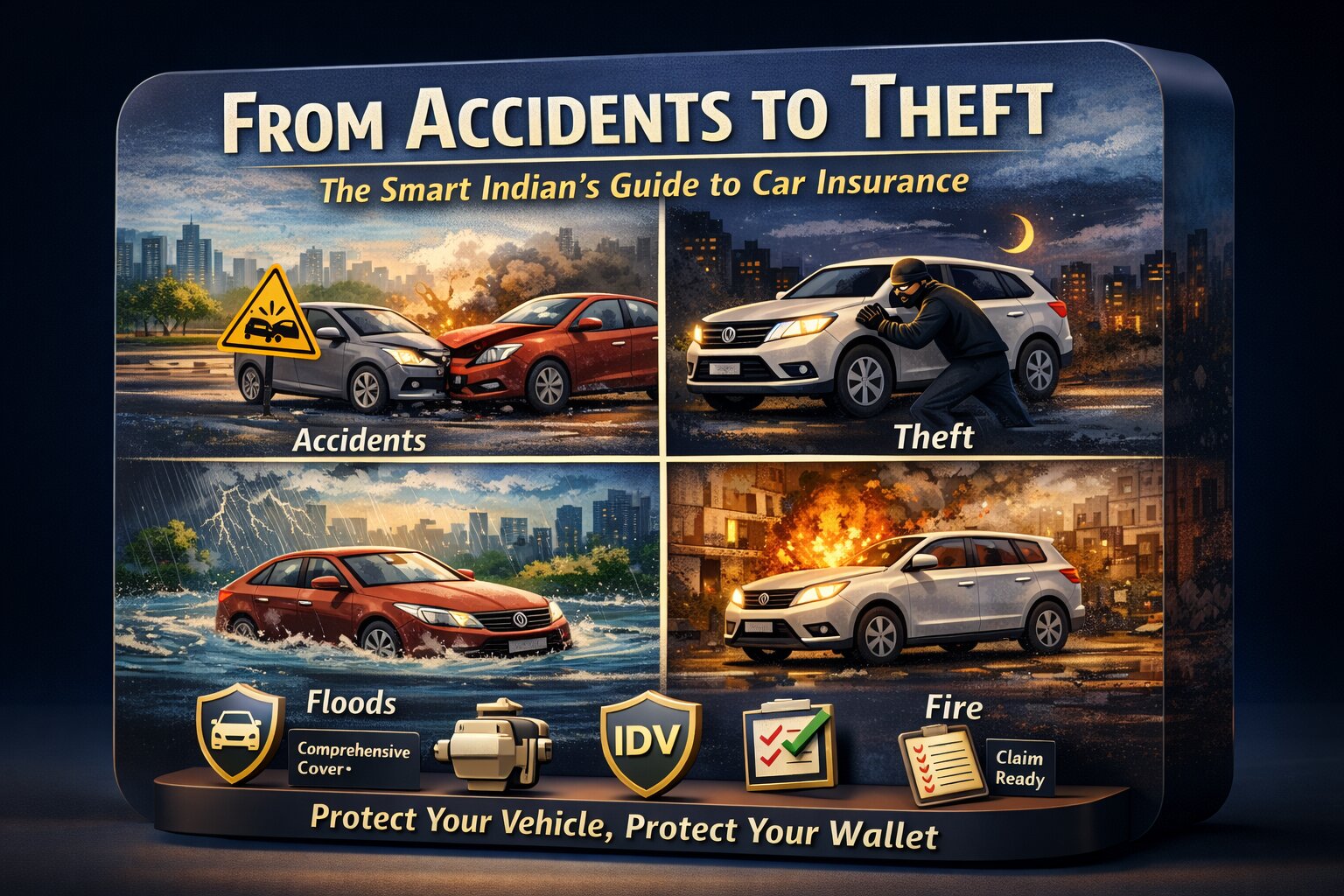
Under the framework governed by the Insurance Regulatory and Development Authority of India (IRDAI), third-party insurance is mandatory. But beyond legality lies strategy. This Discover-ready master guide reframes car insurance as risk engineering—aligned to geography, vehicle profile, behavioral discipline, and financial prudence.
Before comparing premiums, assess your real-world exposure.
| Risk | Where It’s High | Typical Financial Impact |
|---|---|---|
| Accidents | Delhi NCR, Bengaluru peak traffic | ₹25,000 – ₹5 lakh |
| Flood Damage | Mumbai, Chennai monsoons | ₹1 – ₹3 lakh (engine) |
| Theft | NCR, Maharashtra urban belts | Full IDV loss |
| Vandalism | Urban unrest zones | ₹15,000 – ₹1 lakh |
| Fire | Older vehicles, wiring faults | Total loss |
Driver A had comprehensive cover + engine protection.
Claim settled: ₹2.4 lakh.
Driver B had comprehensive cover without engine protection.
Ignition attempted after water entry → Claim rejected.
Flood-prone city?
SUV or high-demand model?
Open street parking?
Financed vehicle?
Highway-heavy usage?
Insurance must follow risk geography + vehicle type + usage behavior—not just price comparison.
Under Indian law, third-party cover is compulsory. But it protects others—not you.
| Feature | Third-Party | Comprehensive |
|---|---|---|
| Legal compliance | Yes | Yes |
| Damage to own car | No | Yes |
| Theft | No | Yes |
| Natural calamity | No | Yes |
| Add-ons available | No | Yes |
You hit a luxury SUV in Bengaluru traffic:
Third-party pays their damage.
Your ₹3 lakh repair bill? Out-of-pocket.
When third-party might suffice:
Car older than 8–10 years
Low resale value
Rare usage
For cars under 7 years or financed vehicles, comprehensive cover is financially rational.
IDV defines maximum payout in theft or total loss.
Lower IDV = lower premium
Lower IDV = lower claim settlement
Market value: ₹11 lakh
Insurer suggests IDV ₹9 lakh
Premium reduces slightly
If stolen → ₹2 lakh shortfall
Choose upper band of IDV range
Avoid underinsuring SUVs in theft-prone zones
Reassess IDV annually at renewal
Saving ₹3,000 in premium can cost ₹2–3 lakh at claim time.
Not all add-ons are equal. Prioritize based on probability × severity.
Engine Protection
Critical in flood-prone cities like Mumbai & Chennai.
Zero Depreciation
Full part replacement without depreciation cuts.
Return to Invoice (RTI)
Full invoice payout in total loss (ideal for new cars).
Roadside Assistance (RSA)
Highway breakdown safety net.
Consumables Cover
Covers oils, nuts, bolts—commonly excluded.
Without engine protect → Hydrostatic lock excluded.
With add-on → ₹1.8 lakh settled.
Engine Protect + Zero Dep + RSA form the core triad for urban India.
SUV theft clusters remain active in NCR and Maharashtra.
Commonly targeted:
Hyundai Creta
Kia Seltos
Toyota Fortuner
FIR within 24 hours
Inform insurer immediately
Both original keys submission
ARAI-approved anti-theft device recommended
If a ₹35 lakh SUV is stolen and IDV chosen is ₹31 lakh → ₹4 lakh wealth erosion.
In high-theft zones, insurance equals asset protection—not compliance.
NCB reduces own-damage premium from 20% to 50%.
| Claim-Free Years | NCB |
|---|---|
| 1 | 20% |
| 2 | 25% |
| 3 | 35% |
| 4 | 45% |
| 5 | 50% |
Repair cost: ₹6,000
NCB benefit: ₹9,000
Better to avoid claim.
Allows one claim without losing accumulated bonus.
NCB behaves like financial compounding—protect it strategically.
Higher voluntary deductible reduces premium but increases self-risk.
Example:
Voluntary deductible ₹10,000
Premium reduction ₹1,200
One claim wipes 8 years of savings.
Low annual mileage
Experienced driver
Strong emergency fund
Deductibles must reflect liquidity strength—not optimism bias.
Premium differences of ₹500–₹1,000 are irrelevant compared to claim experience.
Evaluate:
Claim settlement ratio
Network garages in your locality
Cashless claim process
Turnaround time
Visit insurer website
Locate nearest cashless garages
Read claim reviews
Understand surveyor process
Insurance is tested during crisis—not at checkout.
With rising adoption of EVs like Tata Nexon EV:
Battery cost: ₹5–8 lakh
Battery accounts for 35–40% of vehicle value
Charging equipment damage coverage critical
Ensure:
Battery covered under comprehensive
Fire & short-circuit protection
Charging liability clarity
EV insurance must prioritize battery and electrical system protection.
| Myth | Reality |
|---|---|
| Cheapest policy is best | Service quality determines outcome |
| Flood damage always covered | Engine damage often excluded |
| Third-party is sufficient | It protects others, not your asset |
Car < 5 years
Metro city
10,000 km annual usage
→ Comprehensive + Engine Protect + Zero Dep + NCB Protect
Car 5–8 years
Moderate usage
→ Comprehensive + Engine Protect
Car > 8 years
Low resale value
→ Third-party or basic comprehensive
Recalculate IDV
Re-evaluate add-ons relevance
Compare garage network expansion
Reassess deductible
Review claim experience reports
Confirm NCB transfer accuracy
Most buyers fall prey to:
Premium anchoring bias
Underestimation of low-probability high-impact events
“I won’t claim” optimism bias
Insurance exists precisely for tail-risk events.
Car insurance is not about avoiding penalties.
It is about preventing a liquidity shock.
A ₹20,000 annual premium protects against ₹5–35 lakh downside risk. When viewed through capital preservation principles, the decision becomes rational—not optional.
Get the latest articles delivered to your inbox