
The Hidden Cost of Buying Insurance: Online vs Agent vs Advisor Explained for Indian Families
Super Policy Team •July 2, 2026 | 5 min read • 227 views
Super Policy Team •July 2, 2026 | 5 min read • 227 views
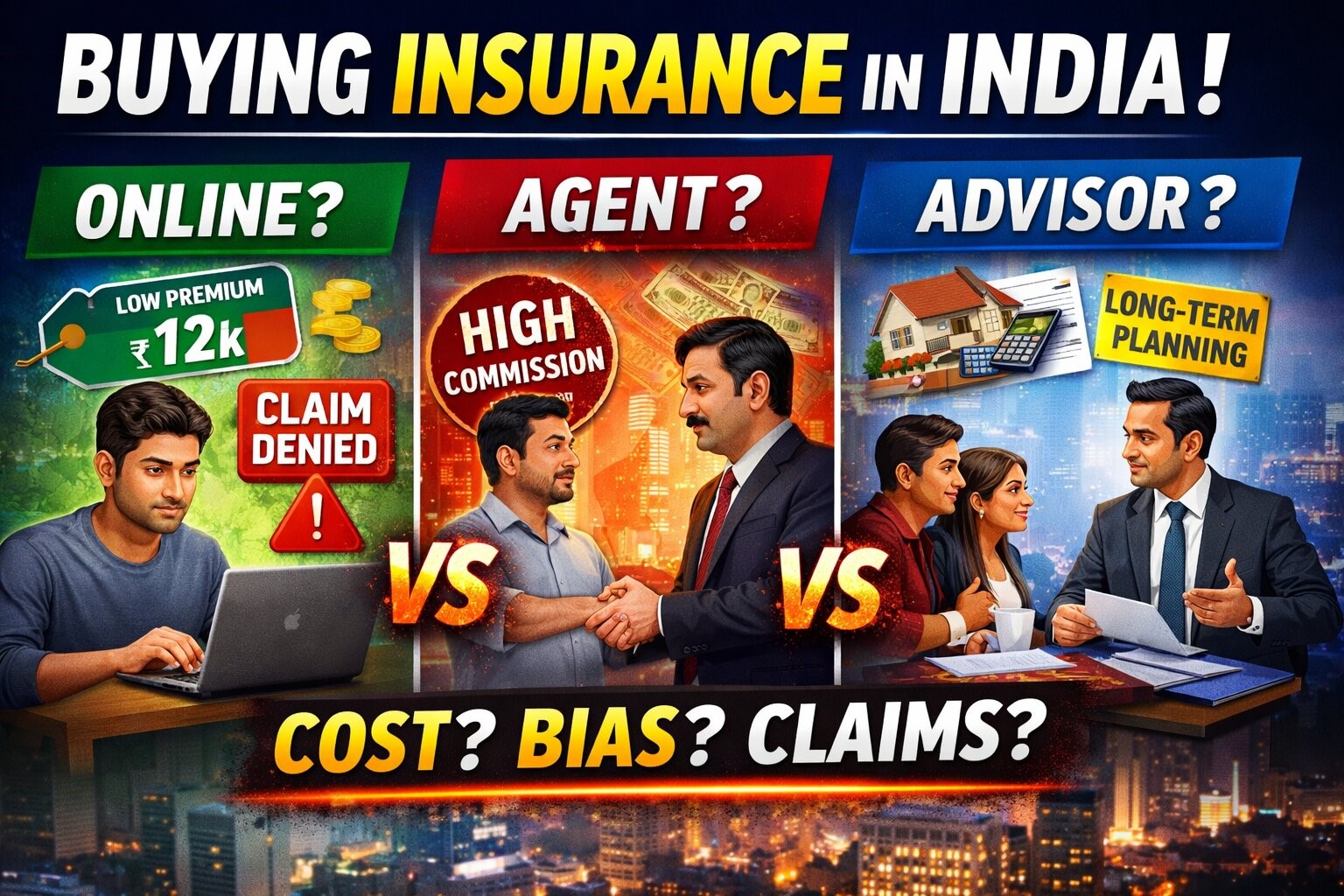
Two 30-year-olds buy a ₹1 crore term insurance policy for 30 years.
Person A pays ~₹3.6 lakh total.
Person B pays ~₹4.35 lakh total.
Same insurer.
Same coverage.
Same tenure.
The difference is not the policy. It’s the distribution channel.
Before you buy insurance this year, understand this:
How you buy matters as much as what you buy.
Insurance distribution in India operates under the supervision of the Insurance Regulatory and Development Authority of India — but the incentive structures across channels are fundamentally different.
Let’s dissect this structurally.
There are only three meaningful channels:
Direct online purchase
Through an insurance agent
Through a financial advisor
Each comes with cost architecture, behavioural influence, and risk implications.
You purchase directly from insurers such as
HDFC Life,
ICICI Prudential Life Insurance,
Tata AIA Life Insurance
Or through aggregators like
Policybazaar.
Lower visible premiums
Instant comparisons
Transparent CSR data
Zero face-to-face sales pressure
For pure term insurance, online premiums are often 10–25% cheaper because commissions are reduced or eliminated.
Online platforms optimize for comparison — not suitability.
You may:
Choose the lowest premium (anchoring bias)
Underestimate required coverage
Ignore riders
Misdeclare health history unintentionally
And in claims? You deal directly with escalation systems.
A 32-year-old salaried professional buys the cheapest online term plan.
He forgets to disclose mild hypertension.
Five years later, claim dispute arises.
Insurance contracts punish incomplete disclosure.
Online works best when:
Your medical history is simple
You understand underwriting
You calculate Human Life Value properly
Often tied to one insurer (for example, LIC of India).
Agents:
Fill documentation
Guide medical tests
Provide claim-time assistance
Earn commission embedded in premium
Trust.
Accessibility.
Handholding.
In semi-urban India, relational finance still dominates.
Commission is the economic driver.
High commission products:
Endowment plans
Traditional savings policies
Certain ULIPs
Low commission product:
Pure term insurance
Agents don’t always sell what is optimal. They sell what pays.
That does not mean all agents mis-sell.
But the structure creates bias.
⚠️ Red Flag:
If a policy is described as “guaranteed 8–10% return with insurance benefit,” pause immediately.
Insurance is primarily risk transfer — not wealth creation.
Advisors may be commission-based or fee-only.
Registered Investment Advisors operate under the oversight of the Securities and Exchange Board of India for advisory functions.
Insurance is integrated into:
Asset allocation
Retirement projections
Liability mapping
Estate planning
Instead of “Which policy?”, the question becomes:
“How much risk exists in your financial life?”
A 38-year-old business owner:
₹1.5 crore home loan
Two dependents
Volatile income
Online purchase might undercalculate coverage.
Agent might push savings-linked insurance.
Advisor calculates inflation-adjusted income replacement over 25 years.
Coverage jumps to ₹3–4 crore.
Suitability improves.
Explicit advisory fee (in some models)
Quality varies widely
Requires financial discipline
But behavioural distortions reduce significantly.
Assume:
Age 30
₹1 crore term plan
30-year tenure
| Channel | Annual Premium | 30-Year Outgo | Incentive Layer |
|---|---|---|---|
| Online | ₹12,000 | ₹3.6 lakh | Minimal |
| Agent | ₹14,500 | ₹4.35 lakh | 15–35% Yr 1 commission |
| Advisor (Fee-based) | ₹12,000 + advisory fee | ₹3.6L + fees | Transparent |
Over decades, embedded commission compounds.
Cost difference ≠ small.
Insurance buying is emotional.
Common biases:
| Bias | Where It Dominates |
|---|---|
| Anchoring (lowest premium) | Online |
| Authority bias | Agent |
| Overconfidence | Online |
| Complexity avoidance | Agent |
| Underinsurance | Both |
The advisor model reduces bias — if fiduciary.
Here’s the uncomfortable truth:
Many households:
Are underinsured
But heavily invested in low-return savings insurance
Why?
Because “forced savings” feels safer than pure protection.
This is psychological comfort, not financial optimization.
→ Buy term online. Keep it simple.
→ Avoid savings plans. Consider advisory calculation.
→ Agent/advisor assistance helps underwriting clarity.
→ Advisor required. Estate risk dominates.
Claim Settlement Ratio (CSR) is widely marketed.
But CSR ≠ smooth claim.
Real determinants:
Accurate disclosure
Medical documentation
Nominee awareness
Policy clarity
Even a 99% CSR insurer can reject non-disclosure cases.
Insurance is not about probability of death.
It is about probability of documentation error.
Online optimizes cost.
Agents optimize relationship.
Advisors optimize alignment.
No channel is universally superior.
But misalignment is expensive.
What is my inflation-adjusted Human Life Value?
What liabilities remain if I’m not there?
Am I mixing insurance and investment?
Is my intermediary incentivized by commission?
Can my nominee manage claim documentation?
If you cannot answer these, pause.
Insurance is not an investment product.
It is a contract transferring financial risk.
When structured correctly, it preserves family dignity.
When mis-sold, it locks capital inefficiently for decades.
The difference is rarely the insurer.
It is almost always the distribution channel.
Get the latest articles delivered to your inbox