
₹1 Crore Insurance Claim Rejected? 7 Hidden Life Insurance Clauses Every Indian Family Must Know Before Its Too Late
Super Policy Team •August 28, 2026 | 8 min read • 12 views
Super Policy Team •August 28, 2026 | 8 min read • 12 views
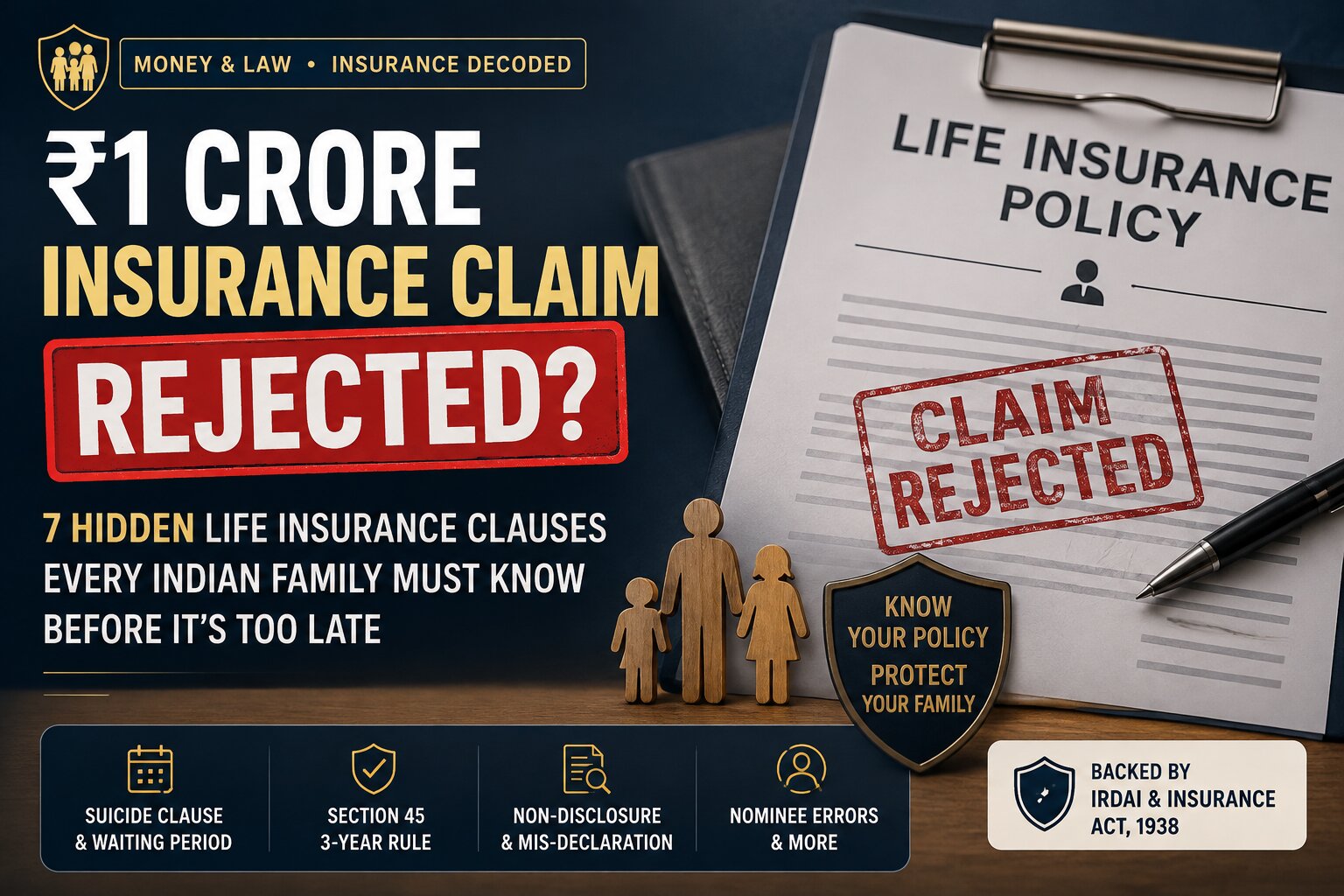
The premium was paid on time. The claim still got rejected. Here's the fine print insurers never highlight — and the law that protects you anyway.
Ramesh, a 41-year-old IT professional from Pune, paid his term insurance premium of ₹18,000 a year without fail for six years. His sum assured: ₹1 crore. When he passed away suddenly, his wife filed the claim expecting the insurer to honour a policy the family had trusted for years. Weeks later, the letter arrived: claim repudiated.
Stories like this go viral every few months on Indian social media — and for good reason. A life insurance policy is meant to be the one financial promise that never breaks when a family needs it most. Yet every year, thousands of claims are rejected or short-settled, often because of clauses buried on page 14 of a policy document nobody reads twice.
This article breaks down, in plain language, the hidden clauses that most commonly derail life insurance claims in India — and, more importantly, the legal protections under the Insurance Act, 1938 and IRDAI regulations that are designed to stop insurers from misusing them.
According to IRDAI's Handbook on Indian Insurance Statistics for FY 2023-24, the overall individual death-claim settlement ratio across LIC and private insurers stood at 96.82%, with private insurers clustering near 99% and LIC around 96.6–96.8%.
That sounds reassuring — until you remember it also means roughly 3 in every 100 death claims were NOT settled, either repudiated, rejected on technical grounds, or left pending. On a ₹1 crore policy, that 3% is precisely the family that needed the payout the most.
Health insurance — often bundled into the same conversation — paints an even starker picture: IRDAI's FY25 data shows insurers processed 3.26 crore claims with an 8% repudiation rate, roughly 1 in every 12 claims denied. The takeaway for life insurance buyers is the same: the fine print decides the outcome far more than most policyholders realise.
Below is a quick-reference table. Read it once before you buy a policy, and again the moment you're filing a claim.
|
Hidden Clause |
What It Really Means For Your Claim |
|
1. Suicide Clause |
If death by suicide occurs within 12 months of the policy start (or revival) date, the insurer pays only 80% of premiums paid, not the full sum assured. After 12 months, the full death benefit applies — this is an IRDAI-mandated rule since 2014, not insurer discretion. Example: Sum assured ₹1 crore, premiums paid so far ₹90,000. Suicide in month 8 → nominee gets ₹72,000 (80% of premiums), not ₹1 crore. Suicide in month 13 → nominee gets the full ₹1 crore. |
|
2. Section 45 — 3-Year Rule |
Under Section 45 of the Insurance Act, 1938 (amended 2015), an insurer CANNOT reject a claim for misrepresentation or non-disclosure once the policy has run for 3 years from inception or revival — except in cases of proven fraud. Many families don't know this rule exists and accept rejection letters without challenge. Example: A policy bought in 2020 is still active in 2026. Even if the insurer discovers in 2026 that a minor detail was misstated back in 2020, it legally cannot use that to deny the claim — the 3-year window closed in 2023. |
|
3. Non-Disclosure at Purchase |
Undisclosed smoking, alcohol use, pre-existing illness, hazardous occupation or income mismatch is the single most common ground for rejection within the first 3 years. Insurers can investigate and repudiate if the omission is proven 'material' and deliberate. Example: A policyholder ticked 'non-smoker' but medical records post-death show a 10-year smoking history. If the policy is under 3 years old, the insurer can reject the ₹1 crore claim and refund only the premiums paid. |
|
4. Lapsed Policy / Grace Period |
Missing a premium payment beyond the grace period (typically 15–30 days) lets the policy lapse. A death during a lapsed period is not payable. Reviving a lapsed policy also restarts certain waiting/contestability clocks, including the suicide clause. Example: Annual premium due 1 April, grace period ends 30 April (monthly mode) or 15 May (yearly mode). Policyholder dies on 20 May without paying — the policy has lapsed, and the ₹1 crore claim is not payable at all. |
|
5. Nominee & Documentation Errors |
Incorrect nominee names, outdated nominee details, or mismatched KYC documents are frequently cited as 'technical' grounds for delay or rejection — even though IRDAI's Protection of Policyholders' Interests Regulations, 2017 say genuine claims should not be denied purely on procedural technicalities. Example: Policy names 'nominee: mother' but she passed away 5 years ago and was never updated. The family now has to go through legal heirship proof, delaying a straightforward ₹50 lakh payout by months. |
|
6. Delay in Intimation |
Insurers sometimes reject claims citing late reporting of the death. IRDAI has repeatedly clarified that a reasonable delay — one that doesn't affect the insurer's ability to verify the claim — cannot by itself be valid grounds for rejection. Example: A grieving family, unaware of the 'immediate intimation' clause, reports a death 45 days later with a valid death certificate and no discrepancy. IRDAI rules say this delay alone cannot justify rejecting the claim. |
|
7. Free-Look Period Fine Print |
You get 15 days (30 days for policies bought online/electronically) from receiving the policy document to review and exit if terms don't match what was promised at sale — with only proportionate deductions. Few buyers use this window to actually reread the exclusions. Example: An agent verbally promised 'critical illness cover included,' but the policy document has no such rider. Spotting this within the free-look period lets the buyer exit with a near-full refund — after it lapses, they're bound by the printed terms only. |
Viral posts often stop at 'insurers reject claims' — but Indian law has steadily tilted toward protecting policyholders. Three frameworks matter most:
▸ Section 45, Insurance Act 1938 (2015 amendment): The insurer cannot repudiate a life claim for non-disclosure or misstatement after 3 years from policy inception/revival, except in cases of established fraud.
▸ IRDAI Protection of Policyholders' Interests Regulations, 2017: Insurers must handle claims fairly, cannot deny genuine claims on minor technicalities, and must clearly communicate reasons for rejection in writing.
▸ Insurance Ombudsman & Consumer Protection Act, 2019: If a claim is unfairly rejected, policyholders/nominees can approach the Insurance Ombudsman (free, faster than courts) or the Consumer Disputes Redressal Commission (District/State/National) for relief.
|
⚖️ REAL PRECEDENT In Satwant Kaur v. New India Assurance (2009), the Supreme Court upheld rejection where a major pre-existing illness was deliberately concealed. But in Religare Health Insurance v. Harish Kumar (2018), courts ruled that if the insurer cannot prove the condition was pre-existing, the claim cannot be denied. The burden of proof matters — and it usually sits with the insurer, not the family. |
1. Get the rejection letter in writing with the exact clause and reason cited — insurers are required to specify this.
2. If the policy is 3+ years old and the rejection cites non-disclosure, cite Section 45 directly in your appeal to the insurer's Grievance Redressal Cell.
3. Every insurer has an internal Grievance/Customer Complaints Cell — this is mandatory and must respond within a set timeline.
4. For claims up to ₹50 lakh (and in many cases beyond), the Insurance Ombudsman offers free, time-bound resolution — no lawyer required.
5. For larger disputes or where you want compensation for deficiency in service, approach the District, State or National Consumer Disputes Redressal Commission.
▸ Disclose everything at purchase: Even minor conditions, smoking/tobacco habit, and occupation details — omission is the #1 rejection trigger.
▸ Never miss the grace period: Autopay via ECS/NACH removes the single biggest cause of unintentional lapse.
▸ Keep nominee details current: Update it after marriage, childbirth, or address change — errors here cause claim delays.
▸ Check both CSR and ASR: Compare Claim Settlement Ratio AND Amount Settlement Ratio (not just CSR by count) before buying.
▸ Use your free-look period: Read exclusions and waiting periods within the free-look window — exit if the fine print doesn't match what the agent promised.
The Bottom Line
Insurance is a contract of utmost good faith — and in India, that good faith is increasingly backed by regulation, not just insurer discretion. Knowing these seven clauses won't make a policy claim-proof, but it turns a family from a helpless bystander into an informed challenger. Read the policy document once, fully, today — not after a rejection letter arrives.
This article is for general information and does not constitute legal or financial advice. Consult a licensed insurance advisor, the Insurance Ombudsman, or a lawyer for guidance on a specific claim.
Get the latest articles delivered to your inbox