
Science, Data, and Medicine: How India’s Healthcare System Is Being Rebuilt
Super Policy Team •April 23, 2026 | 6 min read • 113 views
Super Policy Team •April 23, 2026 | 6 min read • 113 views
For decades, healthcare systems—particularly in developing economies like India—have operated in a reactive mode. Patients seek care after symptoms worsen, diagnoses arrive late, and treatments often follow generalized protocols. This model is no longer sustainable.
Rising lifestyle diseases, uneven doctor availability, escalating costs, and an ageing population are pushing healthcare to a breaking point. The most powerful force reshaping this reality is not policy alone or funding alone—but science.
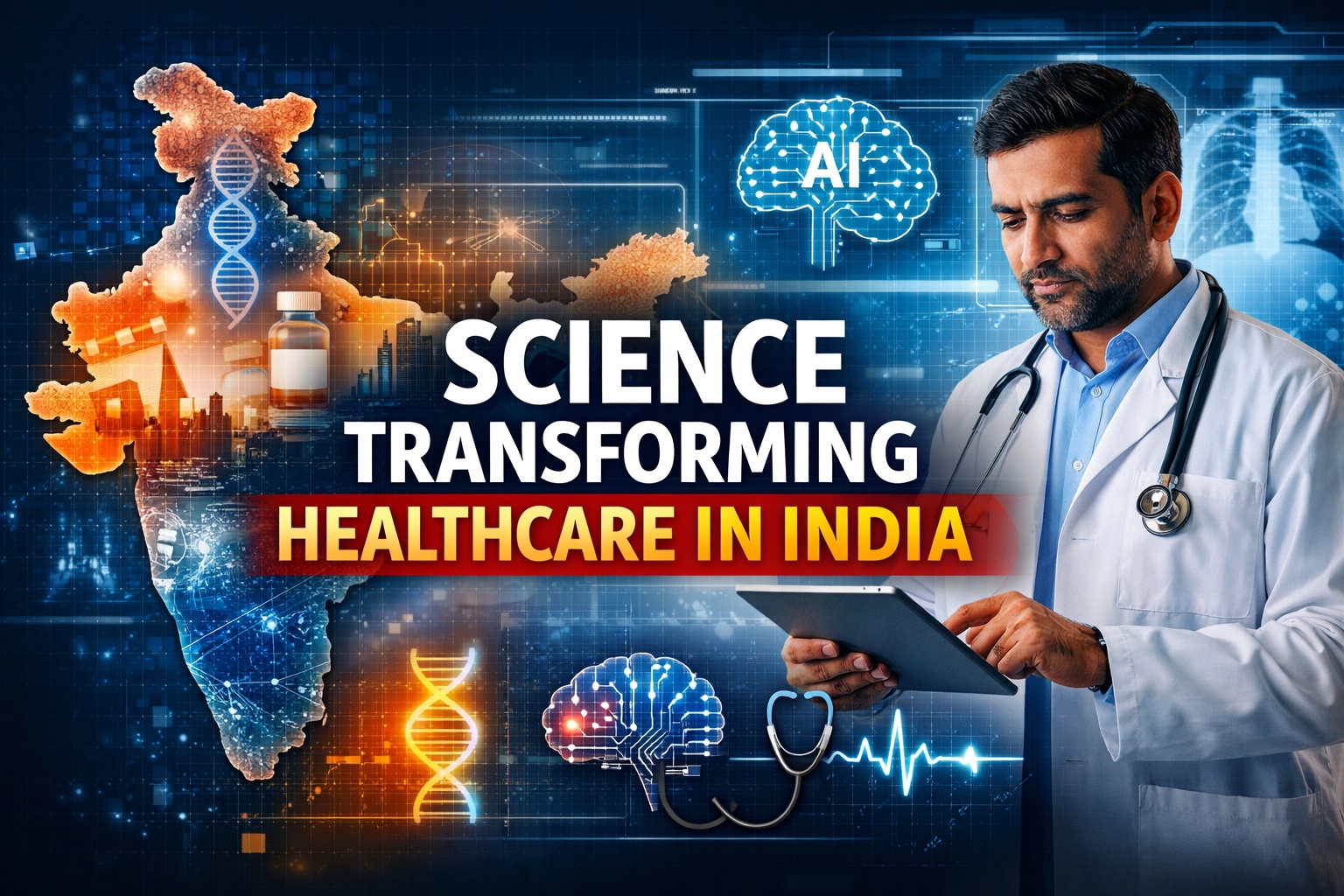
Across biology, data science, genomics, engineering, and public health research, scientific breakthroughs are fundamentally changing how diseases are understood, detected, prevented, and managed. In India, science is not just improving healthcare quality—it is enabling scale, affordability, and access at population levels previously considered impossible.
This article explores how science is transforming healthcare in India—from hospitals and diagnostics to public health and preventive care—and why this shift marks a permanent structural change.
Traditional medicine focused on treating visible symptoms. Modern science has shifted healthcare toward understanding disease at its molecular and cellular origins.
Diseases are now studied at the level of genes, proteins, and immune pathways.
Chronic conditions such as cancer, autoimmune disorders, and neurological diseases are no longer treated as single entities but as biologically distinct subtypes.
Immunology and molecular biology have unlocked therapies that activate the body’s own defense mechanisms.
Why this matters in India:
Late-stage diagnosis is common due to access gaps. Science-driven early detection and targeted therapy significantly improve outcomes while reducing long-term treatment costs.
India’s population is genetically diverse, yet medical treatments historically relied on Western clinical data. Genomic science is correcting this mismatch.
Genome India Project is creating an Indian genetic reference database to improve diagnostic accuracy and drug effectiveness.
Cancer treatment in leading Indian hospitals increasingly uses tumor genetic profiling to select therapies.
Prenatal and rare disease screening using genomic sequencing is enabling early intervention.
Instead of standardized drug protocols, patients receive treatments tailored to their genetic makeup—reducing side effects, improving efficacy, and avoiding unnecessary therapies.
Bottom line: Precision medicine makes healthcare more effective and more economical over the long term.
India faces a chronic shortage of trained specialists, particularly in radiology, pathology, and ophthalmology. Science-led artificial intelligence is filling this gap.
AI algorithms detect tuberculosis, lung nodules, and strokes from imaging scans in district hospitals.
Retinal screening tools identify diabetic retinopathy in primary care settings.
Digital pathology platforms assist cancer diagnosis in Tier 2 and Tier 3 cities.
AI does not replace doctors—it extends clinical expertise to regions where specialists are unavailable. Diagnosis becomes faster, more consistent, and less dependent on geography.
This is not future healthcare. It is already operational healthcare.
Drug development has moved from trial-and-error chemistry to mechanism-driven science.
Growth of biologics and biosimilars targeting specific disease pathways.
mRNA platforms accelerating vaccine and therapeutic development.
Computational drug discovery reducing development time and costs.
India’s pharmaceutical ecosystem now combines scale manufacturing with scientific innovation—positioning the country as both a domestic healthcare solution and a global supplier.
India has become a global example of science-backed frugal innovation—engineering medical solutions that are clinically robust and economically accessible.
Portable ECG, ultrasound, and blood diagnostic devices.
Low-cost ventilators and critical care equipment.
Wearables for continuous monitoring of cardiac and metabolic health.
Why this is important:
Engineering science ensures advanced healthcare is not confined to elite hospitals but reaches semi-urban and rural populations.
Healthcare digitization in India is built on scientific standards of data security, interoperability, and clinical validation.
ABHA digital health identity enabling longitudinal health records.
Telemedicine platforms supported by secure communication protocols.
AI-based triage and decision-support tools integrated into public health workflows.
These systems reduce duplication, improve continuity of care, and generate data for population-level health planning.
India’s disease burden is increasingly driven by diabetes, heart disease, hypertension, and obesity. Science is pushing healthcare upstream—toward prevention.
Predictive risk models using population and lifestyle data.
Behavioral science guiding lifestyle modification programs.
Continuous monitoring tools enabling early alerts and interventions.
Why This Changes Economics:
Preventive care reduces hospitalization, long-term medication dependency, and productivity losses—making healthcare systems sustainable.
Epidemiology, data modeling, and vaccine science have reshaped India’s public health capabilities.
Evidence-based vaccination strategies.
Disease surveillance using real-time data.
Resource allocation driven by predictive modeling.
Science enables policymakers to act before healthcare systems are overwhelmed.
With increasing technological power comes responsibility. Regulatory science ensures innovation does not outpace safety.
Clinical trials and peer-reviewed validation.
Patient data privacy and consent frameworks.
Equity-focused deployment of healthcare technologies.
Science not only innovates—it sets the rules for its own application.
Science has shifted healthcare from:
Reactive → Predictive
Generalized → Personalized
Hospital-centric → Patient-centric
In India, this shift is especially significant because scientific innovation solves for scale, cost, and access simultaneously.
Healthcare is no longer about treating illness alone. It is about maintaining health, extending productive life, and optimizing human potential.
The future of healthcare in India will not be decided solely by more hospitals or higher spending. It will be decided by how effectively scientific knowledge is integrated into everyday care.
Science is transforming healthcare into a system that anticipates disease, personalizes treatment, and reaches people where they live—not just where hospitals exist.
This is not an incremental upgrade.
It is a structural reset.
And it has already begun.
Get the latest articles delivered to your inbox