
How Your Car’s Fuel Type Affects Your Insurance Premium
Super Policy Team •November 2, 2026 | 10 min read • 8 views
Super Policy Team •November 2, 2026 | 10 min read • 8 views
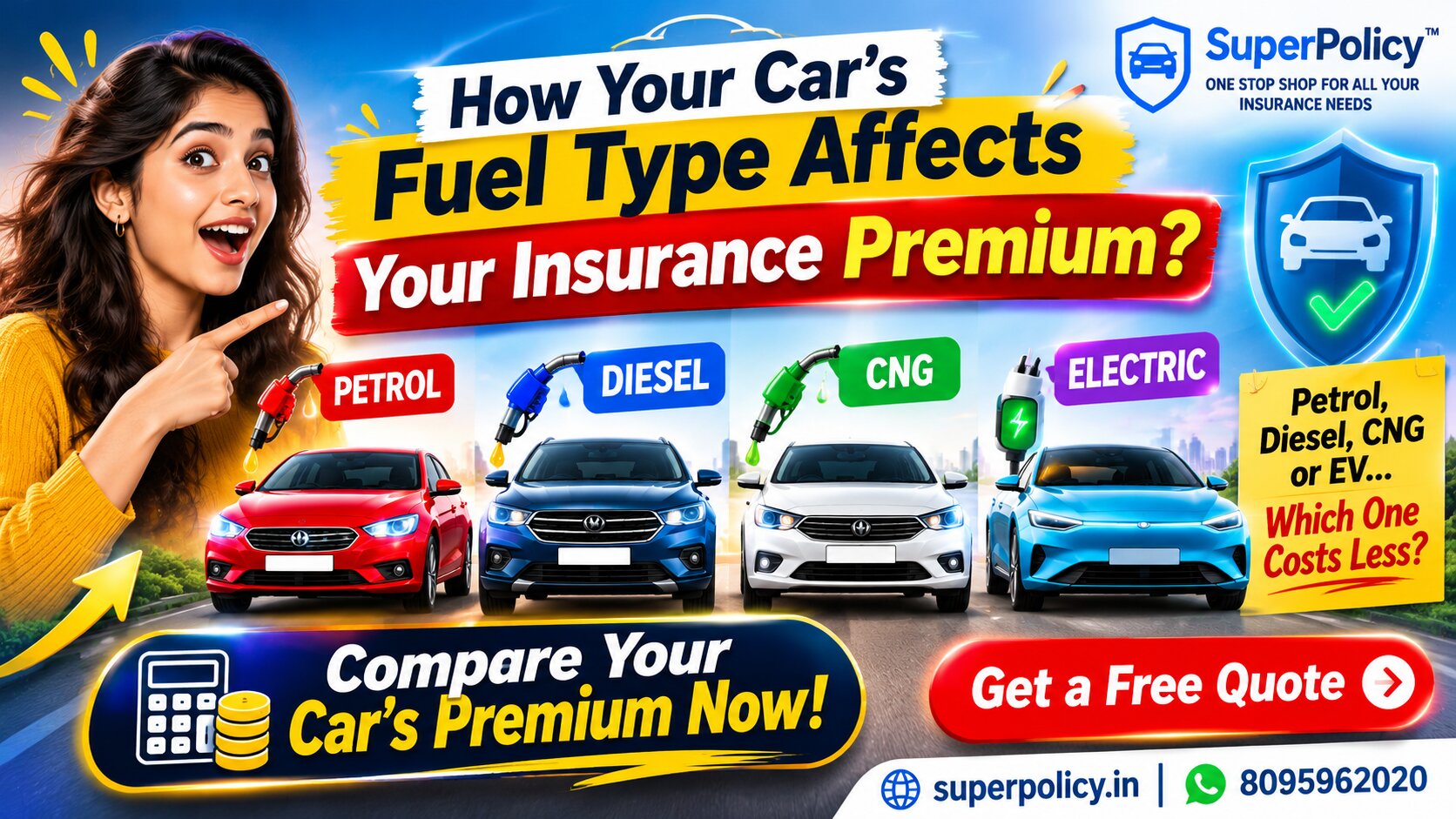
Two cars can look almost identical on the road and still arrive with very different insurance bills. The reason is often hidden under the bonnet, or in an electric car, under the floor. The fuel your car runs on shapes how it is priced, how expensive it is to repair and how insurers assess its risk.
If you are buying a new car, switching fuel types or simply renewing a policy, understanding this link can save you real money and prevent an unpleasant surprise at claim time. Here is a clear, practical breakdown for Indian car owners.
“
Fuel type rarely changes your premium directly. It changes it through the car’s value, its repair costs and the add-ons it needs.
THE NUMBERS THAT MATTER
|
₹60 extra third-party charge on CNG cars |
~4% of kit value as own-damage loading |
₹1,780 lowest annual EV third-party rate |
18% GST on the premium |
Petrol cars tend to have the most predictable and often the lowest premiums. Diesel cars usually cost more to insure because they are priced higher and are costlier to repair. CNG cars carry a small fixed extra charge plus a loading for the kit. Electric cars enjoy a discounted third-party premium but often a higher own-damage premium because of their higher value and specialised repairs.
The details matter, so let us look at how a car insurance premium is actually built.
CURIOUS ABOUT YOUR CAR? See what your own petrol, diesel, CNG or electric car would cost to insure. Get an instant quote on SuperPolicy →
A comprehensive car insurance policy has two distinct parts, and fuel type touches each one differently.
This covers injury, death or property damage you cause to others, and it is compulsory under the Motor Vehicles Act. The rate is not set by your insurer. It is notified by the government with the insurance regulator, IRDAI, and it depends on engine capacity for petrol, diesel and CNG cars, and on motor power in kilowatts for electric cars. That means a petrol and a diesel car of the same engine size pay the same basic third-party premium.
This covers damage to or theft of your own car. Insurers price it using the car’s Insured Declared Value (IDV), its age, your city, your claims history and the add-ons you choose. Fuel type affects this half indirectly, through the car’s price, repair cost and specialised components.
The table below shows the basic annual third-party rates for private cars. These are the figures before 18% GST.
|
FUEL CATEGORY |
CAPACITY BAND |
ANNUAL PREMIUM (BEFORE GST) |
|
Petrol, Diesel, CNG |
Up to 1,000 cc |
₹2,094 |
|
Petrol, Diesel, CNG |
1,000 cc to 1,500 cc |
₹3,416 |
|
Petrol, Diesel, CNG |
Above 1,500 cc |
About ₹7,900 |
|
Electric |
Up to 30 kW |
₹1,780 |
|
Electric |
30 kW to 65 kW |
₹2,904 |
|
Electric |
Above 65 kW |
₹6,712 |
CNG-fitted cars pay an additional ₹60 on the third-party premium, whether the kit is factory-fitted or fitted later. Electric cars benefit from a discount built into the notified rates.
Each fuel type brings its own mix of vehicle value, repair complexity and specialised components. Here is how insurers see each one, and what you can do about it.
Petrol cars are the most common on Indian roads, which gives insurers deep claims data and spare parts that are easy to find. Their ex-showroom prices are generally lower than comparable diesel variants, so the IDV is lower and the own-damage premium follows. For most city drivers with moderate running, petrol remains the most economical fuel to insure.
Diesel variants usually cost more to buy than their petrol twins. A higher purchase price means a higher IDV, and since own-damage premium is calculated on IDV, you pay more. Diesel engines also carry costlier components such as turbochargers, injectors and emission systems, which push up the repair bill when a claim arises. Diesel cars are often used for longer distances, which increases exposure to accidents. The third-party portion, however, remains the same as a petrol car of equal engine size.
A CNG kit adds risk that insurers must price, so there are three things to know:
– Additional third-party charge: a fixed ₹60 applies to all CNG and LPG kit-fitted cars.
– Kit value in own damage: the kit is added to the IDV and charged at roughly 4% of its value on the own-damage side.
– Declaration is essential: a retrofitted kit must be RTO-approved, recorded on the registration certificate and declared to your insurer. An undeclared kit can lead to a rejected claim.
Because the extra premium is modest, CNG often delivers the best balance between running cost and insurance cost, particularly for high-usage drivers and fleet owners.
Electric cars receive a discounted third-party premium, which makes the liability half cheaper than that of a comparable petrol or diesel car. The own-damage half tells a different story. EVs are priced higher, so IDV is higher, and the battery pack is the single most valuable component. Repairs often require trained technicians and imported or proprietary parts. The result is that total premiums can be higher or lower depending on the model, but the EV-specific add-ons deserve your attention:
– Battery protection: covers damage to the battery and related components, which is where repair bills climb steeply.
– Charger and charging cable cover: protects the home charger and portable cable against damage or theft.
– Roadside assistance with towing: valuable because many EVs cannot simply be towed on two wheels without risk to the drivetrain.
– Zero depreciation: ensures claims on high-value parts are paid without deductions for wear.
NEXT STEP Not sure which add-ons your fuel type needs? Our advisors will walk you through it. Book a free consultation →
|
FUEL |
THIRD-PARTY PREMIUM |
OWN-DAMAGE DRIVERS |
ADD-ONS WORTH CONSIDERING |
|
Petrol |
By engine cc |
Lower IDV, widely available parts |
Zero depreciation, engine protection |
|
Diesel |
By engine cc |
Higher IDV, costlier engine components |
Engine protection, zero depreciation, consumables |
|
CNG |
By engine cc plus ₹60 |
Kit value added to IDV, about 4% loading |
Kit cover, zero depreciation, roadside assistance |
|
Electric |
By kW, discounted |
Highest IDV, battery and specialised repairs |
Battery protection, charger cover, towing |
Illustrative guide. Actual premiums vary by insurer, vehicle model, age, location and claims history.
It is easy to over-credit fuel type. In practice, several other factors can move your premium by more than the fuel choice itself.
– Insured Declared Value: your car’s current market value. A higher IDV raises the premium but also your payout.
– No Claim Bonus: each claim-free year earns a discount on the own-damage premium, building up to a substantial saving.
– Location: cities with heavier traffic and higher theft or flood risk attract higher premiums.
– Voluntary deductible: agreeing to bear a larger share of any claim lowers your premium.
– Add-on selection: every extra cover raises the premium, so choose the ones that fit your car and driving.
1. Compare quotes every year. Insurers price fuel types and models differently, and the cheapest option last year may not be the cheapest now.
2. Protect your No Claim Bonus. For small repairs, paying out of pocket can preserve a larger discount.
3. Declare every modification. A CNG kit or accessory that is not on the policy is a liability at claim time.
4. Match add-ons to the car. A diesel owner may prioritise engine protection, while an EV owner should prioritise battery and charger cover.
5. Choose a sensible IDV. Under-insuring cuts your payout, and over-insuring wastes money.
6. Raise your voluntary deductible. If you can comfortably absorb small losses, this lowers your premium.
7. Renew on time. A lapse can cost you your No Claim Bonus and trigger a fresh inspection.
COMPARE AND SAVE Put these tips to work and see plans side by side. Compare car insurance on SuperPolicy →
Generally petrol. The third-party premium is identical for the same engine size, but diesel variants usually carry a higher IDV and costlier repairs, which raises the own-damage premium.
Yes, modestly. You pay an extra ₹60 on the third-party side and a loading of roughly 4% of the kit’s value on the own-damage side. You must also inform your insurer and get the kit recorded on your registration certificate.
It depends. The third-party portion is cheaper for EVs, but the own-damage portion is often higher because of the vehicle’s value and the cost of battery and component repairs. Comparing quotes for your specific model gives the real answer.
Hybrid electric vehicles are eligible for a smaller third-party discount than fully electric cars. Check with your insurer for the rate that applies to your model.
Third-party cover satisfies the legal requirement, but it does not pay for damage to your own car, your CNG kit or your EV battery. For vehicles with high-value components, comprehensive cover is the safer choice.
READY TO FIND THE RIGHT COVER?
Get your car insurance quote in minutes, whatever fuel it runs on.
Tell SuperPolicy your car’s make, model and fuel type. We will help you compare plans from leading insurers, point out the add-ons that genuinely matter for your vehicle, and take you from quote to instant policy issuance with a simple online process. No pressure and no obligation.
INSTANT CAR QUOTE superpolicy.in/insurance/car →
FREE CONSULTATION superpolicy.in/schedule-call →
CALL OR WHATSAPP 8095962020 →
EMAIL info@superpolicy.in
SUPPORT HOURS Monday to Saturday, 9:00 AM to 6:00 PM
SuperPolicy™ is a brand of Barik Insurance Brokers Pvt. Ltd.
IRDAI Direct Insurance Broker (Life & General) | License No. 955 | Valid till 02/04/2027 (renewable) | Code No. IRDA/DB1078/2024 | CIN: U66220TZ2023PTC029071 | Bangalore Office: No 146, Sukhavana, Sridhar Gardenia, Near Manasa Foundation, Chikka Gubbi, Bangalore 560077.
Premium figures are indicative, exclude GST unless stated, and are based on the latest notified basic third-party rates for private cars. Actual premiums depend on the insurer, vehicle, location and policy choices, and rates are revised periodically, so please confirm at the time of purchase. Standard T&C apply. Insurance is the subject matter of solicitation. For more details on risk factors, terms and conditions, please read the sales brochure carefully before concluding a sale.
Get the latest articles delivered to your inbox