
Passenger Vehicle Insurance: Bus, Van & Tempo Traveller 2026
Super Policy Team •October 28, 2026 | 15 min read • 14 views
Super Policy Team •October 28, 2026 | 15 min read • 14 views
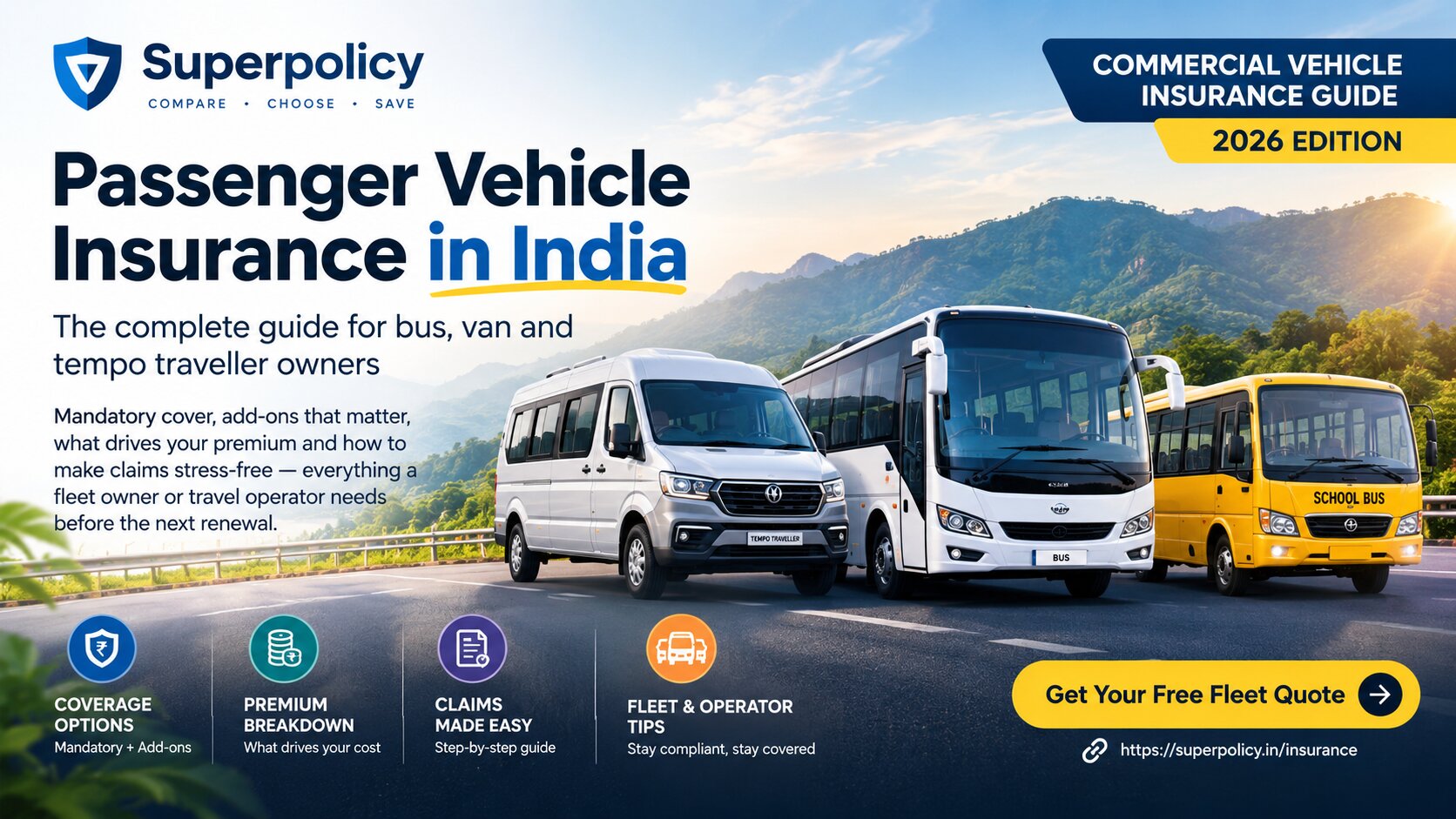
Prepared by the Superpolicy Editorial Desk | Updated October 2026
Behind every tempo traveller heading for the hills, every staff bus on its dawn shift and every school van on its morning loop sits one promise: the passengers will reach safely. Insurance is the financial half of that promise.
India recorded roughly 4.8 lakh road accidents and about 1.72 lakh deaths in 2023, according to official ministry data. For a vehicle that carries ten, twenty or fifty people at a time, one mishap can mean injuries, claims and court cases across many families at once. Without the right cover, those costs fall squarely on the owner: on the business, the vehicle and sometimes on personal assets.
This guide explains passenger carrying vehicle (PCV) insurance in plain language: what the law demands, which policy fits which vehicle, the add-ons worth paying for, how premiums are built and how to keep claims clean. If you would rather have an expert shape the cover for your fleet, Superpolicy can help you compare and customise options in one place.
|
THE 60-SECOND SUMMARY ▪ Third-party cover is compulsory. Running a passenger vehicle without it can attract a fine of ₹2,000 (₹4,000 for a repeat offence), up to three months' imprisonment, or both. ▪ Liability for death or injury is unlimited; third-party property damage is capped at ₹7.5 lakh under a standard policy. ▪ Owner-driver personal accident cover of at least ₹15 lakh is part of the standard package for individual owners who drive their own vehicle. ▪ LMV licence holders may drive passenger vehicles up to 7,500 kg gross weight. Larger buses need the heavy passenger vehicle licence. ▪ Premium = third-party (government-notified) + own damage (insurer-priced) + add-ons − discounts + GST. |
Passenger carrying vehicle insurance is a motor policy built for vehicles that transport people for hire or reward, or as part of an organisation's transport operations. A private car policy assumes occasional, low-occupancy use. A PCV policy prices in heavier running, bigger liability exposure and the statutory duties owed to everyone on board.
|
VEHICLE CATEGORY |
TYPICAL USE |
WHAT INSURERS LOOK AT |
|
Tempo travellers & passenger vans |
Tourist, corporate, airport and event transfers (typically 9 to 26 seats) |
Seating capacity, vehicle age, route type, driver profile |
|
Maxi-cabs & mini vans |
Local sightseeing, shuttle and pilgrimage trips |
IDV, accessories, CNG/LPG kit declaration |
|
Mini & midi buses |
Staff transport, intercity and charter services |
Seating, permit type, usage pattern, claims history |
|
Full-size AC and luxury coaches |
Long-distance tourism, inter-state operations |
High IDV, add-ons, roadside assistance, fleet size |
|
School, college & staff buses |
Fixed daily routes with regular passengers |
Educational-institution category, passenger safety cover |
Section 146 of the Motor Vehicles Act, 1988 says no motor vehicle may be used in a public place unless a valid third-party liability policy is in force. Under Section 196, driving or allowing an uninsured vehicle to be driven is an offence: ₹2,000 and/or up to three months in jail for a first offence, and ₹4,000 for a subsequent one. Beyond the fine, a lapsed policy can hold up services such as fitness renewal, and any accident during the lapse leaves you personally liable.
For a public service vehicle, the policy must also cover your legal liability for death or bodily injury to passengers carried. Compensation is decided by Motor Accident Claims Tribunals, which weigh the victim's age, income and dependants. For a full bus, awards across several claimants can climb steeply, and unlimited third-party liability for death and injury means the insurer, not you, absorbs them when you hold a valid policy.
A vehicle off the road earns nothing, and a repair bill for a coach or traveller can run into several lakhs. Financiers also generally insist on comprehensive cover until the loan is cleared. For most operators, a comprehensive policy with well-chosen add-ons turns an unpredictable loss into a predictable, budgetable expense.
|
FEATURE |
THIRD-PARTY ONLY |
COMPREHENSIVE (PACKAGE) |
STANDALONE OWN DAMAGE |
|
Third-party injury, death & property damage |
Yes |
Yes |
No (needs a separate valid TP policy) |
|
Legal liability to passengers |
Yes |
Yes |
No (via TP policy) |
|
Damage to your own vehicle |
No |
Yes |
Yes |
|
Fire, theft, flood, riot and other perils |
No |
Yes |
Yes |
|
Owner-driver PA cover |
Yes, if the owner qualifies |
Yes, if the owner qualifies |
Only if not already held elsewhere |
|
Best for |
Legal minimum; older, low-value vehicles |
Most operators, financed or high-value vehicles |
Owners with a multi-year TP policy running |
|
WHAT IS TYPICALLY COVERED |
WHAT IS TYPICALLY EXCLUDED |
|
▪ Accidental damage to the vehicle (collision, overturning, impact) ▪ Fire, explosion, self-ignition and lightning ▪ Theft of the vehicle ▪ Natural calamities such as flood, cyclone, storm, earthquake and landslide ▪ Man-made events including riot, strike, malicious acts and terrorism ▪ Damage in transit by road, rail, inland waterway, lift or air ▪ Third-party death, bodily injury and property damage ▪ Your legal liability to passengers of a public service vehicle ▪ Personal accident for the owner-driver (₹15 lakh minimum) ▪ Liability to paid driver, conductor or cleaner, as per policy wording |
▪ Normal wear and tear, ageing and depreciation ▪ Mechanical or electrical breakdown not caused by an insured event ▪ Consequential loss, including lost bookings and income ▪ Driving without a valid, effective licence or while intoxicated ▪ Use outside permit conditions or carrying passengers beyond the permitted seating ▪ Engine damage from driving through or restarting in flood water (unless Engine Protect is added) ▪ Damage to tyres and tubes alone, unless the vehicle is damaged at the same time ▪ War, nuclear risks and deliberate damage ▪ Claims arising while the policy had lapsed |
Exact inclusions depend on the insurer's policy wording and the add-ons you choose, so read the schedule and exclusions before you pay.
Add-ons turn a standard policy into one that fits how you really operate. Availability, vehicle-age limits and pricing vary by insurer.
|
ADD-ON |
WHAT IT DOES |
WHO SHOULD CONSIDER IT |
|
Zero depreciation |
Pays for replaced parts without deducting depreciation, so claims leave you with far less to pay |
Newer vehicles and high-value coaches |
|
Engine & gearbox protect |
Covers damage from water ingression or lubricant leakage that a base policy excludes |
Operators on monsoon or waterlogged routes |
|
Consumables cover |
Pays for nuts, bolts, oil, coolant and similar items normally left out of claims |
Anyone who claims regularly |
|
Roadside assistance |
Towing, flat tyre, battery jump-start and breakdown help |
Long-route and tourist operators |
|
Passenger personal accident |
Fixed benefit per seat for death or disability of passengers, regardless of fault |
Tour, school and staff transport operators |
|
Legal liability to paid driver / cleaner / conductor |
Covers your obligations to employees under the Employees' Compensation Act |
Every operator who employs drivers or crew |
|
Geographical extension |
Extends cover to neighbouring countries as permitted |
Cross-border and pilgrimage tour operators |
|
Return to invoice |
Total loss or theft is paid at invoice value, not just IDV |
New, financed vehicles |
|
PRO TIP Declare everything you have fitted: air-conditioning units, entertainment systems, LED lighting, CNG or LPG kits and body modifications. Undeclared additions can lead to a reduced or rejected claim, and declared ones are covered at the right value. |
|
Total premium = Third-party + Own damage + Add-ons − Discounts + GST |
The third-party portion is regulated. It is notified by the Ministry of Road Transport and Highways in consultation with IRDAI and revised from time to time, so no insurer can discount it. For vehicles carrying more than six passengers, it is built from a base amount plus a per-seat loading, which is why a 12-seater and a 45-seater differ widely. Educational-institution buses and electric passenger vehicles have their own treatment in the notified rates.
The own-damage portion is where insurers compete. It depends on the following levers:
|
FACTOR |
HOW IT MOVES YOUR PREMIUM |
|
Insured Declared Value (IDV) |
Higher IDV raises premium and the payout in a total loss or theft |
|
Vehicle age, make, model and fuel |
Newer, costlier models carry more own-damage premium; older ones may qualify for fewer add-ons |
|
Seating capacity and usage |
Staff, school and tourist use are rated differently |
|
Registration zone (RTO) |
Accident-prone and metro zones can cost more |
|
Claims history and No Claim Bonus |
A clean record earns a discount on the own-damage premium, up to 50% at the top of the NCB ladder |
|
Voluntary deductible |
Agreeing to bear a small amount per claim lowers premium |
GST is charged on premiums, generally at 18% for comprehensive motor policies. Operators registered under GST can often claim input tax credit on eligible commercial vehicle premiums; confirm the treatment for your situation with your tax advisor.
IDV is broadly the manufacturer's listed price less age-based depreciation, adjusted for accessories. Beyond five years it is agreed between you and the insurer. Setting it close to the vehicle's genuine market value is the sweet spot: set too low and a total-loss payout falls short, set too high and you overpay for years.
|
Not sure which IDV or add-ons suit your routes and fleet? Superpolicy's insurance experts can help you compare options and build cover around how you actually operate, not a one-size-fits-all package.
|
1. Protect your No Claim Bonus. Pay very small damages out of pocket when it makes sense; NCB can cut own-damage premium substantially over time.
2. Renew before expiry. A break in cover can mean a pre-inspection and loss of NCB, and NCB generally lapses if renewal is delayed beyond 90 days.
3. Compare like-for-like. Match IDV, add-ons and deductibles before comparing price, because the cheapest quote is often the thinnest cover.
4. Choose a realistic IDV. Neither inflated nor squeezed.
5. Consider a voluntary deductible. If you can absorb minor repairs, you can trim premium.
6. Go for fleet or multi-vehicle arrangements. One renewal date, one point of contact and often better pricing.
7. Invest in safety. Trained drivers, GPS tracking and fatigue management cut claims, which protects your record; some insurers also reward them.
8. Buy add-ons by need, not by habit. Pay for engine protect if your routes flood, not because it is on the list.
In November 2024 a five-judge Constitution Bench of the Supreme Court held that a holder of a Light Motor Vehicle licence can drive a transport vehicle of the LMV class with a gross weight up to 7,500 kg, without a separate endorsement. Most tempo travellers and vans fall in this band, so insurers cannot reject a claim merely because the driver held an LMV licence. Medium and heavy passenger vehicles above 7,500 kg still require the corresponding licence class, and some states have additional badge or endorsement requirements, so verify locally.
|
KEEP CURRENT AND HANDY |
WHY IT MATTERS |
|
Registration Certificate (RC) |
Proves ownership and category; every claim starts here |
|
Driver's licence of the right class |
The single most common ground for disputes |
|
Route or contract-carriage permit |
Use outside permit conditions can void a claim |
|
Fitness certificate and PUC |
Show the vehicle is roadworthy and compliant |
|
Valid insurance policy and schedule |
Check IDV, usage type and add-ons match reality |
|
1 |
Secure the scene |
Stop safely, switch on hazard lights, move passengers away from traffic and call 112 for police and ambulance help. |
|
2 |
Get the injured treated |
Medical care comes first. Do not delay treatment to sort out paperwork. |
|
3 |
Inform the police |
Obtain an FIR or police report wherever there is injury, death, third-party damage, theft or major loss. Keep a copy. |
|
4 |
Notify your insurer at once |
Call the claims line or use the app the same day, ideally within 24 hours. Late intimation is a frequent cause of disputes. |
|
5 |
Document everything |
Take photos and video of the vehicle, scene and number plates; note witness details. Do not admit fault or settle privately. |
|
6 |
Survey and repair |
A surveyor inspects the damage. Repair at a network garage for cashless service, or choose reimbursement. |
|
7 |
Settlement |
The insurer assesses the claim against policy terms, applying deductibles and depreciation unless zero-depreciation applies. Theft and total loss are settled on an IDV basis. |
▪ Policy copy, RC, driver's licence, permit and fitness certificate
▪ Duly filled claim form and KYC details
▪ FIR or police report, where applicable
▪ Photographs, repair estimate and final invoices
▪ For theft: keys, FIR and the final police report
|
THIRD-PARTY CLAIMS AND INJURED PASSENGERS Never settle with an injured person or their family privately without informing your insurer. Third-party death and injury claims are decided by Motor Accident Claims Tribunals, and your insurer defends and pays within policy terms. Good to know: the Cashless Treatment of Road Accident Victims Scheme, 2025, in force since 5 May 2025, entitles any road-accident victim to cashless treatment of up to ₹1.5 lakh for a maximum of seven days at designated hospitals. |
|
COMMON REASON |
HOW TO PREVENT IT |
|
Policy lapsed on the date of loss |
Set renewal reminders 30 days ahead or opt for auto-renewal |
|
Driver without a valid or correct-class licence |
Verify licence class and expiry at hiring and every year |
|
Drunk or drugged driving |
Zero-tolerance policy with random checks for fleets |
|
Use beyond permit, route or seating capacity |
Respect permit terms and never overload |
|
Late intimation |
Report the same day, even if the damage looks minor |
|
Undeclared modifications such as a CNG kit or body changes |
Endorse changes on the RC and the policy |
|
Wrong usage type or vehicle details |
Review the policy schedule on receipt and correct errors immediately |
|
Engine damaged by restarting in flood water |
Never restart; tow the vehicle; consider Engine Protect |
1. Claims record: Look at the insurer's published claim settlement figures and genuine customer feedback.
2. Network garages: Cashless repair access along your regular routes, not just in one city.
3. Speed of survey and settlement: IRDAI rules set timelines; ask how the insurer meets them.
4. Add-on depth: Flexibility to choose the cover you need, with transparent conditions.
5. Fleet handling: Single dashboard, consolidated renewals and a dedicated point of contact.
6. Clear wording: Transparent IDV, exclusions and deductibles with no surprises.
7. Support and grievance redressal: 24x7 claim assistance, plus IRDAI's Bima Bharosa portal and the Insurance Ombudsman if a dispute needs escalation.
Q. Is insurance mandatory for a tempo traveller or bus in India?
Yes. At a minimum you need valid third-party liability cover under Section 146 of the Motor Vehicles Act. Comprehensive cover is not legally compulsory, but it is strongly advisable and usually required by lenders.
Q. Does the policy cover passengers travelling in my vehicle?
A liability policy covers your legal liability for death or injury to passengers of a public service vehicle. For a fixed benefit per seat regardless of fault, add passenger personal accident cover.
Q. Can a driver with an LMV licence drive a tempo traveller?
Yes, if the vehicle's gross weight does not exceed 7,500 kg, as clarified by the Supreme Court in November 2024. Heavier buses need the heavy passenger vehicle licence. Check any additional state requirements.
Q. Is owner-driver personal accident cover compulsory?
It applies to individual owners who drive their own vehicle, with a minimum sum insured of ₹15 lakh, unless they already hold a personal accident policy of at least that amount. It is not available where the vehicle is owned by a company or firm.
Q. What happens if my policy has expired?
Renew immediately. A vehicle running without valid cover breaks the law, claims for losses during the lapse are not payable, and a long break can mean inspection and loss of NCB.
Q. What is IDV and why does it matter?
IDV is the maximum sum payable on total loss or theft. It also drives your own-damage premium, so it should reflect the vehicle's real market value.
Q. Can I cover several vehicles under one policy?
Many insurers offer fleet or multi-vehicle policies with a common renewal date and consolidated management. Terms and eligibility vary by insurer.
Q. Can I buy or renew online?
Yes. Keep your RC, previous policy details and claims history handy, compare options, pay online and receive the policy digitally.
|
PROTECT EVERY JOURNEY Every seat deserves protection. Whether you run one tempo traveller or a fleet of fifty buses, the right policy matches your routes, drivers and risk, not just the lowest number on a quote. Superpolicy helps you compare, customise and secure passenger vehicle insurance without the paperwork maze. 1 Share your vehicle details 2 Compare tailored options 3 Get covered |
Disclaimer: Insurance is the subject matter of solicitation. This article is for general information only and is not legal, tax or insurance advice. Coverage, exclusions, premiums, add-ons and claim terms depend on the insurer's policy wording and applicable IRDAI and Motor Vehicles Act provisions, which may change. Please read the policy documents carefully before buying.
Get the latest articles delivered to your inbox